According to Reuters, U.S. President Trump said on Jan. 20 that there is “no turning back” on the issue of Greenland, stressing that the region is of critical importance to U.S. and global security, and he did not rule out the possibility of taking tougher measures.
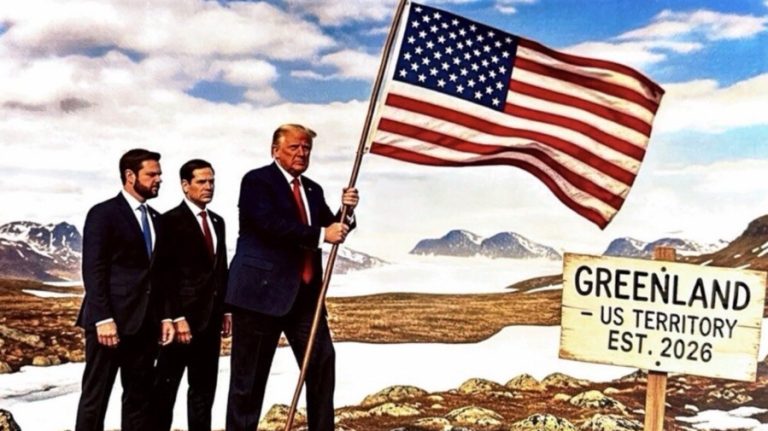
Trump made the remarks after speaking by phone with NATO Secretary General Mark Rutte. He later posted several AI-generated images on social media, including one showing himself holding a U.S. flag in Greenland, and another map depicting Canada and Greenland as part of U.S. territory.
“Greenland is vital to national security and world security—there is no turning back on this,” Trump said.
The comments further heightened tensions between the United States and its European allies. Greenland is currently administered by Denmark, a NATO member.
Strong reactions from France and the EU; trade friction risks rise
On Greenland, French President Emmanuel Macron and Trump showed clear differences. Trump later made public a private exchange between the two, in which Macron said he did not understand the U.S. approach on Greenland and suggested convening a G7 meeting after the Davos forum to coordinate.
Success
You are now signed up for our newsletter
Success
Check your email to complete sign up
Trump has previously said that if European countries obstruct the U.S. position, he would consider imposing tariffs of up to 200 percent on French wine and champagne.
The European Union has begun assessing countermeasures, including the possible use of the never-before-activated Anti-Coercion Instrument, which could restrict U.S. products worth about €93 billion.
Danish Prime Minister Mette Frederiksen told parliament: “We can discuss politics, the economy, and security—but sovereignty, democracy, and national borders are not negotiable.”
European Commission President Ursula von der Leyen said in Davos that Europe must build “a more strategically autonomous Europe” under the new international environment.

US downplays conflict; Treasury secretary sends calming signals
Amid concerns about deteriorating U.S.–EU relations, U.S. Treasury Secretary Scott Bessent sought to cool tensions.
Speaking in Davos, he said reactions to the Greenland issue were “overly tense,” adding: “It’s only been 48 hours—there’s no need to overinterpret this. I believe a solution beneficial to both the U.S. and Europe will ultimately be found.”
Markets, however, remained cautious. U.S. stock futures fell while gold prices rose, indicating investor wariness over geopolitical risks and trade frictions.
According to Axios, the White House sees this year’s Davos forum as an important political and economic showcase. Treasury Secretary Bessent will lead the delegation and hold daily press briefings before Trump’s arrival, with themes such as “Smart money is betting on America” and “America-First trade is changing the world.”
Bessent is also scheduled to meet Chinese Vice Premier He Lifeng, one of the most closely watched bilateral engagements of the forum.
Citing government sources, Axios reported that the White House intends to draw a sharp contrast at Davos between “U.S. economic momentum” and “sluggish European growth,” while bluntly criticizing the global elite.
In prepared remarks, Bessent said: “As the United States approaches its 250th anniversary, President Trump has launched a new phase of ‘parallel prosperity’—Main Street and Wall Street will grow together.”
He also warned that any European retaliation over Greenland would be “very unwise.”
Davos as a stage; US emphasizes a ‘strong entrance’
The Washington Post noted that this year’s Davos forum has evolved from a traditional economic gathering into a diplomatic arena centered on Trump’s policies.
White House officials said Trump will emphasize: economic growth and housing affordability; that “America First” does not mean “America alone;” and the reshaping of the global economic order.
The administration also plans to bypass traditional international media and communicate directly with domestic audiences through Republican-leaning platforms. Outlets including Real America’s Voice will provide round-the-clock coverage from Davos.
A government official told Axios: “This is not a defensive trip—it’s a debut showcasing U.S. economic dominance.”
Greenland spillover draws attention from Russia
Russian Foreign Minister Sergei Lavrov also commented on Greenland, saying the island is “not a natural component of Denmark,” while denying that Russia intends to intervene.
Analysts say the U.S.–EU rift over Greenland is creating strategic space for other major powers and testing coordination within NATO.
As Trump prepares to deliver a speech and promote his “Peace Commission” concept, this year’s Davos forum has shifted from an economic meeting to a key stage for geopolitical maneuvering.