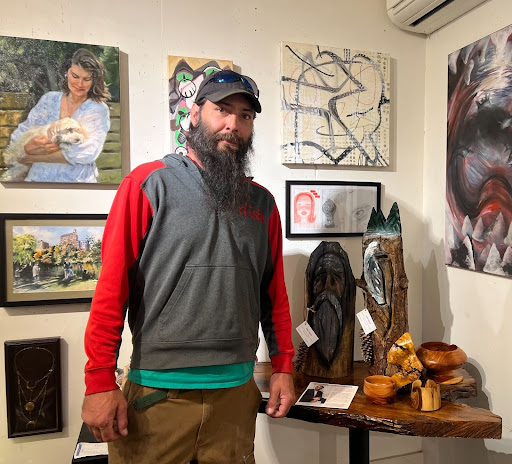
Steven Van Tuyl comes from the township of Lumberland, New York. From a young age, he worked alongside his father and grandfather, developing a strong interest in woodworking that has stayed with him ever sinc
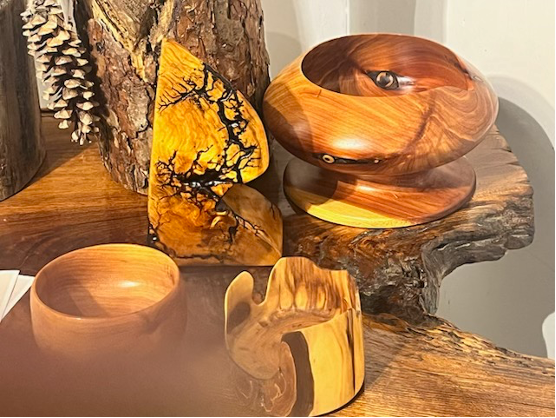
He has now owned a tree business for over 15 years, but some wood can’t be cut into firewood, and he can’t just throw it over a bank to rot. So he asked customers to let him take it home and turn it into wooden bowls. Because, as Steven told me: “Some of the wood, you just can’t throw it away. You can’t see, you go to waste. I like to see everything get used the best as possible. Even if it’s refurbished, go to yard sales, refurbished tables, bread baskets, anything wood, I’ll be more interested. And I refurbish them to bring new life.”
“I got a kick out of all this stuff at a young age, even at 40 years old. And I got 40 more years to go doing it. I just began.” Steven added.
He has his own 60-foot bucket truck, his own stump grinder, he does his own climbing.
“If that wood bowl or that top, because I make wooden spinning tops. And if I could make someone happy with what I do, my mission is accomplished.” He said. He takes his business seriously, his artwork seriously, and let alone help other people and help his community.
Success
You are now signed up for our newsletter
Success
Check your email to complete sign up
Helping people is his passion
Steven does a lot of community work for charities, for veterans, and for children and adults facing various challenges, including autism, Down syndrome, cancer—you name it.
“If the family’s house burns down, we will help you. If one of your family members is very sick, you cannot afford a doctor or whatever, minus medical, if you need help, if it’s food, if you need firewood cut, if you need your grass cut. As a community, me, my friends, we reach out to one another, and we get things done.”
Steven also supports people with various disabilities, whether they were born with them or injured in accidents. Some have lost limbs and create incredible artwork using only their feet. Others paint by holding a brush in their mouths. He donates money to these artists—sometimes a small percentage, sometimes more, depending on the charity—to help them enjoy what they do and feel happy.
Some people have been in car accidents, hit their head, and “rattled their cage” a bit, and doing artwork can help bring back certain memories. Like, “Hey, what do you remember? Draw it.” They might sketch a picture from their memory, and it may help restore some memory awareness. Steven has even read studies showing that art can help bring back memories through simple sketches.
For some events, Steven donated other woodwork pieces he had made to school scholarships and raffles. Whoever purchased them, the full amount went directly to a good friend of his, whose young daughter had been diagnosed with cancer. People were trying to raise money to support her, and Steven wanted to help. “I gave a couple of little pieces of wood, and I have no clue how much they made off it. I don’t care about whether they made a lot, because it went to them and went to a good cause.”
His motto is “Do what you can when you can.”
When I said: “So, helping people is your passion!”
Steven replied: “Do what you can when you can. That’s my motto. Do what you can when you can, especially when they need it.”
And there’s times where, if he is injured, he can’t do it, he’ll do what he can to reach out to someone else that might be able to help. He told me: “You know, you can’t leave neighbors and somebody starving; Or, big snowstorm, you come out, you help them shovel snow, power outage, you go over your neighbors and see, are you guys, okay? Do you need anything?”
“I do a lot of different things. I don’t know why. It’s just, I have a heart. I think that’s what it is. I have a heart. Not bad for a hairy fella.” He smiled. He even told me he needs a whiter beard, a little bigger belly, so he could play Santa in the future. Such a sweet, warm hearted man!
But other than that, he simply loves artwork, even though he doesn’t do it as much now. Because he owns a tree business, he spends more of his time focused on the family business. As a stepdad and step-grandpa, he knows family comes first before his personal artwork time.
“The best I can do is family first! Then you do what you can for others, only if it’s not going to bring your own self down. You can’t help others, if it’s going to put yourself in a worse scenario. So it’s hard to help someone, and if you’re going to be worse off, maybe that’s not the right time for that individual. If you can do it, you can. But if you can’t, no hard feelings.”
Help to get kids into art
Most people understand that if you can’t do something, you simply can’t. For Steven, it’s about finding peace—something he feels the whole world needs. That’s where artwork comes in. “I reached out an olive branch to the kid, the little boy that’s hanging out with us, my neighbor, I’m good friends with his mother, but the kid doesn’t like to do artwork.”
Steven brought this kid to the gallery, UpFront Exhibition Space, and this kid just told Steven a little bit ago: “When I get home, I think I’m gonna go draw some.”
“So if he goes home and he draws a picture tonight, I feel it was worth my time to bring him here, because now he’s involved with art, and he never was.” His mom even told Steven that he’s not interested in art. She’s kind of like, good luck, he’s not into it. Good luck, you deal with him. “I go, it doesn’t bother me, none. I show him. I explained about the different artwork, and I go: Hey, pick one on this wall, what’s your favorite? You can tell he’s not into it, but I go punt: You have to pick one and tell me why. Then he picked one.”
And this is one of the missions of the project “Paint the World with Love”, help to get kids into art! Steven just helps a young boy, just turned 11, never draws anything, and he might start doing artwork tonight!
When I asked Steven at last: “If there is anything else you want to speak to our reader?”
He said: “Hey, we’re just more arts less war!”
Yes! More Arts, Less War!
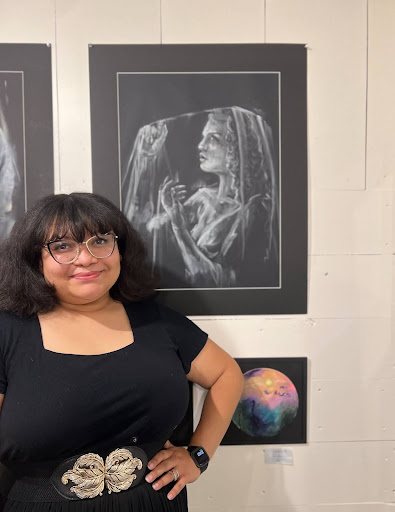
I had an interview with the young artist, Kat M Hamilton, at UpFront Exhibition Space, Port Jervis. On Oct.11th, 2025. Here is our dialogue.
Jane: First, could you tell us your name?
Kat: I’m Kat M Hamilton.
Jane: I just feel so impressed by your artworks.
Kat: Thank you!
Jane: Could you just tell us a short about yourself, how you fell in love in the arts?
Kat: Yes, of course! I actually started very young, when I was 12 years old, and my first art show was in the National Arts Club in New York City. So I was really lucky as a kid. I’ve been an artist for 23 years.
Jane: Wow, when you were little, you already… Great! Especially this one, this picture, what is the name of it?
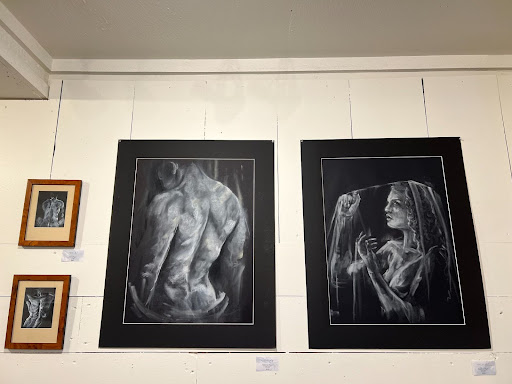
Kat: “Enliven”. That painting is called “Enliven”. I believe my artwork is me being very vulnerable to people, because when you’re from New York City, you have to be hard, you have to be strong. I was never like that in the city, I was always different. And for me, creating was me being soft. It was me getting everything in here out onto the surface.
“Enliven” was a piece I created when I found out for me having children was going to be very hard. So I had to create beauty. I had to be okay with being a woman again, like I didn’t feel okay about it. That piece was about transparency and removing a veil that I always taught myself that I had to be under all the time. So that’s what that piece is about.
Jane: So you mean you have children already or?
Kat: No, not yet. I’ve been married for eight years, but I’ve been with my husband for 15, we’ve been together a long time.
Jane: So what do you mean? Maybe I didn’t understand, you want to make more artworks before you maybe have children?
Kat: No, I wanted to have a child, but at the time, my child didn’t make it. For me, that was hard, because that’s what I always wanted. So, again because I am who I am, I throw myself into my artwork and find deeper meanings for everything. And that piece was about me being loving, being a woman, even with all this stuff going on!
Jane: Oh, okay. I just need time to get it.
Kat: Yeah, no no it’s okay, it’s okay.
Jane: Just say anything more about this one, because I love it so much!
Kat: Thank you!
Jane: You know, I think that the clear part is so difficult to make people feel it is a clear part. How long does it take you?
Kat: Are you sure you want to know? 40 minutes! (She laughed)
Jane: Only 40 minutes? (I was too… surprised!!!)
Kat: Only 40 minutes!
Jane: You mean the whole thing, not only the clear part, the lady, the whole works?
Kat: Yes.
Jane: Maybe 40 years! (We laughed) But 40 minutes?! How do you do it?
Kat: When I started drawing better, I had to draw people. For me because I overthink everything, if I spend too long on it, I mess it up, I mess it up. So I learned how to create really fast.
(“Lucky you!” A man beside us said. We all laughed.)
Jane: I agree with it. I always overthink, and then mess up everything.
Kat: Yeah, exactly. So, for me, I had to learn how to do things really fast. A lot of the time I have tools that make a direct like a direct stripe, and from there I manipulate it. That one was pastel, pan pastel. They come with sponges that are like this. And I literally go: one, two, and then down. That’s it.
Jane: Wow, I cannot imagine that! The philosophy of you, you draw so fast, it comes from your teacher, or it comes from yourself?
Kat: From me, a lot of it from me, because my teachers did not like……
Jane: Your teacher likes your drawing slowly.
Kat: Yeah, she wanted me to do…… Like one of my teachers, I remember, they told me I wouldn’t be an artist because I didn’t put enough attention into everything. And I said, I don’t care what you say. And I did. I became an artist by myself. I did it all myself.
Jane: Because you just love drawing, love painting. Even though she says that, you still love it. Right?
Kat: Yeah. Because for me, it was fighting against the norm that other people like, I went to different colleges, for different reasons, and a lot of the colleges I had, they would tell me how I have to create. I know! Don’t tell me what I’ll learn. I don’t mind learning, but don’t tell me how mine should be, because you want it to be your way. So I decided to go to school for art because I wanted to be a teacher, to be different from the other ones. That’s why I chose it. When I teach classes, I don’t tell you what to do. I will tell you how to blend, how to mix colors. I try to help you with techniques, but I’m not going to tell you what to paint. I’m not that type of person. That’s how I teach.
Jane: Where are you teaching?
Kat: I teach here, and I teach at Awakening, which is a Crystal Shop down the road. I do that every other month. That one’s more meditative, the one here is more instructional.
Jane: Very nice.
Kat: Thank you!
Jane: Anything else you want to say?
Kat: Okay, let’s see. I started my store a year ago. My store by myself.
Jane: You have a store by yourself?
Kat: Yeah, the art supply store in the corner, inside, that’s a little store. That’s mine.
Jane: Really? This gallery (Upfront Exhibition Space) includes your store? So whenever people come in, they see you first.
Kat: Yeah. I opened that by myself a year ago, I just had a year.
Jane: What do you sell?
Kat: Art supplies. Oil paints. But, what makes my store different is a lot of the stuff I sell was made by another artist.
Jane: Not from your arts.
Kat: No, it’s from artists all over the country. Like, I have pastels, that is an artist who makes pastel paintings, he also makes the pastels. So I sell that. I have watercolors, another artist makes watercolors. For me, it’s supporting artists from the very beginning.
Jane: Great!
Kat: So my store is called Harikoa, which is Māori for “To be happy.”
Jane: To be happy! I like it! And I need it. I think everybody needs it! I think for our life, remember the American Constitution?(Actually is the Declaration of Independence) How do you say it? the Equal? Liberty?
Kat: The……Oh my God, the commandments, Jesus!
Jane: You learn it from school.
Kat: Yeah. Liberty, justice. (Actually is “Life, Liberty,)
Jane: and the pursuit of
Kat: the pursuit of Happiness! There we go!
Jane: It is people’s rights.
Kat: Yes, yes.
Jane: I remember that. I think people gradually, whatever you do, anything, the purpose finally is for to be a happy person. Is that right?
Kat: Absolutely! I think unfortunately, in our country, everything turns into money, which doesn’t make anyone happy, it just stresses everybody out. That’s why I love being with Gordon so much, because we don’t focus on that. We focus on creating a place where people come to create and be happy. That’s the point of this gallery. Everybody’s equal here, nobody’s different. Everybody has the same space. The art is different because that’s that person. But everybody has the same rules, follows the same thing, because we believe everybody is the same. Everybody wants the same thing. So we have something called Saturday brush strokes, and it’s become so popular here. But Saturday brush strokes are Saturdays, like two Saturdays a month, between one and four. People just come and create. That’s it. There’s no charge.
Jane: Come here?
Kat: Yes, they come here. So you’ll see people in the gallery. We try to keep the phones away, (She laughed) cause we don’t want people on their phones. But everybody brings their snacks and we just share.
Jane: And then paint.
Kat: Yeah, everybody’s doing their own project. Sometimes, let’s say you did a painting at home, but you’re stuck, you don’t know what to do. You can bring it over and we can help you.
Jane: Give them some ideas.
Kat: Yeah. So some Saturdays of the month, that’s kind of what we have going.
Jane: But, I wonder, many artists, are they still facing making a living?
Kat: Yes, that is a problem.
Jane: Do you think you have this problem now?
Kat: Me? No. Because one of the things of being an artist you have to learn early is your money doesn’t come from one spot, when you’re an artist. You have your paintings, yeah, but you have prints. You have to share your artwork, that’s another source. You have to find other ways to show, to show people how to do your work. Teaching is another way, online teaching is another way, you can do contracts for people designing things. You have to find multiple streams of income as an artist, cause it’s not just one.
Jane: Not just you draw it and sell it.
Kat: Exactly! It’s not that simple.
Jane: But do you love that? Do you love to be a teacher? I mean some artists, they maybe only focus on their arts. They have a passion about their arts, but they maybe do not like teaching.
Kat: But that’s fine.
Jane: But you love teaching.
Kat: Yes, I do. Because I like it when people realize what they can do. So I have a project that I always give my students, and they have to do 100 paintings in a week!
Jane: (I was so surprised again!)
Kat: I know. I know it sounds crazy, but they do it, they do it, and it’s because they let go of the expectation.
Jane: Why do you do this?
Kat: Because I need them to understand who they are first. So if somebody likes it, if you go to a class and you find that artist, you want to go to that class because you want to paint like that artist, right? I don’t want that. I don’t want people to come to me because of the way I paint. I want them to come because they want to learn how to paint for themselves. So I have to separate that first, and that project helps me do that. So I always tell them, have an intention for that project. For me, if I do it all the time, I do colors. If you look at my paintings, they’re specific colors. It’s the same colors all the time. So when I do this project, I’m like, Okay, I have to learn how to use other colors. That is my intention. And I do 100 paintings with other colors I do not use, that taught me how to do it. So that’s what I need everybody to learn for themselves before I can fully teach them.
Jane: Okay, great! Thank you so much!
Kat: No problem!
Jane: Right now, I’m fine. I just feel very happy that you can make your life better, not broken because of the art! Somebody may be broken.
Kat: Yeah. In this world, you get a lot of that. And for me, I’m lucky. I’m lucky I had, my mother supported me the whole time. She was like, you can do it. So I did. But if somebody told me I couldn’t do it, I would do it fast! (We laughed)
Jane: And then you’ll have your own way to make your living good.
Kat: Yeah. Again, I’m really lucky. My husband is a musician and a chef, we were just a creative family.
Jane: He loves music and also he loves cooking.
Kat: Yes, me too. Creativity is important! For us! Creating anything has to be, it has to happen because I can’t go a day without doing something. I can’t! Like I do go through depression if I don’t paint, draw or anything. I don’t care if it’s cooking. I don’t care if it’s writing. I don’t care what it is. You have to create something because as a human being, that is where your happiness is, when you make something yourself.
Jane: Does that mean you paint or draw almost every day?
Kat: Yes, in my sketchbook.
Jane: That’s very nice!
A young artist in Europe
Nancy, a young artist, recently fled communist China to escape becoming the third generation in her family to experience persecution that has resulted in death. She is a student majoring in MFA of oil painting at Fei Tian College Northern Campus.
It was Nancy’s first-time traveling to Europe: Florence, Italy. It was also her first-time leaving China. People were crowded, and they talked to each other in a friendly way. “It was a very beautiful time! So peaceful! But for me, I didn’t know how to enjoy it.” Nancy said, “Because I experienced a very harsh and nearly endless persecution in China before.”
Speaking of the past, Nancy recalled that her parents always had conflicts, and made her childhood full of upset. But after they practiced Falun Dafa, a meditation for keeping people’s mind and body healthy, they changed unexpectedly!!! The small family started to experience harmony and happiness!
Unfortunately, it didn’t last long. Since the Chinese Communist Party launched a severe persecution and violence, more and more practitioners have been put into jail and tortured to death. The beautiful family was caught in the middle of the storm.
“My parents were arrested when I was 11,” Nancy said, “My dad was detained in jail for ten years, my mom was forced into a labor camp, and my grandma passed away because of this persecution. Based on this series of tragedies that happened, my life was badly affected.”
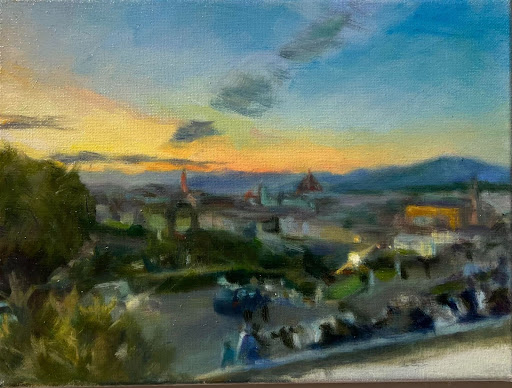
Florence, Italy, was totally a whole new world! It just made Nancy feel like she was in a dream! In her oil painting Sunset in Piazza Michelangelo, Nancy wrote:
“The landscape in the painting is drawn from a day in Florence that marked a turning point in my life: my first experience standing beneath a traditional European skyline, embraced by the golden glow of a sunset I had never known before. Around me were joyful people from every corner of the world, each savoring the same light, the same sky, in peace. It was a feeling both foreign and profoundly familiar—like a forgotten dream, awakening, to find it made real.
In the distance stood the Duomo, majestic and timeless. As I recently looked back at the photograph that inspired this painting, I was transported to that sacred moment, again—a memory now etched in color and brushstrokes.
Through this oil on canvas, I wish to share that beauty, that sense of wonder, and that precious freedom with others. It is a quiet celebration of hope and belonging that inspired my desire to become an oil painting artist.” ——Nancy
In America
However, she couldn’t get used to that kind of life because she felt it was not real. So, she went back to China again.
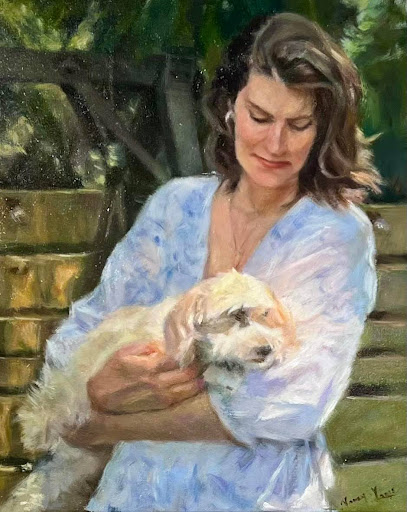
Three years later, Nancy came to America. She met a very nice lady, Sophia, she helped Nancy knowing that she is in the US! In her oil painting Sophia, Nancy wrote:
“In the gentle embrace of a quiet afternoon, my dearest friend Sophia cradles her beloved dog, Teddy, as we share a moment of serene companionship beneath the soft light of the day. More than a friend, Sophia is my American sister — the first soul to welcome me with open arms when I fled the shadows of communist China in search of freedom and truth.
She was the first person in the US placed on my path by God, revealing a world filled with love, humanity, and truth. Through her unwavering kindness, I glimpsed the world as it was meant to be — tender, genuine, and full of quiet hope.
This painting captures not just a moment, but the miracle of God’s Grace. This painting is framed by nature in the peaceful garden, and painted with a grateful heart.” —— Nancy
Many people are fond of Nancy’s artworks. Some asked her with surprise that after experiencing so much pain in her life; how can she still paint with such positive and warm feelings?
Nancy said “Because I practice Falun Dafa.” She started the cultivation at six years old, even earlier than her parents. Through this spiritual cultivation, she understands the suffering is not endless, sometimes just like a test, which only can make her character stronger. “I feel more humbled by God’s design for my life. When I make my art pieces, I want to share these kinds of feelings, love and hope, with people, to let them feel a little better when they are in hard times.”
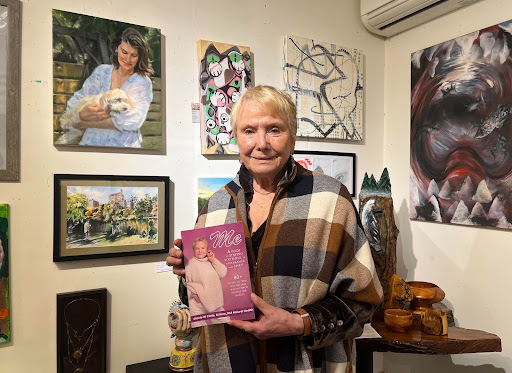
I had an interview with the author of the book me, Gisela Di Carlo, at UpFront Exhibition Space, Port Jervis. On Oct.10th, 2025. Here is our dialogue.
Jane: So you already know our newspaper, Vision Times?
Gisela: Yes.
Jane: Where do you get it?
Gisela: In Milford. Or whenever I go to the Chinese supermarket in Middletown.
Jane: You mean the Da Tang supermarket?
Gisela: Yes. I’ve been to China, and I love Chinese people. I used to work for a Chinese company.
Jane: Great! And what’s the reason you come to this gallery?
Gisela: Because I know the person that started this exhibit here, and I said, these young artists often do work within art for a while, and then they can’t make any money, or they lose interest, or they…it’s very hard to keep the passion. It’s very hard because if you don’t have people further you and encourage you and yourself, you don’t have the fire. You have to have fire.
Jane: You have to be motivated by some…
Gisela: Not only motivated, you have motivation you have to have, but you have to have fire. You have to have a need to do it. If you don’t have the need to produce art, you’ll never amount to much. So when you are motivated first, and you don’t have success yet, because nobody starts out having success. Success builds. It comes with time. If you then go and become an engineer or become a lawyer instead, or whatever, you may lose that passion. But you can keep that passion if you create something that you really want. When I started out, I’m 83 now,
Jane: Wow! You really look pretty young. 83 years old?!
Gisela: Yeah, I wrote this book last year. (Her book: me). When I started out, I started painting, sculpturing, I started all kinds of things, and it was all nice. People complimented me on it, people said: “ What a talent you are!” But it didn’t satisfy me.
If it doesn’t satisfy you, leave it. Do something else. I found something that would satisfy me, is writing and natural health, a doctorate in natural health. I do cosmetics, I do things that benefit people. That’s my passion. These artists, their passion should be to paint if they want to.
Jane: But I have a question. I think if you want to do something good, you have to have a passion, you have to love what you are doing. But what you are talking about is why people gradually lose their passion. It is because what?
Gisela: Because there is no validation. We, in our society, our validation is money. If you don’t make any money with it, how are you going to succeed?
Jane: Okay, so somebody…
Gisela: And then you lose the passion. Sometimes also you lose the passion, because that passion you had, it’s like a love affair between a man and a woman. Sometimes it just goes away.
Jane: Fades.
Gisela: It fades. It’s the same thing with art. Like what I do, I’m a homeopathist and I help people without pharmaceuticals. The people that come to me, they never ever go back to a doctor. Maybe for a screening or maybe for their broken arm to x- rayed it, but otherwise, they don’t go to doctors. I’m usually so successful I make them well without pharmaceuticals.
Jane: Wow!
Gisela: But that’s not what we’re talking about. What we’re talking about is the passion of art. Art is a very difficult thing to keep. It’s like love. Love is a very difficult thing to keep.
Jane: I totally understand.
Gisela: Yeah, and that is what this is about. If you really have the need to do it, you understand? You have the need. You must do it. Nobody can stop you! Then you become great!
Jane: Okay. But I have another question, if the artist really has no money, what will…
Gisela: What will they do? Then you paint at night. Go in the daytime to work, something else. Paint at night, or weekends or on your holidays or at another time.
Jane: So if you have to, you will separate.
Gisela: Yes, you have to separate.
Jane: Earn money to make a living, and then you keep your passion.
Gisela: Yes. You have to do that. If you don’t, you lose the passion
Jane: Because…
Gisela: Because you don’t practice it. You have to practice it. Constantly! Constantly! I know many artists that have been there, there’s one here in Port Jervis that I’ve been friends with for 20 years, he has been an artist for 50, 60 years, and has made a living with it, because he’s very good. But when he studied out, not having any money, almost starving.
Jane: Right now what about him?
Gisela: He’s now working on his art, and he’s making some money, but his wife works too.
Jane: How do they make a living?
Gisela: His wife works! He used to, he used to make it.
Jane: Through the arts.
Gisela: Yes. He used to have very good commissions. But, the arts, that’s why I like what Carmelle is doing. We have to keep this alive. Without this, like music, musicians, any kind of art, without art, humans are very, very poor!
We have to have art! We have to have something beautiful to look at. We have to have something beautiful to hear. We have to have something beautiful to wear, because making clothes is an art form too, like writing is an art form, paintings and sculptures. Without that, humans cannot be humans, really! Even 7,000 years ago! They were drawing on the walls of the caves.
Jane: Yes, even thousands of years ago!
Gisela: Yes, when we were Neanderthals, when we were just starting out to be humans, really, first thing they did
were making sounds like music and making pictures on the walls. We need that! The human person needs that! It’s a need! And we cannot let that go. We have to support it. That’s what I do. This book is about passions. It’s about how to keep young, how to never lose…you understand the word curiosity?
Jane: No. What does it mean?
Gisela: Curiosity is like, I am curious, I want to understand. Like you are now.
Jane: Yes, I am curious about you. (We laughed) Because this is my first time meeting you, it’s a whole new world for me!
Gisela: Yes, curious! C,U,R,I,O,U,S. You need to have that. Otherwise nobody can learn without that.
Jane: Passion plus curious. Curious George!
Gisela: Yes, yes. (We laughed)
Jane: That little book for children. I love that book. When the book, the last part, is the Curious George, holds the balloons. Oh, my God! That’s why I remember that book. I feel fantastic! (We are so excited)
Gisela: Yes. And you know when you go in the woods and you see some animals that are screwing around, you want to go investigate and see what they are doing. That’s curious! You come to interview and find out about that, because people are curious and they should be, that’s also what we need. Without that, we will be just robots.
Jane: Okay, great. So you said when you were young, you liked painting?
Gisela: Yes. I used to paint. I used to sculpt. I like that better than learning mathematics. (She laughed) My father was a concert pianist. He played piano.
Jane: You like piano too?
Gisela: Yes, and I learned some. But I never had the patience to learn it for life, because it was not something that I wanted to do the rest of my life. I found what I wanted to do the rest of my life,
Jane: Not the painting, not the piano?
Gisela: Right. Writing and healing people, that’s my passion! And if I don’t do that, I’m unhappy. I get depressed.
Jane: That feeling! So bad!
Gisela: Yeah, and everybody does. If you’re not allowed to do what your passion is, you can get depressed, and you get sick.
Jane: I totally agree with you. You know, I love my job!
Gisela: I can see it. I can see it. That is so great!
Jane: Every time I drive my car outside, I see the blue sky. Look what I do: I deliver newspapers; I’m an agent, if people like the advertisement to put in our newspaper, I can help them do it. I love my job! And also I can report and let our editor edit the article. Sometimes I even speak to myself while driving: “I love my job! I love my job!” That is the passion. So I totally understand you.
Gisela: Very good. I’m glad you do.
Jane: Yes. So tell me about this one, the book, me, When you write it?
Gisela: Last year. This is my present.
Jane: You give it to me?
Gisela: Yes.
Jane: Thank you! These are all the things about passion?
Gisela: No, it’s how to keep young.
Jane: How to keep young? Passion can keep you young. Because if you keep doing whatever you like, you will have the spirit to overcome everything, every difficulty.
Gisela: Yes, there we go.
Jane: Cool. I love this kind of thing.
Gisela: Yes. So you read that. And it’s written very easy, there are no big words like pharmaceutical or technical words. It’s written for anybody that can read it.
Jane: Here is your name.
Gisela: It’s Gisela Di Carlo. I have a diploma in homeopathy. I have a doctorate in natural health.
Jane: Great! Thank you so much! How long did it take you to write this book?
Gisela: Six months. I didn’t really want to write a book, but I like writing. I wrote articles and I wrote programs for people that wanted to learn about natural health or who wanted to learn skincare. That’s how I started out with skin care. I was the International Training Director for a big national cosmetic company.
Jane: So, that is not about writing.
Gisela: No, but it was. Because I had to write a lot, I had to write the programs that they wanted to learn. But then I got married four years ago, again. My previous husband died, and I was alone for one year. Then I met this wonderful man, and I got married again. He told me: you have to write all your knowledge down. This is all my knowledge, how to keep happy and young. 80s, 90s, hundreds, I plan to live as long as I can, with the same spirit that I have now.
Jane: Great! If people want to buy your book, where do they go?
Gisela: Barnes and Nobles, not in the shop, but online. But you can also, I have a website, Gisela di carlo.com.
Jane: Okay. Again, about this gallery, what are the reasons you come here?
Gisela: I would like to come and tell these artists how to keep their passion, and how to keep young. Plastic surgery doesn’t keep you young. I don’t have plastic surgery. I don’t have any implants. I don’t have anything, nothing, nothing artificial.
Jane: That’s great, you are really healthy.
Gisela: Healthy and curious, and happy.
Jane: Great! Thank you so much! Is there anything else you want to speak to our reader?
Gisela: What I would like because I read, and I’m familiar with your paper, I wouldn’t mind writing an article for you guys.
Jane: Really? What kind of article do you want to write?
Gisela: Article about how to keep young. Because you always have an insert of natural health.
Jane: Yes, we have the lifestyle. If you write an article, we can publish it. That’s wonderful!
Gisela: Yeah. You just contact me and I’m gonna give you my calls.