
By Jin Yan and James Jseng, Vision Times
Lionel Messi has once again made World Cup history at this year’s FIFA World Cup. But in China, coverage of the Argentine star’s record-breaking performance has become unusually restrained.
On June 22, the 38-year-old Argentina captain scored twice against Austria in the 2026 World Cup group stage, bringing his career World Cup goal total to 18 and surpassing German striker Miroslav Klose’s long-standing record of 16 goals. The milestone made Messi the top scorer in World Cup history.
Just six days earlier, Messi had scored a hat trick against Algeria, lifting his World Cup total to 16 and tying Klose’s record. His latest performance, coming 20 years after his first World Cup goal in 2006, cemented his place as the tournament’s all-time leading scorer during his sixth World Cup campaign.
State media praise, then silence
In China, however, the tone of coverage quickly became complicated. After Messi’s June 17 hat trick, state media CCTV News and CCTV Sports initially praised his performance on social media. CCTV Sports reportedly wrote: “To say Messi has become a god is a compliment to the gods,” noting that at 38 years and 357 days old, he had become the oldest player in World Cup history to score a hat trick.
Success
You are now signed up for our newsletter
Success
Check your email to complete sign up
But by June 18, many Messi-related posts from CCTV-affiliated accounts had reportedly disappeared or become difficult to find. Searches for Messi on CCTV Sports’ social media showed little recent coverage directly related to his record-breaking performances.
CCTV has not publicly commented on the apparent deletion or reduction of Messi-related content. Other state media outlets, including Xinhua and People’s Daily, continued to publish some Messi-related reports, suggesting that the approach was not entirely uniform across China’s media system.
Online rumors also claimed that broadcasters were instructed to avoid close-up shots of Messi during matches, but those claims have not been independently verified. Still, some Chinese fans said they noticed fewer close-ups and less celebratory commentary than in previous World Cups.
Hong Kong match controversy
Messi’s uneasy media treatment in China can be traced in part to a major controversy in February 2024, when Inter Miami played a friendly match in Hong Kong. Messi remained on the bench for the entire match, citing injury, while tens of thousands of fans who had paid high ticket prices left disappointed. Days later, he appeared as a substitute in a match in Japan, triggering anger among fans in Hong Kong and mainland China.
Hong Kong Chief Executive John Lee said he was “extremely disappointed,” while the Hong Kong government later withdrew a HK$16 million subsidy application connected to the event.
Chinese state media also weighed in. The Global Times published a commentary suggesting that Messi and Inter Miami’s actions “could not rule out political motives” and that “external forces” may have sought to embarrass Hong Kong. As the backlash grew, nationalist commentary framing the incident as an insult to China spread widely online. Several commercial partners also faced pressure from consumers.
Messi later posted a video on Weibo explaining that his absence was due to injury and saying it had “nothing to do with political reasons or any other reasons.” He also sent greetings to Chinese fans.
Politicized sports coverage
The Messi controversy recalled earlier moments when international sports became entangled with Chinese politics. In 2019, CCTV suspended most NBA broadcasts after then-Houston Rockets general manager Daryl Morey posted support for Hong Kong protesters. Broadcasts resumed gradually after the NBA, in CCTV’s words, “continued to express goodwill.”
In Messi’s case, there is no formal announcement of a ban. Yet his visibility on some of China’s most influential media platforms appears to have narrowed. His image was also reportedly removed from the opening montage of CCTV’s football program “Total Soccer,” where footage of him lifting the 2022 World Cup trophy was instead replaced with a shot of former Germany captain Philipp Lahm.
That replacement drew its own irony among observers, as Lahm has previously spoken critically about human rights conditions in authoritarian states.
China’s World Cup contradictions
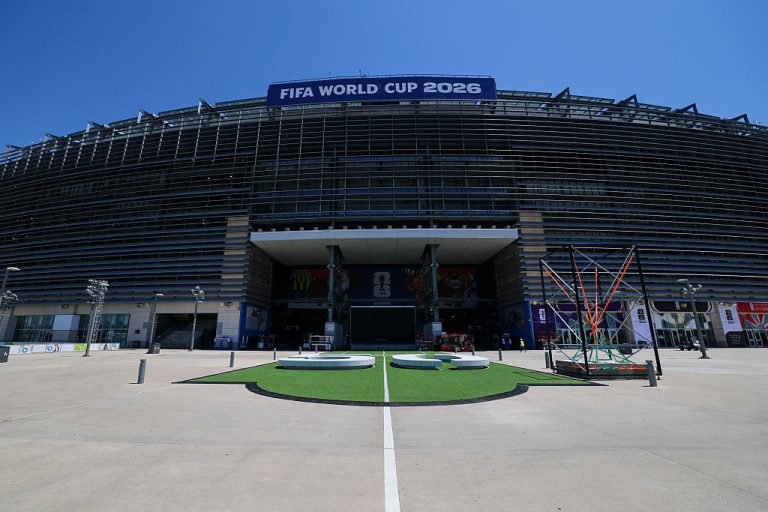
The muted treatment of Messi comes as Chinese companies remain highly visible at the 2026 World Cup. Sponsors such as Hisense and Mengniu have invested heavily in stadium advertising, ensuring strong brand exposure to global audiences.
At the same time, Chinese viewers are seeing a more politically filtered version of one of the tournament’s biggest stories. Chinese capital is prominently displayed around the pitch, while one of football’s most celebrated players appears to receive noticeably constrained treatment in domestic media.
As Argentina continues its World Cup campaign, Messi’s record could grow even further. But in China, the way his achievements are presented may continue to reveal as much about politics as it does about soccer, or football, depending on where you’re reading this from.