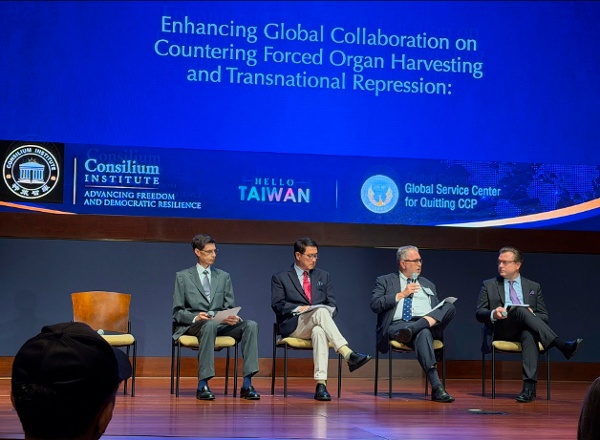
WASHINGTON D.C. — On July 21, a coalition of human rights advocates, medical ethics experts, and policy scholars convened at the U.S. Capitol for the Chinese Freedom & U.S.–Taiwan Security Forum 2026, where speakers renewed calls for stronger international action to confront the Chinese Communist Party’s (CCP) practice of forcibly harvesting organs from prisoners of conscience, including Falun Gong practitioners.
Organized by the Consilium Institute and Hello Taiwan, the forum’s fourth panel focused specifically on forced organ harvesting, with participants arguing that the abuse has continued despite years of international investigations and growing evidence. Speakers urged governments, medical institutions, and news organizations to take more decisive action through legislation, ethical safeguards, and greater public awareness.
RELATED: Virginia Community Leaders Warn of CCP’s Growing Influence and Transnational Repression
Media scrutiny and censorship
Jan Jekielek, senior editor at the English-language edition of The Epoch Times and moderator of the panel, said that although evidence has accumulated for years, the international community has yet to take sufficiently meaningful steps to fully sever ties with China’s transplant system.
One of the panel’s featured speakers, Erping Zhang, spokesperson for the Falun Dafa Information Center, argued that political and economic considerations have led portions of the Western media to shy away from reporting on the issue. He cited the experience of former New York Times Beijing correspondent Didi Kirsten Tatlow, who has publicly described obstacles she encountered while investigating China’s organ transplant system.

Success
You are now signed up for our newsletter
Success
Check your email to complete sign up
According to Zhang, Tatlow learned of potential evidence in 2016 after overhearing a private conversation involving prominent Chinese transplant surgeon Chen Jingyu, whose remarks suggested that organs from prisoners of conscience continued to be used despite Beijing’s 2015 announcement that it had transitioned to a voluntary organ donation system. Zhang said Tatlow attempted to pursue the story but encountered resistance from editors and ultimately left The New York Times in 2017.
In 2019, she later submitted written testimony to the independent China Tribunal, describing her experience covering the issue. Reflecting on Tatlow’s account, Zhang told the forum, “From Didi Tatlow’s experience, we can see that mainstream media failed to fulfill their responsibility to expose this crime against humanity. Instead, they attempted to suppress their own reporter’s investigation into this evil.” He urged journalists and media organizations to resist self-censorship and continue investigating allegations of human rights abuses in China.
Experts challenge Beijing’s organ transplant claims
Canadian human rights lawyer David Matas, who addressed the forum remotely, argued that Beijing’s official explanations regarding the source of transplant organs have changed repeatedly over the past four decades, undermining the government’s credibility.
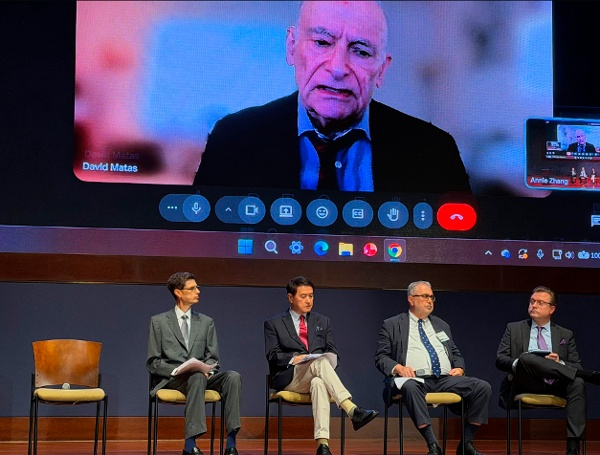
He said Chinese authorities now claim organs are obtained through a voluntary donation system established in 2015, but maintained that such assertions are inconsistent with the lack of transparency surrounding China’s transplant system and the unusually short waiting times reported by patients. Matas said these discrepancies are consistent with the findings of independent investigations conducted by nongovernmental organizations, including the International Coalition to End Transplant Abuse in China (ETAC).
Piero Tozzi, senior director for China policy at the America First Policy Institute (AFPI), echoed those concerns during the forum, stating that “China does not have a genuine voluntary organ donation system.” He argued that the CCP systematically violates the internationally recognized “dead donor rule,” adding that analyses of China’s transplant data show significant discrepancies between the country’s reported donor figures and the number of transplants believed to have been performed.
Congress advances legislation
The forum also highlighted recent legislative efforts in the United States aimed at addressing forced organ harvesting. Among the most closely watched measures is S.4009, the Falun Gong and Victims of Forced Organ Harvesting Protection Act, introduced on a bipartisan basis by Sens. Ted Cruz (R-Texas) and Jeff Merkley (D-Ore.).
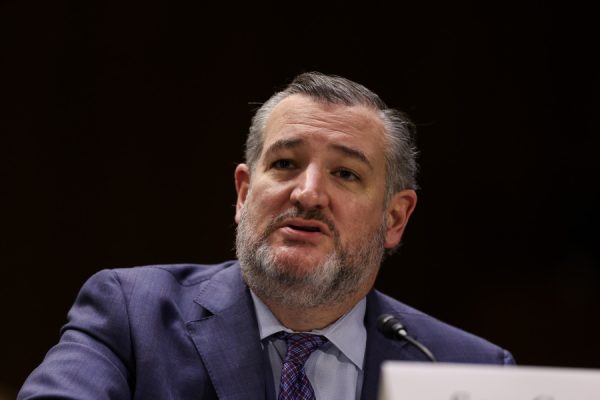
The bill advanced with strong support from the Senate Foreign Relations Committee in late June. The Lantos Foundation for Human Rights and Justice welcomed the legislation, calling it evidence of bipartisan determination to confront what it described as one of the “most disturbing human rights abuses” of the modern era.
At the House level, lawmakers have already passed the Stop Forced Organ Harvesting Act of 2025 and the Falun Gong Protection Act by voice vote, which both advanced with unanimous support. Meanwhile, several states, including Texas, Utah, Idaho, Tennessee, Arizona, and Arkansas, have enacted legislation prohibiting commercial health insurers from covering organ transplant procedures performed in China under opaque sourcing practices.
Calls grow for greater accountability
The discussion also focused on the role of the global medical community. Alejandro Centurion, deputy director of medical affairs for Doctors Against Forced Organ Harvesting (DAFOH), said awareness within the medical profession remains insufficient despite years of evidence and advocacy. “Greater awareness will lead to stronger legislation and accountability, while helping the medical community reclaim its ethical leadership,” he said.
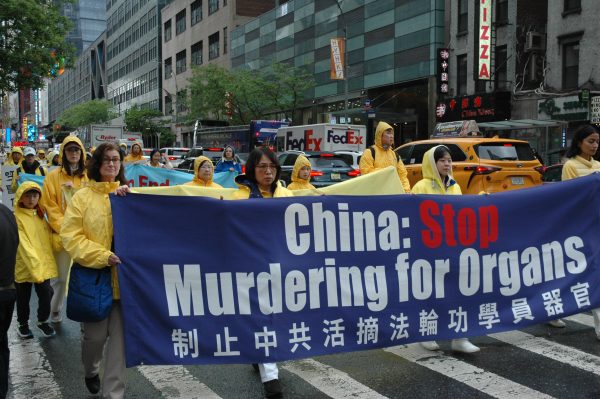
According to information presented during the forum, participants argued that confronting forced organ harvesting extends beyond protecting persecuted groups such as Falun Gong practitioners and Uyghur Muslims. They said it also represents a broader test of international medical ethics, human dignity, and the willingness of democratic societies to hold perpetrators of crimes against humanity accountable.
Falun Gong, also known as Falun Dafa, is a spiritual practice rooted in the principles of Truthfulness, Compassion, and Forbearance that was introduced to the public in 1992. In July 1999, China launched a brutal campaign to eradicate the practice after seeing its rapid rise in popularity as a threat to its authoritarian regime. Since then, thousands of practitioners have perished at the hands of Chinese police, with many today still undergoing routine monitoring, arbitrary travel bans, and arrests.
Speakers concluded that governments, healthcare professionals, and the media all have a responsibility to ensure the issue remains in the international spotlight rather than allowing political or economic considerations to silence further scrutiny.