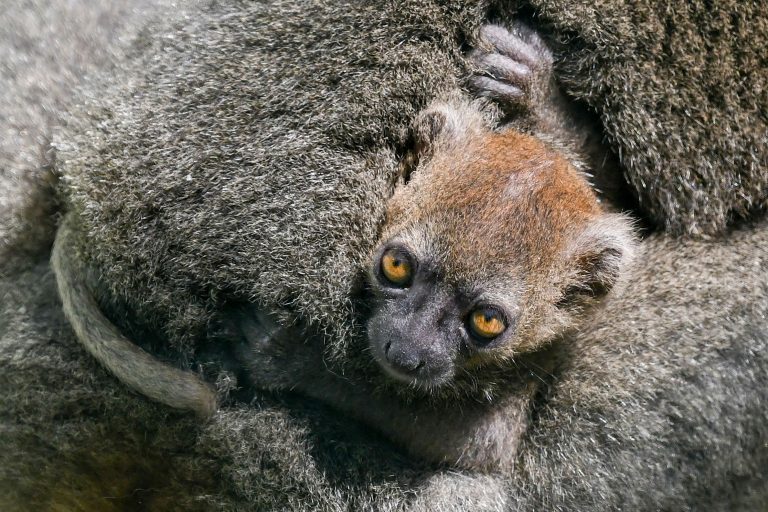
On Oct. 24, the Cotswold Wildlife Park ushered in the birth of one of Madagascar’s most endangered lemurs; the greater bamboo lemur. This marks a triumph in wildlife conservation as there are so few of these rare creatures left in captivity and the wild.
The unnamed baby lemur, whose gender has also not been identified, was born to a breeding male, Raphael, and female, Bijou at the park. Its birth marked the fourth consecutive year that the Cotswold Wildlife Park had bred these threatened primates; the only zoological collection in the UK to have done so in 2024.
There are currently only 36 greater bamboo lemurs in captivity worldwide, and the species is classified as “critically endangered” by the International Union for Conservation of Nature (IUCN). Moreover, there are seven other zoological collections globally that house greater bamboo lemurs.
“Lemur species in Madagascar are under tremendous pressure from habitat destruction and the rapidly rising human population. It is vital that we raise awareness for this unique group of primates before it is too late,” Jamie Craig, general manager of Cotswold Wildlife Park, told the BBC.
“At Cotswold Wildlife Park, we are committed to conserving this species and we fund an extremely important site in Madagascar, as well as participating in several other conservation projects with the Cotswold Wild Park conservation trust.
Success
You are now signed up for our newsletter
Success
Check your email to complete sign up
“We are extremely privileged to keep both of these species at the park; they are extremely rare in captivity and they are fantastic ambassadors for our fundraising efforts.”
Other than Cotswold Wildlife Park, the parent lemurs are part of a larger European Breeding Program, which aims to maintain the genetic diversity among captive populations to ensure their survival. It coordinates breeding efforts between zoos and wildlife parks to create a backup population in case the species becomes extinct in the wild.
Cotswold Wildlife Park is also involved in “in-situ conservation projects” in Madagascar, providing financial support for conservation sites in the animals’ habitats.
READ MORE:
- Treatment of Andean Condor Showcases Challenges of Wildlife Conservation
- Spain Ends Traditional Bullfighting Award Amid Cultural Shift, Animal Advocacy
- After Sharing Dalai Lama’s Speech, Tibetan Monk Sentenced to 18 Months in Jail
The greater bamboo lemur
The greater bamboo lemur hails from the Madagascar rainforest, where they mainly eat bamboo shoots and culms. These lemurs usually feast on the culms between August and November, while they eat the shoots at the start of the rainy season.
Certain bamboo species have been known to contain levels of cyanide, which would be deadly to animals of the lemur’s size. Yet, these primates have adapted to process the cyanide through urination, allowing them to gain much-needed protein from the plants. It is this unique diet, however, that often makes it difficult to sustain the lemurs in captivity.
Males can breed with multiple females — the breeding season occurs between April and June — leaving the females with a gestation period of around 150 days. Infants stick with their mothers for their first two weeks of life, but they have a high risk of falling off their backs or bellies when climbing. Their risk of falling decreases when they reach two months old.
Between 1973 and 2014, Madagascar lost 37 percent of its forest cover to human expansion, agricultural developments, logging and mining, depriving the lemurs of their habitat and sources of food.
Now, there are only a few hundred greater bamboo lemurs left in the wild. This makes the recent birth at Cotswold Wildlife Park essential to conservation efforts as the park hopes to reintroduce the species into the wild sometime in the future.