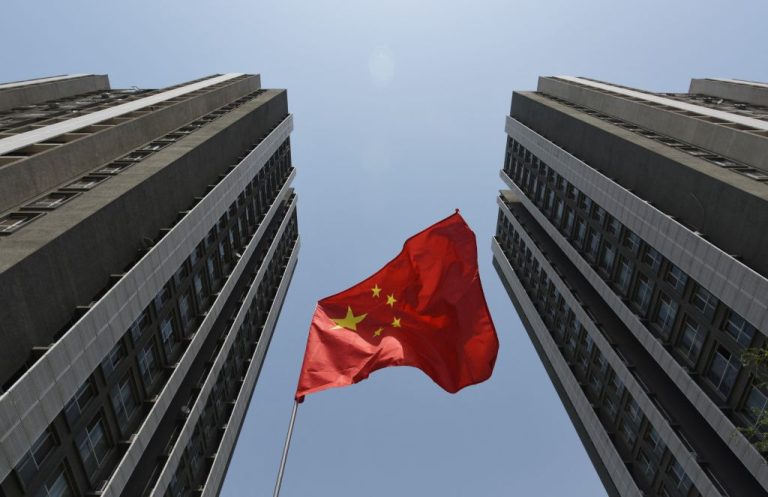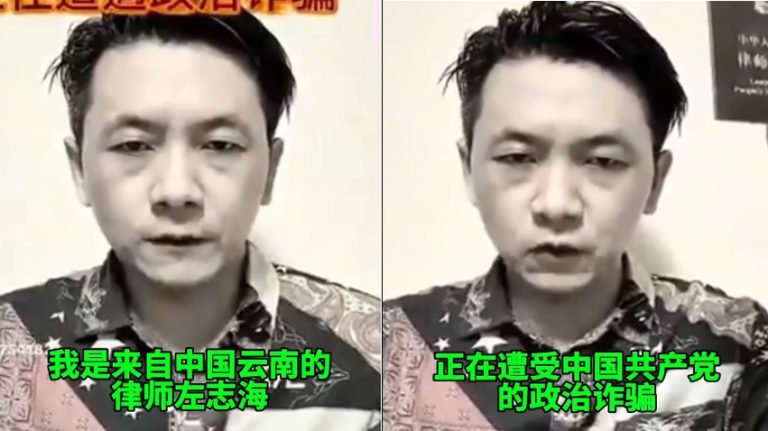
As the Chinese Communist Party (CCP) holds its 20th Central Committee Fourth Plenary Session in Beijing, a self-recorded video from a man identifying himself as a lawyer from Yunnan Province has gone viral online.
In the video, the man introduces himself as Zuo Zhihai and declares that “the Chinese people are victims of the CCP’s political fraud.”
The release of his message — coinciding with one of China’s most politically sensitive weeks — has drawn widespread attention and sparked intense online debate.
The video, first posted on Oct. 21 by the X (formerly Twitter) account “People’s Mineral Republic of China,” shows Zuo sitting calmly before the camera, speaking in a steady but resolute tone.
“Today, I speak to you as a lawyer — and with my conscience,” he begins. “The Chinese people are victims of the Chinese Communist Party’s political fraud.”
Success
You are now signed up for our newsletter
Success
Check your email to complete sign up
According to Zuo, the CCP first seized China’s land, mines, forests, and waterways under the banner of “state” and “public” ownership.
He claims that citizens are legally barred from owning these resources and must instead pay the Party high prices to rent or use them.
“In this process,” he said, “the CCP completed its exploitation of the Chinese people.”
Zuo further alleges that the CCP has monopolized nearly all major sectors tied to daily life — including oil, water, electricity, gas, telecommunications, banking, finance, and transportation — under the label of “state-owned” or “central” enterprises.
“Through these monopolies,” he said, “the Party exploits the people while claiming to serve them.”
He accused the CCP of disguising Party interests as national interests, transferring all governing power into its own hands.
“Even the national treasury, which should belong to the people, has been privatized into the Party’s own vault,” he said.
Tax burdens and growing inequality
Zuo argued that the CCP arbitrarily determines how much citizens must pay in taxes, leaving the public with no right or ability to question how their money is spent.
“The financial system now exists to extract as much as possible — from national resources, public wealth, and private businesses — into the pockets of Party officials and their families,” he said.
He added that this system has created widespread hardship, claiming that out of China’s 1.3 billion people, nearly 900 million live in poverty with limited access to welfare or medical care.
These figures, however, could not be independently verified.
Zuo said the CCP has turned housing, education, and healthcare into instruments of control.
Ordinary families, he claimed, must drain their savings to buy an 80-square-meter apartment — and even then, only receive usage rights instead of full ownership.
“Forty-five percent of the purchase price,” he said, “goes to the Party in taxes and fees.”
He further alleged that hospitals routinely deny treatment to patients unable to pay, resulting in countless preventable deaths among poor families, children, and the elderly.
The video spread rapidly across Chinese-language platforms before being removed by censors. Thousands of users reposted clips, screenshots, and transcripts — many praising Zuo’s courage.
“He’s exposed the entire system of exploitation — military control, propaganda, censorship, and monopoly,” one commenter wrote. “We are slaves.”
Others expressed concern for his safety:
“He’s brave, but I hope he stays alive,” another user said. “This struggle will be long — we need people like him to survive.”
A tense political backdrop
Zuo’s message comes at a time of mounting pressure within the CCP’s top ranks.
The Fourth Plenary Session, held Oct. 20–23, followed the purge of nine senior generals, all personally promoted by Xi Jinping, signaling deeper rifts in China’s leadership.
At the same time, a surge of public dissent and whistleblower activity has drawn global attention.
The suspicious death of actor Yu Menglong, a CCTV insider’s revelations, and even comments from a “red second-generation” Party descendant calling for an end to the Great Firewall have amplified a growing sense of unrest.
Observers note that such outspoken voices — once extremely rare — are becoming more common, reflecting what some describe as a slow but visible public awakening.
“People are beginning to see through the illusion,” one overseas analyst told Vision Times. “The more the regime censors, the more citizens start asking why.”