Public frustration toward Xi Jinping is easy to understand. Yet, as commentator Lü Honglai argues, calling for Xi to “step down” misses the larger point.
It is not Xi himself, he writes, but the one-party dictatorship that produced him that must be brought to an end.
Xi Jinping, who rose to absolute power despite what critics call a “primary-school-level PhD,” has concentrated authority in his own hands. Everything—from domestic affairs to foreign policy—is said to require his personal command.
He has repeatedly claimed to “chart the course for global development,” even as his governance drives domestic discontent, economic decline, and international isolation.
Lü describes Xi as “the most foolish and incompetent ruler since the Communist Party’s founding,” but insists that forcing him out now would be a directional mistake.
Success
You are now signed up for our newsletter
Success
Check your email to complete sign up
In his view, Xi’s continuation in power exposes the CCP’s internal decay more effectively than any reform movement could.
The real source of China’s problems, Lü argues, is the CCP’s political structure—a one-party autocracy that enables unaccountable leaders to rule for life.
Without that system, he asks, how could someone like Xi ever have become China’s top ruler?
Ending the CCP’s monopoly on power, he writes, is the only way to build a new China based on freedom, democracy, and the rule of law.
Otherwise, removing Xi alone would simply produce another version of him—“today Xi Jinping, tomorrow Mao Jinping.”
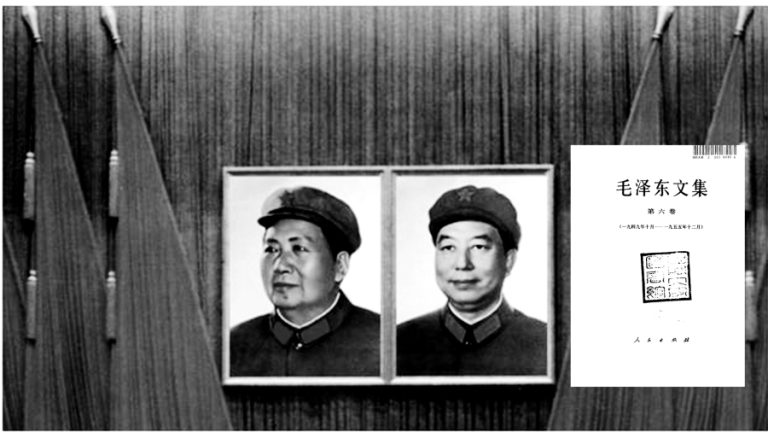
The Myth of a New Hua Guofeng
Many Chinese who hope for change imagine another Hua Guofeng might emerge—someone to “smash a new Gang of Four,” “set things right,” and steer China back toward reform and opening.
Such a scenario, Lü cautions, would only repeat history and deceive the world again.
Rather than hoping for reformers to rescue the Party, he argues, the CCP must face full exposure of its “evil nature” so that both Chinese citizens and the international community abandon all illusions and unite to isolate and sanction the regime.
“If anyone must emerge from within the CCP,” Lü writes, “let it be a democrat—a Gorbachev or a Yeltsin—not another Hua Guofeng or Zhao Ziyang.”
Lü acknowledges the historical roles of reformist figures like Hua Guofeng, Hu Yaobang, and Zhao Ziyang.
But he believes the moment for reform has passed. After years of rejecting universal values and entrenching vested interests, the CCP has lost the capacity for peaceful transformation.
Any new “reform” effort, he says, would only prolong the regime’s life and deepen the suffering of the Chinese people.
From this perspective, Lü suggests, it may be better for Xi to continue his rule to its destructive conclusion—until China’s economy collapses, the regime is fully isolated, and the Party itself disintegrates.
‘Heaven’s will’ and the role of the foolish emperor
In Lü’s moral framework, Xi Jinping’s rule is not an accident of politics but an expression of divine retribution.
“When Heaven wishes to destroy someone, it first makes him mad,” he quotes.
If, at the moment of the CCP’s downfall, there were no foolish tyrants like Xi Jinping, that, he says, “would truly go against Heaven’s will.”
History, Lü argues, has its own logic. Like a dying man who must become terminally ill before death, a regime as vast as the CCP—with millions of troops, police, and nearly 100 million members—cannot collapse overnight.
It must first be brought to the brink of ruin.
Before Xi took power, the CCP presided over the world’s second-largest economy. Foreign investment was booming, and China’s global influence appeared to be rising.
But under Xi’s direction, the economy has declined, internal fear has deepened, and China has grown increasingly isolated abroad.
That, Lü concludes, is Xi Jinping’s true historical role—to accelerate the terminal decline of the Communist system itself.