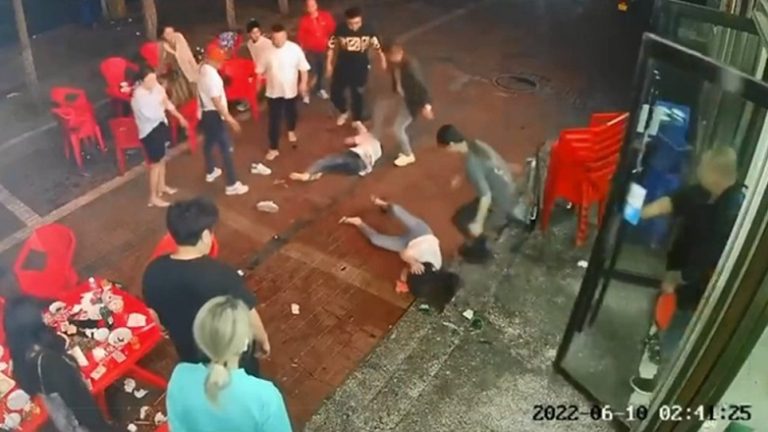
In late October, public outrage over Chinese actor Yu Menglong’s case unexpectedly revived another dark chapter from China’s recent past—the Tangshan beating incident.
Viral videos and online commentaries began linking the two, claiming a disturbing connection through an art installation in Beijing’s 798 Art District.
According to Xiaoxiang Morning News, sculptor Yang Song used two tons of soap to create a three-meter-tall couple sculpture for an exhibition at the 798 Art Museum. Over two weeks, the piece was sprayed with water until it dissolved into foam.
Soon after, netizens noticed that the figures resembled a young couple captured in surveillance footage from the notorious 2022 Tangshan barbecue-restaurant assault.
The assault occurred in the early hours of June 10, 2022, at the Lao Hancheng barbecue restaurant in Tangshan, Hebei. A man named Chen Jizhi and several accomplices sexually harassed a woman dining there. When she resisted, they viciously beat her and three friends.
Success
You are now signed up for our newsletter
Success
Check your email to complete sign up
Other diners reportedly tried to intervene or film the attack but were threatened by the assailants—including, according to witnesses, the same couple later compared to the sculpture. The woman was seen hiding in her boyfriend’s arms in fear. Afterward, users repeatedly asked about the pair’s fate, yet no official follow-up was ever released.
Online claims of a sinister plot
Recent posts allege that the sculpture’s “models” were indeed that couple—and that both were later found dead in a wooded area.
An alleged “insider” quoted on social media claimed the assault had been orchestrated as part of a larger conspiracy.
Independent commentator Li Muyang asserted in his webcast that one of the victims, identified as Liu Wei, possessed a rare Rh-negative blood type, often called “panda blood.” According to the rumor, she was targeted so that her heart could be transplanted to a powerful official.
Liu Wei allegedly received a free meal coupon to the Lao Hancheng restaurant—said to be owned by Chen Jizhi’s cousin. The eatery had supposedly been rigged with cameras trained on her table, and a man in black seen in the footage was rumored to be Tangshan police chief Ma Aijun, surrounded by plainclothes officers.
None of these claims have been verified by Chinese authorities or credible media outlets.
The same online stories allege that one woman was dragged upstairs, assaulted, and later run over by a white car, while others were killed on site.
Liu Wei, according to anonymous sources, was taken away in an ambulance—only to have 1,500 milliliters of blood drawn and her heart removed.
Additional posts insist that hospital footage was fabricated, victims’ families were confined to psychiatric wards, and police collaborated with the perpetrators.
One viral comment read: “The cops and criminals worked together. They found scapegoats, and everyone else walked free.”
Another rumor portrayed Chen Jizhi as a “fourth-generation red elite” with influential lineage—his father allegedly Chen Jianfei, grandfather Chen Hua, and great-grandfather the late PLA general Chen Shiqu—and claimed he later fled to northern Myanmar.
Again, none of these assertions have been confirmed by official or independent sources.
Public shock and expanding theories
As the rumors spread, Chinese social platforms filled with alarm and disbelief: “The Tangshan case was about one girl’s rare blood type—and the whole village paid the price.”
“Everyone involved—the girls, the witnesses, the families—was wiped out. These red elites will do anything.”
“Maybe it’s not just ‘panda blood’ but rarer kinds like Rh-null or the Bombay phenotype. Only a few dozen people worldwide have them—it’s terrifying.”
Some users linked the melting soap sculpture to the couple’s supposed fate: They’ve already turned to foam beneath the 798 underground passage—gone forever. If you have a rare blood type, leave China while you can.”
Observers note that such conspiracy narratives thrive in China’s information blackouts and deep public distrust of official accounts.
While many reject the more extreme versions, others find them plausible precisely because real details remain concealed.
Once a straightforward criminal case, the Tangshan incident has become a symbol of censorship, paranoia, and moral decay—a mirror showing how a society deprived of transparency can turn rumor into its only form of truth.