In the days following the CCP’s 20th Fourth Plenum, reports have emerged of a sweeping military purge targeting senior military officials from the top ranks down.
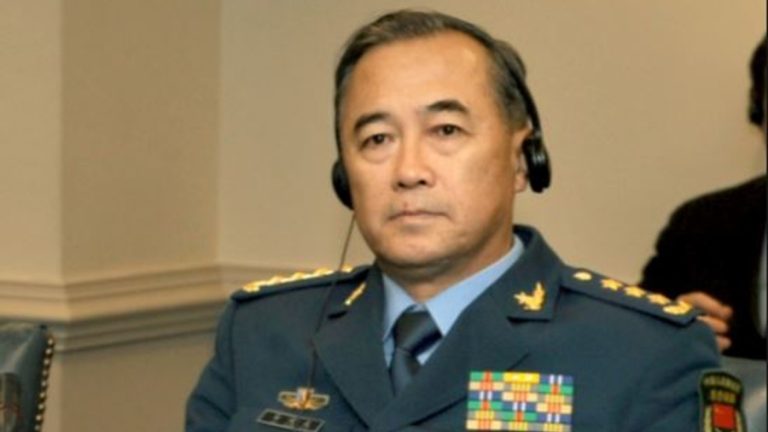
Among the latest claims: Air Force Commander Ma Xiaotian has allegedly been detained, and Zhong Shaojun, Xi Jinping’s longtime military aide, has seen his mother, Zhang Shujuan, taken away for questioning.
Analysts say the probe into Zhong’s family suggests that he has “no path to recovery.”
With three successive directors of the Central Military Commission (CMC) General Office now implicated, Xi appears increasingly isolated at the core of his own military system.
Commentator Jiang Feng cited an online report by the self-media outlet “Da Bao,” which claimed that Zhang Shujuan, mother of Zhong Shaojun, was detained by a joint team from the military disciplinary inspection commission.
Success
You are now signed up for our newsletter
Success
Check your email to complete sign up
Zhang, a native of Kaihua County, Zhejiang, had previously sold local specialty tea—“Huangjincha” (Golden Tea)—at a farmers’ market.
Golden Tea is a traditional variety with a long history.
According to local lore, the Daoist master Ge Hong used it in medicinal elixirs during the Eastern Jin Dynasty.
In the late Tang period, rebel leader Huang Chao’s army reportedly traded gold for this tea after it was used to treat sick soldiers during his campaign through the region—hence the name “Golden Tea.”
From tea vendor to military supplier
How did a small-town tea vendor from Zhejiang rise to become the exclusive supplier for PLA veterans’ sanatoriums across the country?
Jiang Feng traced the connection back to Zhong Shaojun’s appointment.
In spring 2013, Zhong—then deputy director of the Zhejiang Organization Department and known as Xi Jinping’s personal aide—was transferred to the CMC General Office and awarded the rank of senior colonel.
Just months later, on Aug. 23, 2013, Zhang Shujuan registered a company in Hangzhou called Hangzhou Golden Latitude Tea Co., Ltd.
“The timing was remarkable,” Jiang said. “The son enters the CMC, and the mother immediately starts a tea company.”
Though the company employed only about ten people, it soon became the exclusive tea supplier to the PLA’s network of retirement homes and sanatoriums.
By the end of 2013, through Zhong’s connections, Zhang had won a contract under the CMC Health Tea Package Program.
Her product line—marketed as “Jun Huangjinya” (Military Golden Bud)—combined golden tea and eucommia leaves and became the standard tea brand across military sanatoriums nationwide.
From 2014 onward, she effectively monopolized military tea procurement, with annual orders worth tens of millions of yuan.
“Think about it,” Jiang said. “There are hundreds of sanatoriums, each housing retired officers who drink tea daily. That’s a literal gold mine.”
Zhang later joined the Zhejiang Tea Industry Association and partnered with local cooperatives to build small-scale organic tea gardens dedicated to supplying the military.
The arrangement even qualified for agricultural subsidies, making it, in Jiang’s words, “a business that profits from every direction.”
Dramatic accounts of the arrest circulate online
Online reports describe the alleged arrest of Zhong Shaojun and his family as “textbook precision.”
According to these accounts—none of which have been independently confirmed—Hu Chunhua received an “absolute order” from Hu Jintao, then contacted Zhang Youxia to coordinate the operation.
Within an hour, they allegedly assembled an elite guard unit, complete with armored vehicles, which surrounded Zhong’s villa compound in Beijing’s Western Hills.
When the unit broke through the gates, Zhong was reportedly in his study reviewing documents.
“The moment he saw Hu Chunhua and Zhang Youxia leading the team, he turned pale and collapsed to the floor, trembling,” one account claimed.
Witnesses allegedly said that Zhong’s wife, child, and mother were also detained, and the scene turned chaotic.
Both Zhang Shujuan and Zhong’s wife reportedly resisted fiercely, shouting: “You can’t do this! This is an illegal entry! I want to speak to Chairman Xi! We are innocent!”
Sources claim that investigators found classified materials, USB drives, and laptops possibly containing military secrets.
After the operation, Hu Chunhua allegedly ordered: “Seal everything and hand it to the special task force.”
Analysts: No way back for Zhong Shaojun
Reports say that the joint military investigation will focus on how Zhang Shujuan obtained military contracts, how much profit was made, and what role Zhong Shaojun played behind the scenes.
“A tea vendor suddenly becoming a supplier to the entire PLA? No one would believe it without powerful connections,” Jiang Feng commented.
He argued that the case represents not only corruption but also a political and personal humiliation for Zhong Shaojun, once one of Xi’s most trusted aides.
“This is worse than arresting him directly,” Jiang said. “It’s a way to destroy his reputation—and it shows he’s finished.”
The investigation into Zhong is part of a broader pattern: all three of Xi Jinping’s chiefs of the CMC General Office have now faced scandal or disappearance.
1. Qin Shengxiang (2012–2017):
After retiring in 2023, Qin reportedly came under investigation in 2024 for corruption.
2. Zhong Shaojun (2017–2024):
Xi’s long-serving aide from Zhejiang and Shanghai, later promoted to General Office director and then to Political Commissar of the National Defense University.
His transfer was first noted on the website of China’s embassy in North Korea, which listed Xia Zhihe as his replacement.
3. Fang Yongxiang (since 2024):
Appointed around April 2024, but has recently missed several key events, including major military commemorations in Tibet and Xinjiang.
Both Fang and the recently purged Miao Hua are from Xi’s own 31st Group Army, leading observers to suspect a chain reaction.
“Three directors in a row have fallen,” Jiang said. “That means Xi’s military nerve center has become a meat grinder—and he’s the last man standing.”
He suggested that Zhang Youxia may be orchestrating the purge behind the scenes.
Reports: Air Force commander Ma Xiaotian also detained
Following the Fourth Plenum, reports of arrests have multiplied.
An announcement from the 14th National People’s Congress Standing Committee confirmed that several officials—including former Hunan Party Secretary Xu Dazhe, CMC Audit Chief Sun Bin, and former Navy Political Commissar Yuan Huazhi—were stripped of their delegate status.
Observers believe this marks a broader wave of purges extending beyond the military.
Unconfirmed reports claim that Air Force Commander Ma Xiaotian has also been detained.
Ma, born in 1949 in Gongyi, Henan, rose steadily through the air force ranks after graduating from the National Defense University in 1994.
He held successive posts as commander of the 10th Air Army, deputy chief of staff, and later commander of the Nanjing and Lanzhou military region air forces before becoming air force commander in 2012, a position he held until 2017.
He was succeeded by Ding Laihang (2017–2021), who was later removed from his post and stripped of NPC membership in 2023 over a corruption case related to airport construction.
Both men share ties to Xi’s Fujian-era network.
Ding once served as chief of staff of the 8th Air Corps in Zhangzhou, Fujian, and later as commander of the Fuzhou Air Command, where he reportedly had frequent contact with Xi and then-CMC vice chairman Xu Qiliang.
Ma Xiaotian also served earlier in the 24th Air Division, commanding its 72nd Regiment, where he is believed to have worked alongside Ding.
So far, Beijing has not confirmed reports of Ma’s detention.
If true, analysts say, it would mark another major escalation in the military purge following the Fourth Plenum.
According to independent tallies, over 780,000 officials across Party, government, and military sectors have faced investigation this year—a scale some analysts call “systemic collapse.”
By Li Jingyao