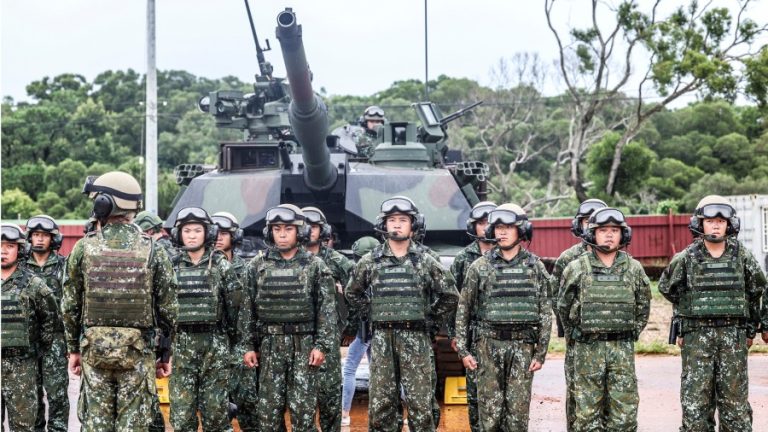
As China’s military expansion accelerates, analysts are asking whether 2027 could mark the most volatile year for the Taiwan Strait.
Following the recent Trump–Xi Summit, where the issue of Taiwan was deliberately left off the agenda, discussion among military and political experts has intensified.
From Trump’s “Taiwan is Taiwan” remark to Beijing’s propaganda push for “Seven Better Outcomes of Peaceful Reunification,” the island’s future now sits at the center of an increasingly complex geopolitical chessboard.
The Trump–Xi meeting on Oct. 31 lasted just over 100 minutes, with no discussion of Taiwan.
Professor Ming Juzheng of National Taiwan University said Beijing had attempted to pressure Washington into a public statement against Taiwan independence, but Trump’s “Taiwan is Taiwan” response effectively stripped the issue from the agenda — preventing the U.S. from falling into what he called Beijing’s “anti-independence trap.”
Success
You are now signed up for our newsletter
Success
Check your email to complete sign up
Former U.S. Defense Department official Hu Zhentong told Vision Times that Trump’s stance demonstrated a firm continuity in U.S. Taiwan policy, limiting Beijing’s ability to frame the issue internationally.
Ming added that Trump’s Asia trip reinforced the U.S.–Japan–South Korea strategic triangle, creating a containment perimeter around China.
“The phrase ‘Taiwan is Taiwan’ could be interpreted as either recognition of Taiwan’s de facto independence or a negotiating signal,” he said. “Either way, it constrained Beijing’s unification agenda.”
Commentator Yao Cheng noted that Wang Huning, one of Xi’s key advisers, has pushed a new “Seven Better” narrative under Beijing’s United Front policy — promoting peaceful unification as an alternative to direct confrontation.
During Trump’s visits to Tokyo and Seoul, both allies pledged to maintain “determined and practical cooperation” in safeguarding Taiwan Strait stability.
Japanese Prime Minister Sanae Takaichi reaffirmed that “a Taiwan contingency is a Japan contingency,” announcing plans to transform Japan’s Self-Defense Forces into a formal national defense military and raise defense spending to 2.5–3 percent of GDP.
Hu Zhentong highlighted three key components of this alliance strengthening:
- Joint Exercises: Expanded “Freedom Shield” and “Rim of the Pacific” drills now simulate Taiwan invasion scenarios.
- Weapons Development: The U.S. and Japan are co-developing hypersonic missile intercept systems to counter China’s DF-series ballistic missiles.
- Forward Deployment: U.S. Marine Littoral Regiments in Okinawa and nine bases in the Philippines now position forces to block the Bashi and Miyako Straits.
Analyst Mark Space noted Japan’s Type 12 anti-ship missiles and F-35B fighters increase its ability to strike coastal targets along China’s mainland.
Yao Cheng added that this tightening alliance forces Beijing to favor psychological warfare over direct conflict, as U.S. treaty obligations could still pull Washington into a regional war even if it sought to avoid one.
Beijing’s ‘Seven Better’ campaign met with skepticism
China’s Taiwan Affairs Office recently promoted its “Seven Better Outcomes After Peaceful Reunification” — promising improved economy, infrastructure, energy supply, social welfare, and international participation for Taiwan.
Professor Ming Juzheng dismissed the proposal as “a thief shouting ‘stop thief.’”
“The one destroying my peace is you,” he said. “Now you promise to guarantee it — what a colossal joke.”
He cited Beijing’s broken pledges in Tibet, Xinjiang, and Hong Kong as evidence that its assurances are meaningless.
“The day you stop threatening us,” Ming added, “ [We’ll] already have everything you claim to offer.”
Yao Cheng provided a detailed breakdown: the campaign seeks to entice Taiwan with promises of energy stability, infrastructure upgrades, lower defense costs, and greater regional identity, but warned that Beijing’s authoritarian system remains fundamentally incompatible with Taiwan’s democracy.
He said the real objective was to help the Kuomintang (KMT) return to power and shift the island’s political balance.
Without concrete goodwill gestures — such as halting military intimidation or restoring people-to-people exchanges — Yao argued, the “Seven Better” plan will remain “an empty slogan.”
Analysts Mark Space and Zhou Ziding highlighted the internal instability of the People’s Liberation Army since Xi’s sweeping purges of the Rocket Force, Eastern Theater Command, and Navy.
The resulting collapse of the so-called “Taiwan Strait faction” has disrupted the chain of command and morale.
Zhou said Xi, focused on securing a third leadership renewal at the 2027 21st Party Congress, is unlikely to risk a major war before then.
Mark added that corruption and the personal wealth of senior officers — much of it held overseas — make the military reluctant to support a high-risk conflict.
Yao Cheng emphasized that Xi’s strategist Wang Huning views “winning hearts and minds” as preferable to war.
“An invasion would carry historic consequences,” Yao said. “If Xi feels fully secure, he might move early — but if the faction around Zhang Youxia gains strength, action will likely be delayed until after Xi’s eventual departure.”
Economic and diplomatic pressures
Mark argued that any Taiwan war would sever China’s maritime trade routes, crippling major ports like Shanghai and Ningbo, and devastating the 40 percent of GDP tied to exports.
The conflict could spill into the East and South China Seas, dragging in Japan as well as the Philippines.
Hu Zhentong said Beijing would face UN condemnation and potential SWIFT financial sanctions, further straining its already slowing economy.
According to Mark and Zhou, a successful Taiwan invasion would require over a million troops, with supply lines vulnerable to disruption.
Taiwan’s asymmetric warfare strategy — combined with U.S. and allied early-warning aircraft, anti-ship missiles, and forward bases — makes a cross-strait operation extraordinarily difficult.
Yao Cheng assessed that China’s recent Eastern Theater drills were symbolic rather than preparatory.
The true window for military action, he said, lies between 2028 and 2030, when political and regional variables could align unfavorably.
On the tactical level, Mark and Zhou believe Beijing might test the waters by attacking Kinmen or other offshore islands, though Taipei could respond by abandoning smaller outposts to focus on main-island defense.
Expert consensus: A 2027 invasion is unlikely
Despite heated rhetoric, most experts agree that Beijing is constrained on all fronts — political, economic, diplomatic, and military.
Professor Ming and Yao Cheng both estimate that a full-scale invasion before 2027 is improbable, though risks will grow in the 2028–2030 window if the KMT fails to return to power.
Ming urged Taipei to raise defense spending to 5 percent of GDP, build a “Shield of Taiwan” through asymmetric capabilities, and leverage its semiconductor dominance to secure global support.
Mark called for broader civil defense training to harden infrastructure against wartime disruption.
Key factors to monitor include:
- Xi Jinping’s internal power consolidation and Wang Huning’s evolving United Front tactics;
- Trump’s planned April 2026 visit to Beijing and any references to Taiwan;
- Expansion of the U.S.–Japan–South Korea alliance and the role of the Philippines;
- Taiwan’s electoral trajectory and its impact on semiconductor supply chains.
Overall, experts conclude that Beijing’s path to war remains fraught with obstacles.
While 2027 is unlikely to bring invasion, the following years could test the fragile stability of the Taiwan Strait.
For now, deterrence and diplomacy remain the best hope for keeping the peace.