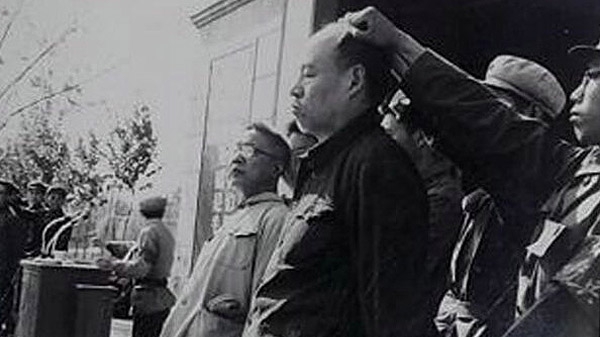
For more than two decades before the Cultural Revolution, Peng Zhen occupied a rare tier inside the CCP hierarchy: a vice–state-level power holder who combined political-legal authority, legislative control, and direct command over the capital.
Between 1949 and 1966, he served as Vice Chairman and Secretary-General of the National People’s Congress (NPC) Standing Committee, a Politburo member, Second Secretary of the CCP Secretariat, and Beijing’s top Party leader.
Only in 1979—after the Cultural Revolution—did Peng Zhen formally rise to a full state-level role, becoming Chairman of the Sixth NPC Standing Committee (1983–1988).
Peng Zhen’s political life reflected the deeper mechanics of CCP internal conflict. In Yan’an, he emerged as one of Mao Zedong’s most trusted operators in purge campaigns. After the CCP took power, he became both “king of Beijing” and the central figure driving China’s political-legal and NPC systems. But in 1966, on the eve of the Cultural Revolution, Mao dismantled him using a calibrated “soft kill” that erased his influence without a formal trial.
The question is not why Peng Zhen changed—he did not—but why Mao chose to discard the enforcer he had relied on for decades.
I. Forged in Yan’an: How Mao turned Peng Zhen into a campaign executor
Success
You are now signed up for our newsletter
Success
Check your email to complete sign up
During the Yan’an Rectification Campaign (1941–45), Mao needed cadres capable of conducting political investigations, interrogations, and organizational purges. Peng Zhen became one of the campaign’s most effective operators.
- 1941: Joined high-level rectification and cadre investigations.
- 1942–43: Took a leading role in the expanded “anti-spy” and “cadre screening” drives.
- After 1943: Helped carry out rectification inside the military, implicating numerous senior officers.
Peng Zhen excelled at translating Mao’s political instructions into concrete mechanisms of control—turning “line struggle” into personnel purges and reorganization. Mao valued him for being loyal, disciplined, and willing to act decisively.
II. After 1949: A power holder who helped Mao blur the boundary between law and political campaigns
Once the CCP established its regime, Peng Zhen advanced rapidly into the core of national leadership. His posts included deputy head of the political-legal apparatus, leader of the CCP’s central political-legal working group, and Beijing’s top Party and government official. Inside the NPC hierarchy, he served as both Vice Chairman and Secretary-General—positions that placed him at the center of legislative operations.
Peng Zhen became Mao’s strongest instrument for giving political movements a legal veneer.
1. ‘Suppressing counterrevolutionaries’: Legalizing a mass campaign
During the 1950–52 Suppression of Counterrevolutionaries, Peng Zhen helped craft regulations on handling “counterrevolutionary elements” and oversaw large-scale public trials and executions in Beijing. The campaign served two functions simultaneously: mobilizing mass participation and reinforcing Mao’s political agenda under the guise of “legal procedure.”
2. The anti-rightist movement: Turning the NPC into a struggle arena
During the 1957 Rectification–Anti-Rightist sequence, Peng Zhen transformed NPC meetings into political struggle sessions. From this legislative platform, he reported the Anti-Rightist campaign’s progress to Mao and supported the use of state institutions to target non-Party intellectuals.
Across these campaigns, Peng Zhen functioned as one of Mao’s most adaptable tools—capable of orchestrating mass movements or embedding them inside formal structures.
III. After the Great Famine: Peng Zhen found himself standing in the path of Mao’s pushback
In the early 1960s, the Party’s governance approach drifted toward the “Liu Shaoqi–Deng Xiaoping model,” which emphasized administration, economic readjustment, institutions, and legal procedures. As Beijing’s Party chief and a key figure in the political-legal system and NPC, Peng Zhen naturally worked within this stabilizing environment.
This shift placed him on the opposite side of the direction Mao intended to take. When Mao prepared to retaliate against the emerging governance trend, the first target had to be a vice–state–level figure who represented institutional order.
IV. The Wu Han affair and the February outline: Mao signals the strike
1. Yao Wenyuan’s attack on Hai Rui dismissed from office
On Nov. 10, 1965, Yao Wenyuan published his critique of Hai Rui Dismissed from Office under directives from Shanghai leaders operating with Mao’s approval. The article targeted Wu Han—Beijing’s deputy mayor and a close friend of Peng Zhen—but the political strike was aimed at the Beijing Municipal Committee itself.
Mao quickly redefined the issue: “This is not an academic question. It is a major class struggle.”
Peng Zhen, however, treated the matter as a normal Party dispute. He ordered internal discussions, attempted to limit escalation, and sought to resolve the issue as a scholarly debate—directly contradicting Mao’s intent to convert it into a political confrontation.
2. February 1966: The ‘February outline’
Under Peng Zhen’s leadership, the Central Cultural Revolution Five-Member Group drafted Several Opinions on the Current Academic Discussion (Draft), later known as the “February Outline.” Its principles emphasized:
- criticism of literature should not be escalated into political allegations,
- no accusations of “two-line struggle,”
- no expansion beyond academic debate,
- and no attacks on Beijing’s Party and government institutions.
In effect: debate is acceptable, but not a mass political movement.
Mao rejected the document outright. At a March Politburo meeting, he condemned it as politically wrong and accused the Five-Member Group of blocking the Cultural Revolution. The Outline became the main evidence used to bring down Peng Zhen.
V. Peng Zhen’s political collapse
1. The five-member group is abolished; The CCRG takes control
On April 1, 1966, Mao replaced the Five-Member Group with the new Central Cultural Revolution Group (CCRG), led by Chen Boda with Jiang Qing and Kang Sheng in core roles. The new body reported directly to Mao, removing the cultural and ideological domain from the Secretariat and weakening the Liu Shaoqi–Deng Xiaoping system. Peng Zhen lost one of his central power bases overnight.
2. Politburo sessions become accusation meetings
At expanded Politburo meetings in mid-April, Peng Zhen faced coordinated attacks. Lin Biao labeled him the head of a “Beijing clique,” Kang Sheng called Beijing an “independent kingdom,” and Jiang Qing accused him of shielding Wu Han and opposing Mao.
He was branded as:
- a “big Party warlord,”
- a “legalist authority,”
- and a “black gang leader” opposed to the coming movement.
3. Mao directs from Shaoshan; Peng Zhen is condemned
During the May 1966 Work Conference, Mao—writing from his hometown of Shaoshan—called for the overthrow of “capitalist-roaders in power.” Inside the leadership, it was clear who would fall first: the vice–state-level figure who embodied order in Beijing.
Peng Zhen’s political death was complete. His posts were removed, his reputation demolished, and his role in central decision-making ended.
VI. The ‘soft kill’: A political elimination without trial
Although Peng Zhen later endured detention and struggle sessions during the Cultural Revolution, the decisive elimination occurred in 1966. He lost all posts and platforms, was recast as a political villain, and had his contributions removed from official narratives.
Unlike other senior leaders who suffered violent persecution, Peng Zhen was subjected to a method of suppression that erased him from political life without public prosecution.
How Peng Zhen’s fall opened the path to the Cultural Revolution
1. Collapse of Beijing’s leadership
With Peng Zhen gone, the Beijing Municipal Committee crumbled. Universities, newspapers, and cultural institutions lost Party oversight. Rebel groups, enjoying protection from the newly formed CCRG, attacked municipal Party and government organs. The capital’s breakdown created an ideal stage for the movement to expand.
2. Paralysis of the political-legal system
The political-legal system—long under Peng Zhen’s control—quickly fell apart. Public security organs, courts, and procuratorates were overtaken by military representatives and rebel factions. Law was dismissed as a tool of “capitalist-roaders,” enabling arrests, home raids, public parading, and struggle sessions without constraint.
3. Crippling of the Secretariat and the Liu Shaoqi system
As Second Secretary of the Secretariat and Beijing’s top Party leader, Peng Zhen had been a key pillar of the Liu Shaoqi–Deng Xiaoping governance model. His removal weakened the Secretariat and deprived Liu and Deng of a central ally.
This allowed Mao, Lin Biao, and the CCRG to bypass normal procedures and directly intervene across departments—an essential step in isolating Liu Shaoqi and rebuilding Mao’s personal rule.
Peng Zhen stayed the same — Mao’s needs changed
From Yan’an to the early 1960s, Peng Zhen served as one of Mao’s most versatile instruments. He managed rectification, suppression campaigns, Anti-Rightist drives, and post-1949 political-legal and legislative operations. He understood how to run mass movements and how to maintain formal institutions.
His fall did not stem from ideological deviation. Mao needed a vice–state-level figure who symbolized order—someone whose removal would open the way for a national political movement.
Between 1941 and 1966, the “trusted comrade” Mao once elevated could not escape the fate of a dispensable tool inside the CCP’s system of political survival.