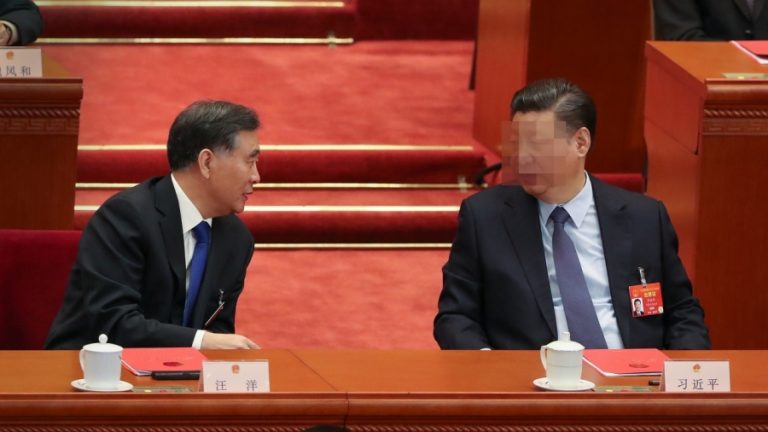
The 20th Central Committee’s Fourth Plenary Session of the Chinese Communist Party (CCP) has concluded, but whether Xi Jinping still holds power or has lost it remains a subject of debate. Recently, some leaks claimed that Xi had already been stripped of power at the Fourth Plenary Session, and the fact it was not publicly announced had a reason. The reports also stated that Wang Yang now controls the overall situation, Wang Huning has become Wang Yang’s “national advisor” again, and Hu Chunhua is in a crown prince–like position.
Communiqué conceals Xi’s loss of power; Wang Yang controls the situation
The Economist reported on the 26th that its team analyzed over 14,000 speeches, articles, and negotiations by Xi since 2013, finding that he appears increasingly confident and decisive, and a formidable figure at the negotiation table. Analysts concluded that Xi is at the peak of his power.
However, leaked sources suggest that, in reality, Xi is in a “Hua Guofeng mode.” Commentator Tang Jingyuan revealed on social media that he obtained insider information about the current CCP situation and the controversial Fourth Plenary Session.
Insiders reportedly stated that the official communiqué from this plenary session is a “colossal lie,” creating an entirely illusory parallel reality. They warned the public not to be deceived by the surface of the announcement. The CCP is skilled at deception and concealment, especially now, facing crises and approaching what some perceive as its final moments, and will use all means to hide the truth.
The sources confirmed a sensational claim: Xi was almost entirely stripped of actual power at this plenary session. According to the leaks, the current CCP leadership structure is as follows: “The military remains under Zhang Youxia’s actual control; Wen Jiabao oversees the overall situation; Wang Yang has effectively returned and presides over work comprehensively; Hu Chunhua is preparing for various responsibilities.”
Success
You are now signed up for our newsletter
Success
Check your email to complete sign up
The reports describe Hu Chunhua as relatively open-minded but still aligned with the party’s priorities. He is essentially following his faction’s line, representing the reform and opening path aligned with Deng Xiaoping’s legacy.
The insiders also mentioned Wang Huning, stating, “Wang Huning has undergone another transformation and has become Wang Yang’s national advisor again.” The overall personnel adjustments have already begun, with many core departments receiving recommendations for personnel changes. At a macro level, CCP diplomacy, economy, and military are undergoing adjustments, with the economic sector quietly preparing for a major transformation.
Propaganda praises Xi, actions undermine him
Tang Jingyuan further disclosed information from a more authoritative source: First, Xi has already been stripped of power at the Fourth Plenary Session and is now essentially in a “Hua Guofeng mode.” Second, the plenary session did not announce this because many tasks were unfinished; Xi left behind too many problems. No one wants to take responsibility, so Xi remains officially in charge. Third, a purge of Xi’s loyalists will continue.
Tang concludes that combining these two sources with his own observations, Xi’s power after the Fourth Plenary Session has been further hollowed out.
However, because many of Xi’s loyalists remain in key positions, he still retains some influence in certain areas. He still has the ability to cause disruptions if he chooses.
Whenever CCP power transitions occur, the central power structure changes how power operates. Over time, provincial and lower-level officials will increasingly learn that Xi has lost power. However, party elders, in order to protect the party, will continue to create the illusion that Xi holds full authority. Tang argues, “For the foreseeable future, the public will continue to see propaganda praising Xi, while in action, his loyalists are being systematically dismantled.”
Tang analyzed that the plenary session’s established power structure centers around a “decision-making and coordination body,” which has effectively replaced and sidelined the original Politburo Standing Committee. Past reports indicated that Wen Jiabao was head of this body, with Wang Yang as executive deputy, and these claims have now been confirmed through multiple channels.
“In other words, during this transition, Wang Yang has taken over party affairs; Zhang Youxia controls the military; Hu Chunhua is likely in a crown prince–like position.”
The regency era begins
Blogger Lao Deng revealed on social media that Hu Jintao’s health has improved considerably, and his activity has increased. He reportedly recently visited elder Song Ping.
Hu Jintao was removed from the closing session of the 2022 20th Congress after Xi’s signal, escorted out by Kong Shaoxun and another unidentified person, and has rarely appeared publicly since. Three years later, the tide seems to be shifting, and the CCP’s power center may have changed.
Veteran media figure Guo Jun stated on the Elite Forum program that after the Fourth Plenary Session, the reality of “Xi down, Hu Chunhua up” has become an open secret in Beijing’s political circles. This power structure resembles Hua Guofeng being sidelined—nominally still in charge, but without real power.
Guo Jun added, “The most obvious change after the Fourth Plenary Session is that the CCP no longer has a single core but multiple cores. The regency era has begun. A temporary central decision-making and coordination group has been formed, chaired by Hu Jintao, responsible for daily CCP decisions and personnel arrangements.”
“Although Xi retains public support, real power has transferred to the elder statesmen, including Hu Jintao, Wen Jiabao, Zhang Youxia, Zeng Qinghong, Wang Yang, and Liu Yuan, each representing different factions and interest groups,” Guo Jun said.
Li Jingyao