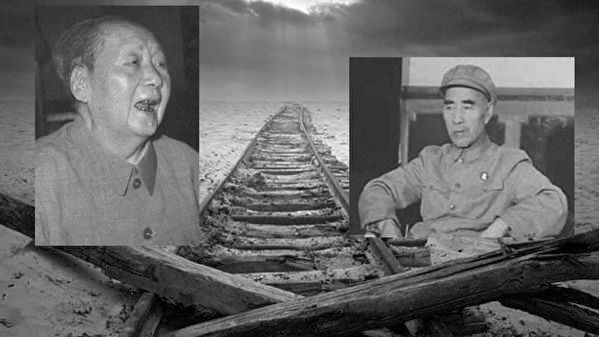
In public, Lin Biao appeared to embody absolute loyalty to Mao Zedong—he bowed, praised, and shouted “Long live Chairman Mao!” with near-religious fervor. To outside observers, he seemed like Mao’s most devoted follower.
As one of the top communist generals in the Chinese civil war, Lin Biao played a decisive role in Chairman Mao’s victory over the Chinese Nationalists, who in 1949 were forced to retreat to the island of Taiwan. In the early stages of the Cultural Revolution (1966–1976) Lin was Mao’s designated successor.
But in private—in hospital rooms, cars, or small spaces where only a guard or two stood by—Lin Biao revealed a starkly different face.
His criticisms of Mao were not slip-ups or isolated thoughts. They formed a consistent, structured view of Mao as a political leader and military strategist. For decades, these remarks circulated quietly within high-level PLA circles, treated as taboo because they punctured Mao’s myth of infallibility and exposed what Lin believed were the Chairman’s dangerous errors and fundamental lack of professionalism.
The following accounts, drawn from multiple oral-history sources, reflect what insiders say were Lin Biao’s true opinions.
Personality judgment: Ruthless, insidious, quick to turn
Success
You are now signed up for our newsletter
Success
Check your email to complete sign up
“The Chairman is insidious; you can’t read his heart.” Lin confided to Wu Faxian and others.
“He hides a knife behind his smile—you never know where the next strike will land.”
“He looks gentle from the outside, but inside he is ruthless,” Lin said.
Mao, he remarked, was: “Cotton on the outside, razor blades on the inside.”
After years beside Mao, Lin concluded: “The Chairman does not understand governance; what he understands is struggle.”
Reflecting on the Great Leap Forward and the Cultural Revolution, he said: “The Chairman has thrown the country into chaos. He thinks a nation can be run through slogans and campaigns.”
To his secretary, he once complained: “If the Chairman goes a day without stirring things up, he feels uneasy.”
Military critique: Mao misunderstands modern war
Lin reserved his most technical and fierce criticisms for Mao’s military thinking.
“The Chairman fights with the mindset of an old bandit. It does not apply to modern warfare.”
He told Li Wenpu: “The Chairman relies on luck, not science.”
“He does not understand modernization—he harms the military.”
Mao opposed a modern air force, resisted Soviet equipment, and dismissed technology. Lin, angry in private, said: “Modern war requires aircraft, artillery, radar. He still talks about willpower and political zeal.”
If Mao’s thinking continued to dominate the PLA, Lin warned: “When war comes, the one who suffers will not be the Chairman—it will be the country.”
“He is turning the PLA into a political troupe, not an army.”
He hated Mao’s effort to drag the Cultural Revolution into military units: “The army is for war, not for Red Guard theatrics.”
When Mao ordered troops to memorize quotations, shout slogans, and denounce officers, Lin said privately: “The Chairman is destroying the army.”
This remark later became forbidden inside the PLA.
On Mao’s autocracy: Institutions destroyed, the state torn apart
“The Chairman fears institutions. He fears anything that restrains him.”
Lin observed repeatedly: “One sentence from the Chairman can overturn all rules.”
He believed the collapse of institutions was the beginning of national disaster: “A country cannot be run on the Chairman’s words; it must rely on institutions. He does not believe in them.”
Among all his remarks, one judgment was considered the most sensitive:
“The Chairman has destroyed the roots of the nation.”
Lin was referring to:
- the Great Famine that killed millions,
- industrial decline,
- the collapse of education,
- the politicization and de-professionalization of the PLA.
He warned: “A country run this way will not end well.”
His final verdict was blunt: “The Chairman has ruined the military, ruined the country, ruined the world.”
A bodyguard recalled Lin whispering in a hospital room: “The Chairman wrecks the country and the army—and still believes he is saving them.”
The tone was bitter and resigned.
Regarding the Cultural Revolution, Lin’s private summary—remembered by his secretary—was: “The Chairman’s path will only push China back into chaos.”
The more Mao damaged the nation, the more Lin Biao feared him
Lin’s conclusion was straightforward: Mao had plunged the state into turmoil, and no one could stop him. Mao had weakened the military and viewed every successor with suspicion.
Lin once said: “What I fear is not war—I fear the Chairman.”
Those who heard it fell silent.
Lin’s private criticisms were rational assessments; his public praise was the language of survival. In private he saw Mao’s destructive impulses, his lack of military professionalism, and his use of the army as a political tool. Lin knew Mao would ruin China—and knew Mao would eventually turn on him.
So he criticized Mao, feared him, avoided him—and yet publicly bowed, flattered, and obeyed.
Lin’s tragedy was that even as one of the few who clearly understood Mao and held high rank, he remained trapped in the system of internal struggle. Like countless others within the CCP’s machinery, he ultimately met his end inside the very structure he served—driven into a dead end by the same “great leader” he privately condemned.