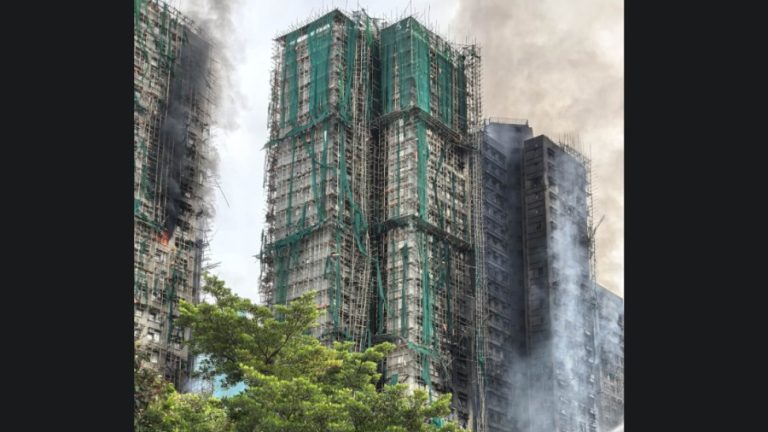
Beijing’s Office for Safeguarding National Security in Hong Kong issued a strongly worded statement on the night of Dec. 3 as public anger over the Hong Fuk Court fire continued to rise. The office said the law would reach “those who oppose China and disrupt Hong Kong, no matter how far they flee,” and warned that anyone crossing the “red line,” even if abroad or in Taiwan, would face consequences.
The unnamed spokesperson accused “a small number of external hostile forces” of taking advantage of the tragedy while presenting themselves as defenders of the public. The statement claimed these groups were trying to recreate the approach of the 2019 anti-extradition protests by supporting local contacts, disrupting relief work, and undermining post-disaster operations. Their actions, it said, were “malicious and despicable.”
Beijing points to ‘external forces’
The office then accused these outside actors of avoiding rescue efforts altogether and instead “spreading rumors from the shadows,distorting facts, and attacking both the government and frontline workers. Such behavior, it said, overshadowed the contributions of those responding to the disaster.
Reiterating its warning, the spokesperson said “those who disrupt Hong Kong will be punished, regardless of distance.” With the National Security Law and the Safeguarding National Security Ordinance now fully in effect, Hong Kong would “never again be left unprotected.” Anyone hoping to revive past resistance movements or “launch a color revolution,” the office added, was “delusional.”
According to the statement, national security laws had already “cast an unbreakable net.” Actions deemed harmful to Hong Kong would be documented and pursued indefinitely, and any “black hand” interfering in the city would be met with the “sword of the rule of law.”
Success
You are now signed up for our newsletter
Success
Check your email to complete sign up
A narrowing space for public criticism
After the Nov. 26 blaze, Hong Kong residents mobilized quickly—organizing supplies, offering assistance, and raising questions about deeper problems surrounding the fire. The mix of public grief and criticism drew quick reactions from both the Hong Kong government and Beijing. Senior officials, pro-Beijing commentators, and the national security office had all warned against attempts to “use disaster to destabilize Hong Kong,” signaling a tightening stance toward dissent.
On Dec. 2, the Association for Democracy and People’s Livelihood (ADPL) planned a press conference to share concerns about the handling of the tragedy. But shortly before it began, organizers notified the media that the event had to be canceled. They said “a certain department” had informed them it could not go ahead. Reports later suggested that party leaders, including chairman Liu Shing-lei, had been contacted by the Hong Kong Police’s National Security Department for a private meeting.
Local commentators voice their frustration
That same day, pro-government columnist Judy Fok wrote a piece titled “First Fix the Rot That Attracts the Flies.” She argued that Hong Kong had been mired in the wrong priorities for years—emphasizing political unity and ceremonial displays while neglecting governance, livelihood issues, and bureaucratic reform. With lawmakers and the media tightly restricted, oversight had faded almost entirely.
“A major disaster was only a matter of time,” she wrote. “What no one expected was that the cost would be hundreds of lives and thousands of families.”
Arrests tied to a petition campaign
Before the latest arrests, Hong Kong residents had launched a petition outlining four demands: support for victims, an independent investigation, a review of regulatory oversight, and accountability for officials.
But on Nov. 29, one of the petition organizers, Kwan Ching-fung, was detained by the National Security Department. The next day, police arrested former Tuen Mun district councillor Cheung Kam-hung and a volunteer surnamed Lee. Both Kwan and Cheung were granted bail on Dec. 1, prompting additional questions about how the authorities were responding to calls for transparency.