By Li Muzi, Vision Times
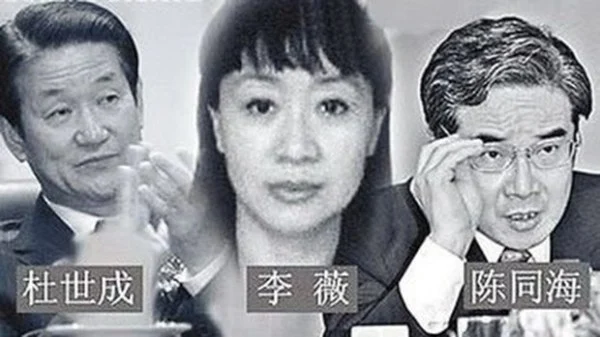
In June 2007, former Sinopec president Chen Tonghai was investigated for accepting bribes totaling 195.73 million yuan. As authorities dug into the case, a mysterious woman with extraordinary reach came into view: Li Wei, Chen’s mistress. What stunned investigators was not merely her influence over Chen, but the revelation that Chen had “generously” introduced Li Wei to another senior official: Du Shicheng, then Deputy Party Secretary of Shandong Province and Party Secretary of Qingdao.
While maintaining an intimate relationship with Chen Tonghai, Li Wei simultaneously became involved with Du Shicheng. And those two were far from her only connections.
Officials linked to Li Wei, some of whom later served sentences alongside Du at Qin Cheng Prison, included former Yunnan Governor Li Jiating, former Beijing Vice Mayor Liu Zhihua, former Supreme People’s Court Vice President Huang Songyou, former China Development Bank Vice President Wang Yi, and former Ministry of Public Security Assistant Minister Zheng Shaodong.
The making of a ‘public mistress’
Who was Li Wei —and how did she move so effortlessly among China’s political elite? According to investigations, Li Wei stood 165 centimeters tall (about 5’4″), favored long straight hair, and used bright colors and flowing fabrics to accentuate her figure. In a power structure still dominated by rigid gender hierarchies, clothing became her weapon — an alternative form of leverage.
Success
You are now signed up for our newsletter
Success
Check your email to complete sign up
RELATED: Yang LanLan Mystery Deepens Amid Court Absences, Alleged Ties to Xi Jinping
Investigations revealed she had established nearly 20 companies in Beijing, Qingdao, Shenzhen, Hong Kong, and overseas, spanning tobacco, real estate, advertising, oil, and securities, with assets approaching 100 billion yuan.
Li Wei was originally a Vietnamese resident. Fleeing war, she moved with her father to Honghe Prefecture in Yunnan at around age seven. Known for her looks, social agility, and early business acumen, she rose quickly and maintained an unusual habit that delighted disciplinary investigators: She kept detailed diaries, much like Chiang Kai-shek once did.
Those diaries allegedly recorded intimate interactions with more than a dozen officials at the provincial or ministerial level, many of whom later retired quietly or were reassigned, escaping public exposure. The diary became a permanent Damocles’ sword over their heads. Ironically, investigators did not initially uncover Li Wei through the diary.
They discovered her accidentally while tailing her from Shandong to Beijing, only to find that the man picking her up at the airport was none other than Chen Tonghai, a figure whose mere presence could make China’s energy sector tremble. Li Wei’s rise followed a pattern: Attach, expand, diversify.
Yunnan: Entering high office through Li Jiating
After obtaining legal residency status, Li Wei married a senior tobacco official in Yunnan’s Honghe Prefecture. In tobacco-dominated Yunnan, this marriage granted her swift access to elite political circles, including then-Governor Li Jiating.
Li Jiating was investigated in 2001 and later sentenced to death with reprieve for accepting more than 18.1 million yuan in bribes. Li Wei appeared before investigators alongside another mistress, Xu Fuying, but escaped serious punishment. She later summarized the lesson as: “You can’t place all your resources on one person. You need a vast network, like an umbrella.”
Guangdong and Hong Kong: Securing mobility
With help from Zheng Shaodong, then a senior security official, Li Wei secured household registration in Guangdong. This status enabled her to travel frequently between the mainland, Hong Kong, and Macau under special arrangements. She later obtained Hong Kong investment-immigrant status, registering companies such as Orient United Industries and Ho Yat International.
Qingdao: Villas, bribes, and real estate profits
After surviving the Li Jiating case, Li Wei moved to Qingdao’s prestigious Badaguan district, operating out of luxury villas. There, she hosted powerful guests, most notably Chen Tonghai and Du Shicheng, the latter of whom later admitted to taking bribes at these properties.
With Du’s assistance, Li acquired two heritage villas worth over 100 million yuan for just 7.5 million yuan. According to Du’s final court ruling, bribes totaling 6.26 million yuan were tied primarily to two women: one who laundered money for him, and Li Wei, who paid him directly.
In 2003, Li obtained development rights to 61,800 square meters of land at Taiping Cape, one of Qingdao’s most scenic locations. Instead of developing it, she flipped the rights to state-linked firms, earning 84 million yuan in profit.
Oil, securities, and judicial capture
With Chen Tonghai’s backing, Li Wei entered the oil sector. In 2004, her advertising firm obtained exclusive rights to Sinopec’s national gas-station advertising network. Meanwhile, she positioned herself in securities markets, building advance stakes in Sinopec-related stocks through hundreds of trading accounts, allegedly using insider information.
Her reach extended into the judiciary. In 2006, Li sought to purchase Zhongcheng Plaza, known as “Guangzhou’s No. 1 unfinished skyscraper.” Businessman Zhong Hua later recalled: “Li Wei wanted to buy Zhongcheng Plaza, offering a very high price, but only if we helped her launder 8 billion yuan.”
After Zhong refused, Li bypassed him through connections with Huang Songyou, former vice president of the Supreme People’s Court, ultimately acquiring the property under Sinopec’s name.
From mistresses shared among officials to billion-yuan laundering schemes, Li Wei’s story is less an anomaly than a microcosm. Often described as an “economy of mistresses,” Li Wei is one of the most vivid annotations to China’s recent political-economic history, revealing a grotesque tableau of power, money, and sex intertwined at the highest levels of the CCP.
Editorial note: Views expressed in this article are the opinions of the author and do not necessarily reflect the views of Vision Times.