By Li Jingyao
Following his absence from a Politburo collective study session last month, former Xinjiang Party secretary Ma Xingrui was again missing from the Politburo meeting held on Dec. 8, further fueling speculation about his political fate.
According to online disclosures, Ma’s case is said to involve an unusually wide network, with as many as 51 officials at ministerial rank allegedly implicated. Reports circulating online claim that Ma’s residences in Beijing and Guangzhou have been searched. The same disclosures have also put forward a list described as a “new Gang of Four.”
Some analysts suggest that if the term “new Gang of Four” is indeed circulating within the Chinese Communist Party (CCP) itself, it could indicate that the political “umbrella” shielding these figures has already collapsed.
Ma Xingrui absent from Politburo meeting
On Dec. 8, the CCP Politburo convened a meeting to analyze economic priorities for 2026 and to review the Regulations on the CCP’s Leadership of Comprehensive Law-Based Governance. The meeting was chaired by CCP leader Xi Jinping.
Success
You are now signed up for our newsletter
Success
Check your email to complete sign up
Anti-CCP blogger Jiang Wangzheng, who has recently released a series of high-profile claims on X, stated on Dec. 9: “There’s no need to argue anymore. Photos from December 8 are already out. Ma Xingrui was not there. Li Xi was not there either. What took place was a Politburo expanded meeting.”
Regardless of whether the session was a regular or expanded Politburo meeting, Ma’s absence has been widely viewed as abnormal. Observers note that senior CCP officials typically miss such meetings for only three reasons: health issues, official travel, or being under investigation. In the first two cases, officials usually reappear publicly soon afterward. In the third, they often disappear from public view entirely without explanation.
Reports claim Ma’s properties searched
Which category Ma falls into remains unclear.
Jiang Wangzheng claimed that investigations into Ma’s case have continued to deepen, involving enormous sums of money and a broad range of individuals. On Dec. 10, Jiang alleged that a villa in Hong Kong’s Pak Shek Kok, registered under Ma’s son-in-law’s name and valued at HKD 125 million, was searched by personnel dispatched by the Central Commission for Discipline Inspection (CCDI). According to the claim, investigators allegedly found HKD 452 million in cash, USD 17 million, and CAD 6.5 million stored in the basement.
Jiang further alleged details involving Ma’s former life secretary, Li Guanglu, including information about mortgages, bank balances, and cash holdings, most of which he described as within “normal range” except for irregularities in loan approvals.
Additional claims mentioned properties linked to Chen Weijun, described as a deputy ministerial-level official, with assets allegedly held under the names of mistresses.
Jiang also stated that Ma’s wife, Rong Li, had been taken in for questioning, and that several business figures connected to the case had been placed under residential surveillance pending trial.
Previously, Jiang claimed that the total amount involved in Ma’s case could reach RMB 300 billion, and alleged that Ma’s wife had longstanding business ties in Hong Kong with the wife of Li Xi, the current CCDI chief. He further claimed that Rong Li, Li Xi’s wife, and Peng Liyuan belonged to what he termed a “first ladies’ circle.”
According to these allegations, Ma and Chen Weijun were said to have bypassed Xinjiang’s finance department by channeling large sums of public funds to companies allegedly controlled by intermediaries, with money eventually flowing to a small circle that purportedly included relatives of Peng Liyuan and Li Xi, as well as figures such as Chen Quanguo and Wang Zhonglin. The claim described this system as effectively treating Xinjiang’s annual fiscal budget as a private cash pool.
Who makes up the new ‘Gang of Four?’
Jiang Wangzheng further claimed that the so-called “new Gang of Four” consists of Peng Liyuan, Yin Li, Yuan Jiajun, and Ma Xingrui, with Peng cast in a role comparable to Jiang Qing during the Cultural Revolution. He did not specify which historical counterparts the other three figures were said to resemble.
Political commentator Li Muyang, speaking on the program News Focus, noted that Yin Li, the current Beijing Party secretary, has risen rapidly in recent years and previously interacted frequently with Peng Liyuan during his tenure at the Ministry of Health. Li said Peng’s appointment as a UN goodwill ambassador for HIV/AIDS was widely believed to have been facilitated by Yin.
Yuan Jiajun, now Chongqing Party secretary, comes from the aerospace sector and once served as Ma Xingrui’s deputy. He overlapped with Xi Jinping during Xi’s time in Zhejiang and has been regarded as part of Xi’s political network. However, Li Muyang cited internal rumors suggesting Yuan also has ties to Peng Liyuan’s family.
Ma Xingrui, a former Xinjiang Party secretary, is said to be from the same hometown as Peng Liyuan in Yuncheng, Shandong Province, and reportedly addressed her as an elder sister. His wife Rong Li was described as a close friend of Peng.
Claims may reflect internal shifts
Among the four names mentioned, analysts widely agree that Peng Liyuan, as Xi Jinping’s wife, would wield the greatest influence. The other three figures are widely believed to have advanced their careers with her backing, becoming key pillars of Xi’s rule.
Jiang Wangzheng did not clarify whether the “new Gang of Four” label originated from within the CCP or was his own characterization.
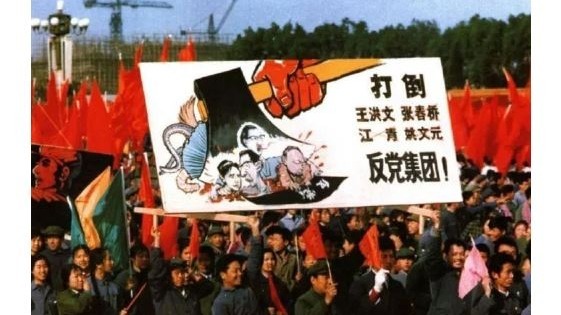
Li Muyang said that if the term is indeed circulating internally, it would reflect significant changes in Xi Jinping’s power structure. He drew parallels with the original Gang of Four, noting that although Jiang Qing and her allies wielded immense power during Mao Zedong’s final years, they were not officially labeled as the “Gang of Four” until after Mao’s death.
Only after Mao died in September 1976 did Hua Guofeng and other senior leaders move swiftly to arrest Jiang Qing, Zhang Chunqiao, Yao Wenyuan, and Wang Hongwen. The term “Gang of Four” was formally adopted by the CCP in 1977, after they had lost Mao’s protection.
‘The umbrella may be gone’
Li Muyang concluded that if Peng Liyuan, Yin Li, Yuan Jiajun, and Ma Xingrui are now being referred to internally as a “new Gang of Four,” it could mean that the political protection over their heads has already disappeared.
“The moment this label emerges,” he said, “it suggests that Xi Jinping’s grip on power has weakened.”
He added that it is difficult to imagine Xi voluntarily moving against his own inner circle. “If Xi is not directing this,” Li said, “then it means his rivals are. And if Xi’s rivals are driving events, then Peng Liyuan becoming exposed and Ma Xingrui falling from power would be entirely logical.”