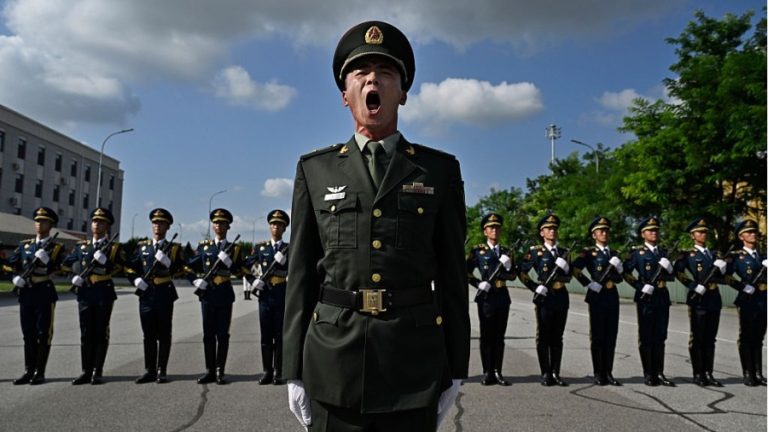
In recent years, large numbers of senior generals in the Chinese Communist Party (CCP) military have been purged. The National Defense University (NDU), which is directly responsible for cultivating senior officers, has also been drawn into power struggles—and in an even more concealed manner. The long-suppressed Liu Yazhou case may represent a hidden front in internal military struggles.
Frequent leadership changes at National Defense University spark anxiety
Information posted on the official website of the Chinese Embassy in North Korea shows that on the evening of Oct. 25, the embassy hosted a reception commemorating the 75th anniversary of the CCP military’s overseas operations. Attending the event was Lieutenant General Xia Zhihe, political commissar of the National Defense University, who was visiting North Korea. This indicates that Xia Zhihe has already replaced Zhong Shaojun as NDU political commissar.
Zhong Shaojun, a close military confidant of Xi Jinping, attended the Fourth Plenum. His quiet removal from office, without any new appointment, suggests he has been dealt with secretly. Zhong had only transferred from director of the Central Military Commission General Office to NDU political commissar in April last year—a move never publicly announced and only indirectly exposed overseas in August through a visit by Singaporean defense officials.
Before Zhong Shaojun, the NDU political commissar was General Zheng He.
Zheng He, born in November 1958 in Shanghai, graduated from Russia’s Frunze Military Academy with a master’s degree in military science. He served long-term in the former Nanjing Military Region, holding positions including brigade commander of the 31st Group Army, division commander of the 91st Division, army chief of staff, and deputy chief of staff of the Nanjing Military Region. After Xi Jinping took control of the military, Zheng successively served as director of the General Staff Training Department, deputy commander of the Chengdu Military Region, director of the CMC Training Management Department, president of the Academy of Military Sciences in January 2017, president of the National Defense University in June 2017, and political commissar of NDU in August 2021.
Success
You are now signed up for our newsletter
Success
Check your email to complete sign up
Zheng He came from the former 31st Group Army of the Nanjing Military Region, a key marker of the so-called “Xi family army,” represented by figures such as former CMC vice chairman He Weidong and CMC member Miao Hua. Many senior figures from the 31st Army have already fallen.
Both recent presidents of NDU—the former president and current head of the Equipment Development Department Xu Xueqiang, and current president Xiao Tianliang—were absent from the Fourth Plenum in October. Xu Xueqiang also missed the November 5 commissioning ceremony of the aircraft carrier Fujian in Sanya.
Rumors that both Xiao Tianliang and Xu Xueqiang had fallen emerged as early as August this year, but no official statements have been issued. Even now, it is unclear who currently serves as NDU president.
Counting from former NDU president General Wang Xibin (term 2007–2013), who was investigated for duty-related crimes in February 2017, subsequent NDU presidents who “ran into trouble” include Xu Xueqiang (August 2021–October 2022) and Xiao Tianliang (February 2023– ). Political commissars who “ran into trouble” include Liu Yazhou (December 2009–January 2017) and Zhong Shaojun (April 2024–October 2025).
According to insiders, morale at NDU is now extremely unsettled. Subordinates cannot make sense of the revolving-door leadership changes, and no one is eager to curry favor with whoever takes office.
The mysterious Liu Yazhou case
Among the troubled NDU leaders, the Liu Yazhou case has had the greatest impact—and remains the most mysterious in how authorities have handled it.
Born in 1952, Liu Yazhou is the son-in-law of former CCP state chairman Li Xiannian. Shielded by revolutionary-elite connections, Liu was promoted to Air Force major general in June 1996.
In 2002, Jiang Zemin selected Liu to attend the senior officers’ training program at the National Defense University, known within the military as the “Dragon Class.” Liu was one of three Air Force generals chosen.
In 2003, Liu was promoted to Air Force lieutenant general; in July 2012, to full general. However, in early 2017—before reaching age 65—he was forced into early retirement from his post as NDU political commissar and was not, as customary, assigned any position in the National People’s Congress or CPPCC afterward.
At the end of 2021, news emerged that Liu Yazhou was under investigation. In March 2023, Hong Kong’s Ming Pao reported that Liu was suspected of amassing enormous wealth through foundations and associations, constituting serious corruption. His wife, Li Xiaolin—daughter of former state chairman Li Xiannian—was reportedly “safe and unaffected.” (After the September 3 military parade in Beijing this year, Xi Jinping’s brother Xi Yuanping hosted a banquet for “red second generation” elites, which Li Xiaolin attended.)
In March 2024, reports claimed Liu had been sentenced to life imprisonment. In contrast to the high-profile handling of Fang Fenghui and the suicide of Zhang Yang, as well as the public purges of Xi loyalists such as He Weidong and Miao Hua in recent years, the “Liu Yazhou case” has seen no official announcement whatsoever.
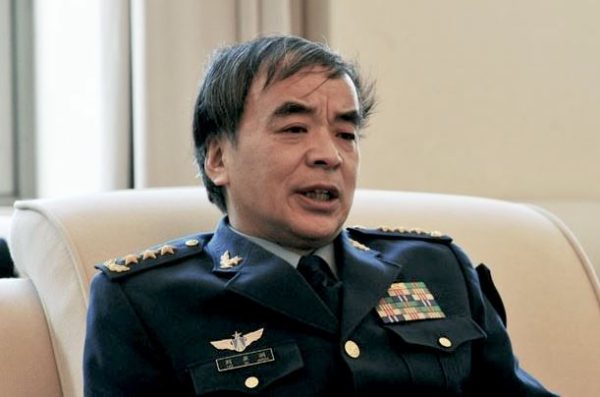
The controversial Liu Yazhou
The National Defense University was formed in January 1986 through the merger of the Military Academy, Logistics Academy, and Political Academy. It is tasked with training senior commanders for the Army, Navy, and Air Force and conducting research on strategy and defense modernization, and is known as the military’s highest institution.
Following Xi Jinping’s military reforms, NDU was reorganized in July 2017 using the former NDU, Nanjing Political College, Xi’an Political College, Art Academy, Logistics Academy, Shijiazhuang Army Command College, Armed Police Political College, and parts of the Equipment Academy.
Three military academies report directly to the Central Military Commission: National Defense University, Academy of Military Sciences, and National University of Defense Technology. Before Xi’s reforms, NDU and the Academy of Military Sciences were full military-region level, while NUDT was deputy level. After reform, all three were downgraded by half a level.
Notably, the reorganization and downgrading of NDU coincided with Liu Yazhou’s quiet retirement.
Among all NDU leaders, Liu served the longest—seven years as political commissar. As a key pipeline for mid- and high-level military talent, many current senior officers are NDU alumni, many of them Liu’s protégés. The current political commissar, Xia Zhihe, is also a former subordinate of Liu.
Liu’s flamboyant personality brought NDU into the spotlight during his tenure.
While at NDU, Liu delivered many internal speeches on military anti-corruption, strengthening the armed forces, reform, and political loyalty. Videos and transcripts circulated widely inside and outside the military. For example, in a Teachers’ Day speech on September 8, 2016, he spoke emotionally of young instructor Xu Ruyan, who died prematurely from overwork. China Military Online even released video footage showing Liu choking up in tears.
On July 6, 2016, at an NDU forum studying Xi Jinping’s July 1 speech, Liu said that former CMC vice chairman Xu Caihou uttered two sentences on his deathbed: first, “Guo Boxiong’s problems are far more serious than mine,” and second, “Among full regional-level commanders, only two never bribed me—Liu Yuan and Liu Yazhou.”
Notably, Liu used the word “bribe,” not “accept bribes,” and did not claim he himself was corruption-free. His remarks also indirectly confirmed that even current CMC vice chairman Zhang Youxia had given money to Xu Caihou.
For years, Liu was also embroiled in ideological controversy and became a frequent target of mainland leftist forces. When Liu fell, the leftist “Red Culture Network” published multiple signed articles in 2023 accusing him of promoting Western “universal values” such as humanity, human rights, democracy, and freedom, branding him an “ambitious conspirator.”
Liu did exhibit liberal tendencies. In a 2010 interview with Phoenix Weekly, he said: “Within ten years, a transition from authoritarian politics to democratic politics will inevitably occur.” He also said that any system unable to let citizens breathe freely, unleash creativity, or elevate true representatives of the people “is destined to perish.”
After Xi came to power, however, Liu shifted course and invested heavily in producing the anti-U.S. propaganda film Silent Contest as a political pledge.
Released in 2013, Silent Contest claimed the United States was infiltrating China on five fronts to overthrow its system. The film was praised by leftists and nationalists but mocked by many netizens as Cold War thinking. It portrayed the Southern Weekly New Year editorial incident as part of a U.S.-orchestrated “peaceful evolution” plot.
The film was banned domestically that same year for unclear reasons. After Liu’s downfall, even if authorities still see political utility in anti-U.S. narratives, they are unlikely to revive it.

Liu Yazhou’s writings branded ‘poisonous weeds’
Liu was imprisoned but not expelled from the Party or the military. This appears less like leniency toward elite families and more like Xi’s fear of military backlash, avoiding open handling. This has made the Liu Yazhou case one of the CCP’s most bizarre major cases.
The case may be special because Liu angered Xi Jinping during discussions on the use of force against Taiwan.
Exiled Australian scholar Yuan Hongbing claimed Liu believed Xi lacked the ability to command a Taiwan war, saying bluntly that “Xi Jinping lacks the qualities of a supreme commander.”
Liu gained fame early for writing military novels and often appeared as a strategist. He authored a nine-volume Collected Works of Liu Yazhou. His essay A Review of the Kinmen Campaign (also called The Battle of Kinmen), completed around 2001, analyzed the PLA’s failed 1949 assault on Kinmen, emphasizing the dangers of fighting unprepared wars. Even after edits, it circulated widely within the military for a decade before Xi took power, causing major shockwaves.
In the essay, Liu warned: “In a future Taiwan operation, we must prepare for a third force intervening suddenly.” He said this force would likely be Japan, primarily the United States.
Today, with Japan’s new prime minister Sanae Takaichi continuing Abe’s stance that “a Taiwan emergency is a Japan emergency,” Liu’s foresight appears partly validated.
Liu also wrote: “I can assert that once a Taiwan Strait war breaks out, the United States will definitely intervene.”
He predicted a U.S. “third option”: allowing China to land over 200,000 troops, then suddenly intervening to seize air and sea control, blockade the strait, and jointly annihilate PLA forces deprived of supplies—delivering a devastating political and psychological blow.
Liu did not oppose the use of force against Taiwan outright; but to Maoist hardliners, such analysis “boosted enemy morale.” Xi, determined on forceful reunification, may have taken offense.
In China’s Grand Strategy for the Next Twenty Years, Liu argued that resolving the Taiwan issue required winning hearts and minds, reforming the mainland political system, addressing Hong Kong governance, and integrating—not conquering—Taiwan. He proposed “one country, two systems of governance” and “separate but not apart.”
These ideas clearly conflicted with Xi’s approach, which is why Hong Kong has effectively become “one country, one system.”
Reports say the military issued a notice in late February 2023 ordering the removal of “harmful Liu Yazhou information” in March, including books, articles, inscriptions, and speeches. Searches in December on major Chinese bookstores yielded no results for his works.
Liu’s writings deeply influenced mid-level officers. One observer close to Beijing circles said Xi labeled A Review of the Kinmen Campaign a “poisonous weed,” accusing Liu of undermining military morale.
After Liu’s fall, open discussion of military strength became taboo. Military commentators once centered at NDU lost influence. Figures such as retired professor Gong Fangbin, Unrestricted Warfare co-author Qiao Liang, and retired general Dai Xu have all kept unusually low profiles. Gong Fangbin was punished last September for saying “Russia will lose” and “Ukraine will win,” and his Weibo account was shut down.
Gong Fangbin had been recruited to NDU by Liu Yazhou, who reportedly intended to groom him as his successor.
Liu Yazhou’s warning may prove prophetic
One valuable aspect of A Review of the Kinmen Campaign is its historical revelations, including the fate of captured PLA soldiers—many of whom were expelled from the Party and military, persecuted for decades, and ruined for life.
These facts reveal the CCP’s brutal and inhumane nature. Allowing soldiers to see them would be enough to destroy morale.
Today, Chinese veterans face severe rights-protection difficulties. The plight of veterans reflects that of active-duty soldiers; injustices at home are often impossible to remedy—this is systemic.
While the CCP military now postures aggressively in the East China Sea, Yellow Sea, and Taiwan Strait, Liu’s Kinmen analysis directly warned against “underestimating the enemy.” He wrote:
“Today’s Taiwanese forces are not Chiang Kai-shek’s troops of the past, nor is Taiwan Kinmen. The Taiwan Strait battle will be ten thousand times harder—not Taiwan defending Taiwan, but the entire West defending Taiwan.”
“Civilian ships are unreliable; public support cannot be relied upon.”
“History tells us: when the overall direction is wrong, even countless brave warriors can only die in vain.”
In recent years, many generals personally promoted by Xi have fallen, confirming that corruption remains rampant. Lower-ranking soldiers are angry, morale is unstable, and mutiny could erupt if war breaks out. Combined with economic decline and potential social unrest, Liu Yazhou’s warning may indeed come true.
As for Taiwan, though supported by the West, it must remember: “Heaven helps those who help themselves.” Liu Yazhou’s old essay still merits consideration from another angle.
(This article is exclusively authorized by Up Media for Vision Times. Unauthorized reproduction is prohibited. The views expressed are solely those of the author.)