By Li Zexu
As Taiwan moves to strengthen its defenses against growing pressure from Beijing, foreign media and security experts are increasingly warning that the Chinese Communist Party’s (CCP) threat to the island is no longer abstract, but increasingly concrete.
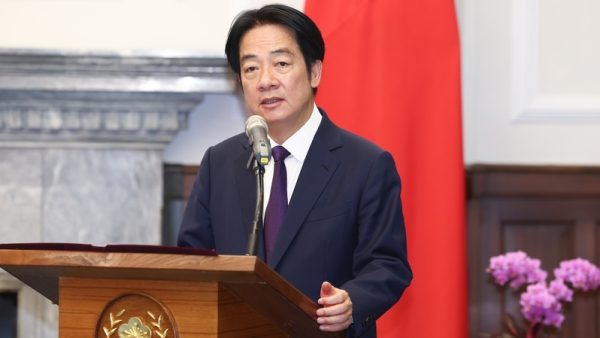
Late last month, Taiwan President Lai Ching-te, who took office in May 2024, announced a proposed NT$1.25 trillion (approximately US$39 billion) supplemental defense budget.
The plan aims to “effectively deter CCP threats” by 2027.
French public broadcaster franceinfo reported that warnings of a possible Chinese invasion of Taiwan by 2027 are not without basis. Alexandre Gandil, a researcher at Université Bordeaux Montaigne, said the U.S. Central Intelligence Agency (CIA) has previously assessed that CCP leader Xi Jinping may instruct the People’s Liberation Army (PLA) to be prepared for an attack on Taiwan before that year.
Success
You are now signed up for our newsletter
Success
Check your email to complete sign up
Gandil noted that 2027 is symbolically significant.
It marks both the 100th anniversary of the PLA’s founding and the convening of the Chinese Communist Party’s 21st National Congress, at which Xi is widely expected to seek an unprecedented fourth term.
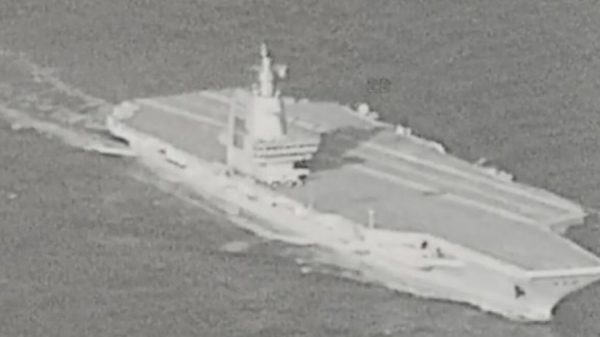
Rising military pressure around Taiwan
In recent years, Beijing has steadily increased military pressure on Taiwan, conducting ever more frequent air and naval exercises around the island.
At times, more than 50 Chinese military aircraft have entered Taiwan’s air defense identification zone within a single 24-hour period.
Reuters has also reported that the PLA has conducted amphibious landing exercises involving civilian vessels—moves widely interpreted as rehearsals for a potential cross-strait operation.
Gandil said that a decade ago, the prospect of a CCP invasion was still viewed by many in Taiwan as a distant concern.
Today, however, the threat has become increasingly tangible, even giving rise to a growing market for “emergency survival kits” in anticipation of a possible Chinese blockade.
Marc Julienne, director of the Asia Center at the French Institute of International Relations (IFRI), said the scale and frequency of the drills demonstrate that Xi’s government has the capability to encircle Taiwan or impose no-fly and no-sail zones.
Whether these actions are intended to prepare for an invasion or to deter Taiwan from declaring independence, Julienne added, “the two objectives are not mutually exclusive.”
Gandil further noted that Beijing has additional pathways to exert de facto control over Taiwan.
These include “united front” operations, aimed at identifying and cultivating individuals who are receptive to CCP narratives, supportive of unification, and capable of acting as intermediaries within Taiwanese society.
Asymmetric defense as Taiwan’s strategic core
According to Gandil, Taiwan’s strategic focus centers on asymmetric warfare, designed to deter a CCP attack while ensuring the island retains the capacity to resist.
This approach extends beyond the military realm.
Both government agencies and civil society groups, he said, are working to raise public awareness and train civilians to effectively respond in the event of an attack.
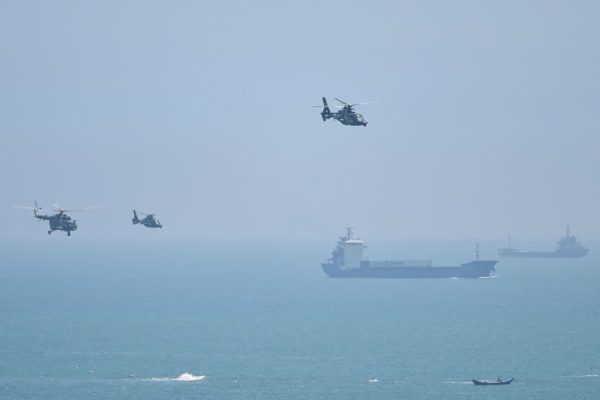
Taiwan security agencies brief lawmakers
On Dec. 17, Taiwan’s Legislative Yuan Foreign Affairs and National Defense Committee invited Tsai Ming-yen, director-general of the National Security Bureau (NSB), and Wellington Koo, Taiwan’s minister of national defense, to deliver a classified briefing.
The topic was “potential military flashpoints in the Taiwan Strait and surrounding areas, and the state of the armed forces’ readiness and response.”
The NSB submitted its written report to lawmakers on Dec. 15.
In the report, the bureau highlighted efforts by the United States and its allies to strengthen collective defense along the First Island Chain.
It noted that Canada, the United Kingdom, France, Germany, Australia, and New Zealand have signed defense cooperation agreements with Japan and the Philippines, expanding joint exercises and patrols to enhance deterrence.
The report also cited strengthened trilateral cooperation among the United States, Japan, and the Philippines, including the deployment of an anti-ship missile strike network along the First Island Chain.
Expanded missile deployments
According to the NSB, U.S. forces have used joint exercises with Japan and the Philippines to deploy Typhon intermediate-range missiles on a mobile basis to Yamaguchi Prefecture in Japan and Zambales Province in the Philippines.
The U.S. has also forward-deployed NMESIS anti-ship missile systems to Okinawa, Miyako Island, Ishigaki Island, and Batan Island in the Philippines.
Japan, the report said, plans to deploy island-defense hypersonic glide projectiles (HVGPs) in Kyushu and Hokkaido.
The Philippines, meanwhile, has deployed BrahMos anti-ship missiles in western Luzon and Palawan Province.
Collectively, these deployments significantly enhance allied capabilities to control key maritime zones along the First Island Chain.
The NSB also cited remarks by Adm. Samuel Paparo, commander of the U.S. Indo-Pacific Command, who said on December 7 that the First Island Chain is the primary focus of the United States’ denial-based defense strategy aimed at countering CCP expansion.
Growing international support
The NSB stressed that security in the Taiwan Strait is vital not only to the Indo-Pacific region, but to global stability and prosperity.
Democratic allies, it said, are strengthening economic and security deployments through diplomatic statements and joint actions to help build a First Island Chain defense framework capable of countering CCP military expansion.
The bureau said it will continue to closely monitor CCP military movements and regional security developments, while maintaining close strategic communication and intelligence sharing with international partners.
Earlier this month, the United States released an updated National Security Strategy, designating the Indo-Pacific as the world’s top strategic priority.
The strategy outlines three core objectives: keeping key sea lanes open, strengthening forward-deployed U.S. forces in the region, and encouraging allies to share defense burdens.
Since the beginning of this year, the United States, Japan, the United Kingdom, Germany, France, Australia, and Italy, as well as NATO, the European Union, and the G7, have repeatedly underscored the importance of peace and stability in the Taiwan Strait.
In response to CCP coercion, the EU and Germany stated in August and October respectively—each for the first time—that the United Nations Charter’s prohibition on the use of force applies to the Taiwan Strait.
US Senate passes ‘Porcupine Act’
Meanwhile, the U.S. Senate has unanimously passed the Providing Our Regional Companions Upgraded Protection in Nefarious Environments Act, commonly known as the PORCUPINE Act.
The legislation amends the Arms Export Control Act to grant Taiwan treatment equivalent to members of “NATO Plus,” which includes NATO allies as well as Japan, Australia, South Korea, Israel, and New Zealand.
The change shortens certification and notification timelines and accelerates approval processes for third-party transfers of military equipment to Taiwan by U.S. allies.
The bill also requires that, within 90 days of enactment, the U.S. secretary of state assess the feasibility of establishing expedited decision-making procedures for defense transfers to Taiwan from NATO members and designated partner countries.
The advocacy group Formosan Association for Public Affairs (FAPA) welcomed the vote, calling it a demonstration of the Senate’s unwavering support for Taiwan.
Lin Su-mei, president of FAPA, said the organization had worked closely since early this year with the office of Sen. Pete Ricketts, a Republican and the bill’s lead sponsor, to advance the legislation.
She said the Porcupine Act has been one of FAPA’s top legislative priorities.
FAPA urged the U.S. House of Representatives to act swiftly to ensure the bill completes the legislative process and becomes law.