By Li Muzi
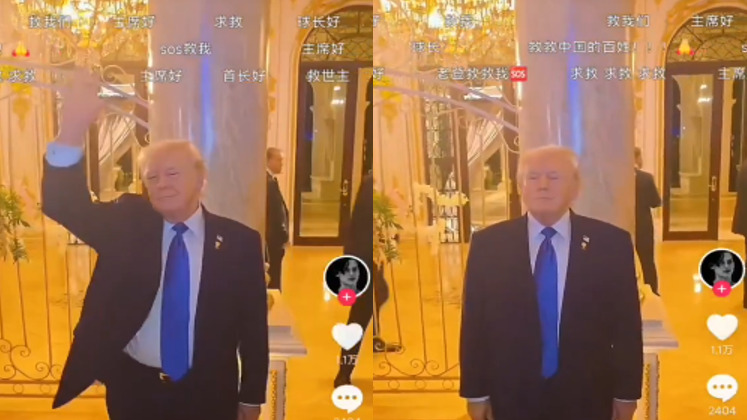
Chinese social media platforms have recently seen an unusual surge of desperate messages posted beneath videos featuring U.S. President Donald Trump. In several widely shared clips, on-screen comments scroll continuously, dominated by appeals for help.
Screenshots circulating online show a short video of Trump waving inside an ornate hall. Within moments, the comment section turned into a real-time stream of “bullet comments.” Messages appearing across the screen included “Save me,” “Hello, Chairman,” “Hello, Supreme Leader,” “Savior,” “Please save us,” “Save the Chinese people,” and repeated cries of “SOS.”
The wave of online appeals followed two major international events that drew intense attention among Chinese netizens: nationwide protests in Iran and the capture of Venezuelan President Nicolás Maduro by U.S. forces. Maduro has long been regarded as a close ally of the Chinese Communist Party (CCP).
Earlier, after news of Maduro’s arrest broke, Chinese users had widely circulated edited versions of the song Beijing Welcomes You to express their emotions. In recent days, similar sentiments resurfaced in the comment sections of Trump-related videos, drawing renewed attention.
Success
You are now signed up for our newsletter
Success
Check your email to complete sign up
Some users drew parallels to scenes from Iran, where citizens facing violent crackdowns had turned to the international community online in search of help. In these posts, Trump was frequently portrayed as an external force capable of intervening or applying pressure.

Mixed reactions among netizens
Not all responses echoed calls for outside help. Some commenters rejected the idea outright, arguing that change must come from within.
“If people want to be saved, they must first save themselves,” one user wrote. “If 70 percent of a country’s population is willing to act, it cannot remain under the control of evil forces forever.”
Another commenter pointed to Iran’s protests, writing that freedom comes at a cost. “Freedom is not free. It must be fought for,” the user said, calling for strikes and collective action.
Others framed the moment in broader terms, describing what they saw as the emergence of a new global wave of democratic movements.

Songs, cartoons, and political symbolism
After Maduro’s capture, numerous versions of Beijing Welcomes You were posted on social media, pairing the song with different images to express their hope that the United States might one day intervene on behalf of the Chinese people.
More recently, a cartoon themed around “Trump Shooting the Sun” circulated on mainland platforms. Some users claimed that earlier versions of similar cartoons had been deleted almost immediately by censors. In this case, users noted that the accompanying background music—again Beijing Welcomes You—appeared to heighten official sensitivity to the imagery.
In online discussions, some users openly interpreted the cartoon as a symbol of the collapse of CCP rule. Comments included statements such as “This is welcoming the U.S. military into Zhongnanhai,” as well as calls for senior CCP leaders to be arrested and tried in the United States for crimes against humanity. These remarks reflect individual opinions circulating online and cannot be independently verified.
Reports of weapon-making videos
Separately, some social media users reported a rise in videos on platforms such as Douyin that allegedly showed instructions for making improvised weapons. According to posts shared online, the trend gained momentum after Iran’s nationwide protests intensified.
Screenshots and descriptions claimed that some videos demonstrated homemade devices said to be capable of lethal force. Commenters wrote that, because legal access to weapons is tightly restricted, some people felt driven to produce them on their own. The authenticity, scale, and intent behind these videos could not be independently confirmed.

Overseas commentary on regime stability
Overseas anti-CCP commentator Weidao wrote on X that the CCP’s decline was accelerating. In his post, he argued that any regime forced to rely on censorship, intimidation, data manipulation, and violence to maintain control had already become a “walking corpse.”
He wrote that internal security spending was draining public finances, while local governments faced bankruptcy, wage cuts for civil servants, unpaid salaries for teachers, hospitals struggling to meet performance targets, and stalled construction projects. According to his commentary, widespread pessimism among young people—reflected in declining marriage and birth rates—pointed to a deep loss of confidence in the future.
Weidao wrote that a regime’s true collapse does not begin with an official announcement, but when people stop believing in it.

Hopes and expectations inside China
A mainland legal professional, identified only by the pseudonym Yang Ming, told overseas media that developments in countries closely aligned with Beijing were being closely watched inside China.
He pointed to recent upheavals in parts of South and Southeast Asia, as well as unrest in Iran, describing them as signals that longtime CCP allies were facing growing instability.
“Many people inside China, including colleagues around me, are waiting with hope,” Yang said. “They are hoping to see the CCP face its reckoning in 2026.”
Yang added that security measures during recent New Year’s celebrations were unusually tight in many cities, which he believes reflects growing official anxiety over public sentiment.