By Zeng Jieming
Countless facts—many of them still unfolding today—have long made one reality clear: the nationwide one-child policy imposed in 1981, approved by Deng Xiaoping and Chen Yun and designed by Song Jian, was a catastrophic decision whose consequences continue to compound. More than three decades of coercive population control not only shattered a reproductive culture that had sustained China for thousands of years, but also produced today’s severely distorted demographic structure and a collapse in birth rates unlike anything in the country’s history.
The breakdown of China’s population structure and the continuing plunge in fertility lie at the heart of its current economic strain and growing social instability. For the first time in more than two millennia, China is experiencing a prolonged population collapse during a period of peace.
In its long-term impact, coercive birth control has proven more destructive than war. Wars, brutal as they are, do not erase a society’s capacity to reproduce. Once fighting ends, birth rates often rebound and societies slowly recover. The CCP’s population policy did the opposite. Through state coercion and ideological pressure, it dismantled the moral legitimacy of having children and hollowed out the cultural foundations of family life.
That is why, even after the policy was formally abandoned, China’s birth rate has continued to fall—and at an accelerating pace. Without extraordinary corrective measures, the trajectory points toward demographic self-destruction. Among the Han Chinese in particular, that process is already well underway.

Consequences of forced birth control
Success
You are now signed up for our newsletter
Success
Check your email to complete sign up
It is no exaggeration to say that the damage inflicted by more than thirty years of forced birth control exceeds the combined harm of Mao Zedong’s political campaigns. Mao-era repression, for all its savagery, came in waves and ended with his death. Demographic collapse, once set in motion, spans generations and is close to irreversible.
What makes this tragedy all the more disturbing is that it did not arise from serious demographic, sociological, or economic analysis. It emerged from the decision-making logic of an authoritarian system.
Deng Xiaoping and Chen Yun, neither trained in population studies or social science, approved the policy with little more than instinct. Implementation was then entrusted to Song Jian, a rocket scientist with no background in the humanities or social sciences, yet convinced that he possessed scientific truth.
In any normal society, such an arrangement would be unthinkable.
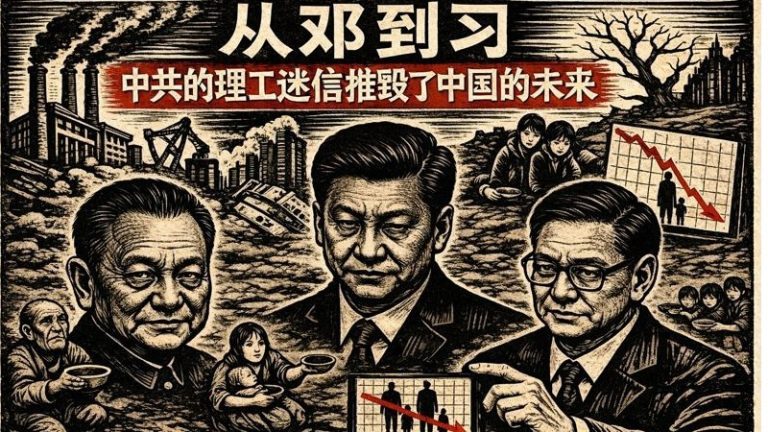
Song Jian’s career lay in aerospace engineering. In the late 1970s, during a visit to West Germany, he encountered Norbert Wiener’s book Cybernetics and treated it as a revelation. Returning to China, he hastily adapted its ideas into what he called “population cybernetics” and presented the concept to Deng and Chen, who were newly restored to power and deeply convinced that China’s poverty stemmed from having “too many people.”
The theory functioned as both a political offering and a career ladder.

An obsession with control
Yet cybernetics was never a settled conclusion within social science. Like Marxism, it represented one line of thought rather than consensus. Even in Western academia, its applicability to human societies remained heavily disputed. Critics warned that reducing societies to mechanical systems ignored human rights, ethics, freedom, and the inherent unpredictability of social life. Governance driven by an obsession with “control” almost inevitably veers toward authoritarianism.
Despite this, Song Jian elevated an untested and controversial theory into doctrine and imposed it wholesale on population policy. People became numbers. Families became variables. The future of a nation became an experiment.
The brutal reality of forced birth control once again exposed the moral fault line at the core of Communist governance. Within its rigid materialist worldview, human beings are not ends in themselves, but instruments. Citizens are treated as resources. Life, dignity, and rights are expendable costs in the pursuit of abstract national goals.
This absence of moral restraint made coercive population control not only possible, but sustainable for decades. Song Jian’s rise was not an accident. It was the predictable outcome of the CCP’s long-standing reverence for engineering logic and numerical control.
Marxist ideology itself elevates “science” while rejecting moral or spiritual limits, predisposing Communist regimes to trust technology, data, and technical elites above all else. From Stalin and Mao to Kim Il-sung and East Germany’s Erich Honecker, this pattern has repeated across Communist states.

Mao Zedong glorified math while dismissing classical texts
Mao Zedong openly insisted that his son study science and engineering, declaring technical fields to be “real knowledge” and suggesting that political power could always come later. Under this mindset, the CCP systematically marginalized the humanities, promoted slogans glorifying math and science, and denigrated humanistic inquiry. Mao dismissed classical texts as confusing and warned that Western humanities made readers politically dangerous.
The consequences were stark. During the Cultural Revolution, writers, artists, and scholars in the humanities suffered persecution far more severe than that faced by scientists and engineers.
After the 1989 Tiananmen massacre, hostility toward the humanities became formal policy. Senior officials labeled liberal arts students as politically suspect, particularly those studying journalism, law, and foreign languages. Journalism programs were suspended nationwide in 1990, creating a lasting rupture in China’s media education.
At the same time, an unwritten but rigid personnel rule took hold: leadership positions would preferentially go to politically “reliable” individuals with technical backgrounds. This environment facilitated the rise of technocratic leaders such as Jiang Zemin, Hu Jintao, Wen Jiabao, Zhu Rongji, and Luo Gan in the post-1989 era.
The Party’s aversion to the humanities is no coincidence. Humanistic thinking—concerned with freedom, dignity, moral responsibility, and the value of life—cuts directly against authoritarian control. Those trained in the humanities are more likely to question power. Technical specialists, shaped by instrumental reasoning, are more easily absorbed into systems of command.
In the CCP’s calculus, engineers are dependable; humanists are dangerous.
A contempt for liberal arts
Ironically, under Xi Jinping, whose own educational background is often mocked, governance has deteriorated even further, reinforcing rather than dispelling technocratic myths. This mindset has damaged not only the ruling system, but also segments of the opposition, including overseas dissident circles that continue to echo contempt for liberal arts education.
Song Jian’s arrogance—and the demographic catastrophe it helped unleash—offers a stark warning. Allowing technocrats devoid of humanistic training to dictate major social policies is profoundly dangerous. Society is not a machine. It is a living system made up of people capable of judgment, conscience, and moral choice.
The tragedy of China’s population policy was not an isolated failure. It was the inevitable result of technocratic obsession, contempt for the humanities, authoritarian decision-making, and hostility toward human rights. Unless these underlying values are confronted, similar disasters will recur.
Today, the consequences are no longer abstract statistics. They are visible in collapsing local finances, strained pension systems, and deep structural unemployment among young people. China has entered old age before achieving prosperity, losing the capacity to reproduce its population before accumulating sufficient wealth.
This outcome was neither fate nor natural disaster. It was a man-made calamity with identifiable causes and responsibility.
When the demographic avalanche fully descends, no technical adjustment will be sufficient. What demands reckoning is not one policy, but a worldview that treats people as tools and society as machinery.