By Chen Jing
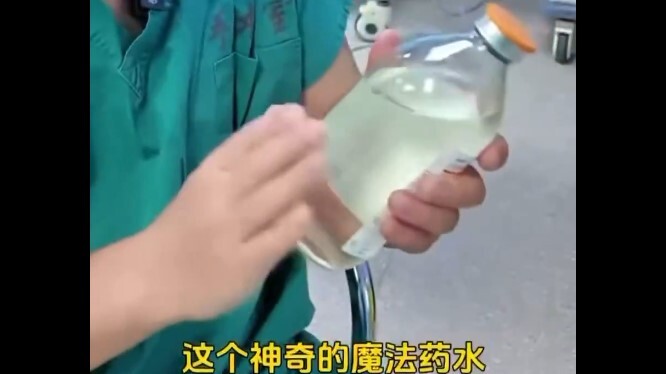
Recently, a science-education video released by Jin Yongqiang, Associate Chief Physician of Pediatric Cardiology at the Heart Center of the First Affiliated Hospital of Tsinghua University, ignited a firestorm online. Wearing a white lab coat and smiling calmly into the camera, Dr. Jin demonstrated a drug known as “cardiac arrest solution.”
“We’re holding a magical potion in our hands—one that can make a person’s heart stop.”
Under ordinary circumstances, this would have been a routine explanation of a surgical technique used in open-heart procedures. But in today’s China—where cases of missing teenagers and unexplained deaths have become disturbingly frequent—the public heard something else entirely. What was meant as medical popularization was interpreted as carrying a chilling subtext.
To many netizens, this was not a life-saving breakthrough, but yet another example of what they bitterly call China’s “world-leading technology for harming people.”
The cold logic behind the ‘magic potion’
Success
You are now signed up for our newsletter
Success
Check your email to complete sign up
In the video, Dr. Jin speaks casually, almost cheerfully, about the solution’s “miraculous” properties. He explains its mechanism with clinical precision: it is a high-concentration potassium-ion solution, administered under low-temperature conditions, often with ice.
“High potassium combined with low temperature causes the heart to stop very quickly,” he says.
In practice, once cardiopulmonary bypass is established, surgeons clamp the root of the aorta and pump the ice-cold solution into the coronary arteries. The heart then rapidly ceases beating and enters what doctors call a state of “hibernation.”
In surgical textbooks, this is standard technique. In the public imagination, under current social conditions, it sounds far more sinister.

The Xincai case and a death shrouded in doubt
Many Chinese readers immediately connected the video to a tragic incident that occurred on Jan. 9 in Xincai County, Henan Province. A male student died on campus under unclear circumstances.
What followed only deepened suspicion. Before the child’s guardians arrived, school officials attempted to transport the body away, triggering a confrontation at the scene. The child’s uncle intervened, physically blocking the vehicle, allowing the family to see the body one final time.
Soon after, a public notice was issued—not by the police, but by the local Education Bureau—declaring that “criminal activity has been ruled out.” In China, such wording often signals the end of official inquiry.
Yet visible injuries on the child’s body told a different story.
Family members who arrived at the scene described a condition that bore little resemblance to a natural death:
- Facial injuries: visible bloodstains at the corners of the mouth
- A suspicious wound: most shocking of all, a hole in the chest roughly the size of a nail
How did this wound occur? Was it caused by a sharp instrument, an accidental puncture, or something else entirely? No explanation was provided. The family demanded answers. What they received instead was a bureaucratic conclusion: case closed.

What ‘criminal activity ruled out’ conceals
Dr. Jin’s video, however unintentionally, appeared to supply what many felt was the missing technical explanation.
He emphasized several key features of the cardiac arrest solution:
- Non-destructive: the solution contains nutrients that protect heart cells during arrest, preventing irreversible damage
- Reversible: once surgery is complete, releasing the aortic clamp allows normal blood flow to flush out the solution, and the heart can resume beating on its own
- Indispensable: without it, forcibly stopping the heart risks permanent failure
To ordinary viewers, this sounds reassuring. To those who have followed allegations of illegal organ harvesting, it sounded like something else entirely: a technical manual for keeping organs “fresh” while the donor is not fully dead.
The implication, critics argue, is devastating. With this technology, a heart can be stopped while the person is still biologically alive, preserved in optimal condition, removed, and immediately transplanted.
‘Now we finally understand how the Xincai boy died’
The video spread like wildfire. To many observers, it functioned as a key unlocking long-standing doubts surrounding the death of the 13-year-old boy in Xincai.
If such a solution were injected, they reasoned, the child may not have been truly dead—only placed into artificial cardiac arrest.
One of the most troubling unanswered questions had been the needle-like puncture in the chest. Official explanations were vague and evasive.
After the video, netizens began connecting the dots:
- “Why was there a hole in the chest? Because the solution can be injected directly into the heart or aorta.”
- “Why use this drug? Because it ensures the harvested heart is still ‘alive’—high-quality and usable.”
The existence of such technology blurs, at the operational level, the line between brain death and cardiac death—a distinction that underpins modern medical ethics.
With a single injection, critics argue, a living person can be made to appear dead while their organs remain perfectly preserved, awaiting removal and sale.
In this case, some believe, the process was interrupted—but the child was still killed.

Devils in human skin: medicine or murder?
In the video, Dr. Jin repeatedly refers to the solution as a “magical potion,” his tone marked by confidence and pride in technological mastery. Yet behind that confidence, critics see a vast ethical abyss.
In a country where organ donor systems lack transparency and teenagers frequently vanish without explanation, the more “advanced” such technology becomes, the greater the threat it poses to ordinary citizens.
What is the true cost of a “perfect heart transplant”?
One life is celebrated as saved, while another is quietly and precisely extinguished.
They no longer need to wait for natural death. With a “magic potion,” death can be manufactured on demand—cleanly, efficiently, without damaging the “parts.”
This is not medical progress, critics say. It is the refinement of a killing assembly line.
When technology becomes a weapon
Doctors are meant to heal. But within vast profit chains and a system lacking meaningful oversight, some medical professionals appear to have grown numb. They speak openly about stopping hearts and harvesting pristine organs, while remaining silent—or even proud—about the possibility of live organ extraction.
If this so-called world-leading technology is not used to benefit humanity, but instead serves to extend the lives of the powerful and conceal acts of killing, then it is not progress at all. It is demonic technology.
As one enraged netizen put it: “This is not something humans do. This is the work of demons. These people wear human skin, hold ‘magic potions,’ and commit demonic acts in operating rooms.”
When technology becomes an accomplice to murder, this bottle of solution becomes a death sentence—one already paid for by countless silenced lives.