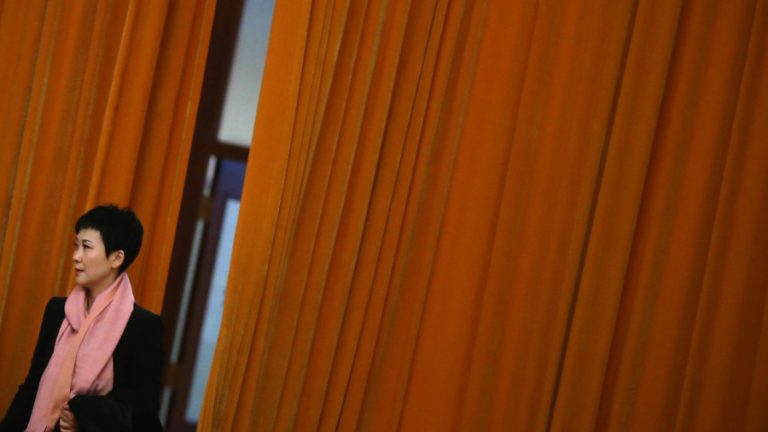
Li Xiaolin is the daughter of Li Peng, the former premier of the People’s Republic of China. Li Peng was long known within the Communist Party as “the helmsman of China’s electric power empire,” a man who controlled one of the country’s most critical strategic sectors.
In China, electricity is a state monopoly. It is not a normal business governed by market competition, but a political resource tightly controlled by the ruling party. To stand at the top of this system requires not merely capital or expertise, but extraordinary political lineage.
Li Xiaolin served for many years as chairwoman of China Power International Development Limited, a major state-linked power company. Whenever she appeared in public, she stood out sharply—dressed in Europe’s most expensive luxury brands such as Chanel and Emilio Pucci—amid gatherings of officials who otherwise cultivated an image of austerity and plainness.
She once declared publicly: “My success comes entirely from my own efforts and has nothing to do with my family background.”
That statement later became a popular joke among the Chinese public.
What did the Panama Papers reveal?
Success
You are now signed up for our newsletter
Success
Check your email to complete sign up
The Panama Papers—a massive leak of offshore financial records—revealed that Li Xiaolin and her husband, Liu Zhiyuan, operated overseas with professional sophistication.
They systematically concealed their identities by using foreign names.
To avoid scrutiny, Li Xiaolin did not register offshore companies under “Li Xiaolin.” Instead, she used the name listed on her Hong Kong passport: “Xiaolin Liu-Li.” The tactic resembled creating an alternate identity—ensuring that auditors and investigators would not immediately connect the offshore entities to the daughter of a former Chinese premier.
A ‘Russian Doll’ method of hiding money
Li Xiaolin did not hold assets directly. Instead, she nested ownership through multiple layers of shell entities.
At the outermost level was a foundation registered in Liechtenstein, a small European country known for extreme financial secrecy. This foundation owned a company called Cofic Investments, incorporated in the British Virgin Islands (BVI). Cofic Investments was the entity that actually held assets.
In practical terms, investigating her wealth required peeling back layers one by one: first locating the BVI company, then discovering that its owner was a Liechtenstein shell. Only after opening that final “box” would Li Xiaolin herself appear.
Where did the money come from?
The leaked documents also revealed how Cofic Investments generated its income.
According to Li Xiaolin’s lawyers, the company earned “intermediary” or “consulting” fees—specifically for helping European manufacturers sell heavy industrial equipment to China.
In practice, this meant that if a foreign company wanted to sell generators or other major equipment to Chinese power plants, the transaction had to pass through Li Xiaolin’s company in order to succeed. This functioned as a disguised toll booth.
Because her family controlled China’s power sector, decisions about who was allowed to sell and who was excluded were effectively made by those connected to the political elite.
This is known as the “agent game.” Foreign luxury brands, multinational corporations, and major banks seeking access to China’s market needed a political “guide.” The relatives of senior Communist Party leaders were ideal intermediaries. Simply by collecting “consulting fees,” they could accumulate wealth beyond what multiple lifetimes could exhaust.
Swiss bank ‘secret accounts’
Even before the Panama Papers, earlier investigations had revealed that Li Xiaolin held five accounts at HSBC in Switzerland, containing approximately US$2.48 million (about NT$75 million).
The revelation caused a major public outcry. Under Chinese regulations, senior officials and executives of state-owned enterprises are prohibited from holding large sums of money overseas without authorization. The disclosed US$2.48 million was widely believed to be merely a fraction—“pocket money”—of her offshore wealth.
Born at the finish line
Li Xiaolin’s story illustrates a broader reality of China’s so-called “red aristocracy”—the children of revolutionary leaders and top Communist officials. Their wealth does not come from superior business acumen, but from being born at the finish line, with access to monopolies, approvals, and political protection unavailable to ordinary citizens.
After her overseas dealings were exposed, Li Xiaolin’s position became increasingly untenable. In 2018, before the age of sixty, she retired early and exited China’s power system. She later shifted into environmental and health-related industries.
Unlike some officials, she was never imprisoned. But the era in which she reigned as China’s untouchable “Queen of Electricity”—a figure whose influence once spanned the entire power sector—came to a quiet end as these overseas financial records came to light.
Corruption within the Chinese Communist Party is widespread. But what most angered the public was not merely the scale of the wealth—it was the hypocrisy.
Li Xiaolin had once stood at a national conference and proposed that “every citizen should be given a moral record.” Only later did people realize that those who lectured the nation about morality and gratitude were often the same ones most actively transferring the country’s wealth abroad.