By Xiao Ran, Vision Times
Just days before UK Prime Minister Keir Starmer is set to visit China, the British government on Jan. 20 formally approved one of the most controversial diplomatic projects in Europe: a plan that would allow the Chinese Communist Party (CCP) to build its largest embassy complex on the continent at London’s historic Royal Mint Court site.
The decision immediately triggered a strong backlash from British residents concerned about Beijing’s growing influence in the region. Prominent Chinese democracy activist Sheng Xue, speaking in an interview with Vision Times, warned that the approval carries profound risks and reflects what she described as a “dangerous turn” in Western policy toward Beijing.
RELATED: Zhou Manzhi Convicted of CCP-Linked Infiltration in Taiwan, Faces 8-Year Sentence
Political concessions
Sheng Xue said the timing of the approval, which comes just ahead of Starmer’s China trip, is no coincidence. “Against the backdrop of cross-party opposition in the UK, warnings from security agencies, and sustained protests by human rights groups, the government’s insistence on pushing this approval through amounts to a unilateral gesture of goodwill and political concession to Beijing ahead of the prime minister’s visit,” she told Vision Times.
Success
You are now signed up for our newsletter
Success
Check your email to complete sign up
She also stressed that public concern over the project is well-founded. The proposed mega-embassy, she argued, should not be viewed as a conventional diplomatic mission, but rather as a potential “forward operating base” for political influence and intelligence activity.
“MI5 has repeatedly warned that the CCP is systematically interfering in British politics, academia, business circles, and the Chinese diaspora,” Sheng said. “Chinese diplomatic missions have long been proven to be deeply involved in intelligence gathering, United Front work, and influence operations. Allowing the CCP to build the largest embassy complex in Europe in the heart of London would objectively magnify those capabilities and risks.”
A national security threat
Sheng warned that the decision could have far-reaching consequences. “This is not an ordinary urban planning or diplomatic arrangement. It is a major political choice involving Britain’s national security, human rights values, and institutional clarity,” she said, adding, “If democratic countries knowingly allow a regime that continues to commit grave human rights abuses and engage in transnational repression to expand its operational space, what erodes is not only moral principle, but national security itself.”
She also pointed to the work of the China Tribunal, which previously held independent hearings in the UK on allegations of forced organ harvesting by the CCP and concluded that such acts constitute crimes against humanity.
“The British government is not unaware of this,” Sheng said. “Yet under these circumstances, permitting a dramatic expansion of the CCP’s diplomatic presence in the UK creates a profound moral contradiction. It will also impose real psychological intimidation and security pressure on Hong Kong democrats, Uyghurs, Falun Gong practitioners, and other dissidents living in Britain.”
According to Sheng, such a move weakens the UK’s commitment to protecting persecuted communities and undermines its long-standing claim to champion human rights and the rule of law.
A broader shift
Sheng cautioned that Britain is not an isolated case, but part of a wider and troubling trend among some Western governments. She noted that Canadian Prime Minister Mark Carney recently visited China, reaching a series of cooperation agreements and publicly stating his intention to work with Beijing to help shape a so-called “new global order.” French President Emmanuel Macron has likewise signaled a desire for closer cooperation with China, openly welcoming increased Chinese investment in Europe at the Davos forum and stating, “We need more direct Chinese investment in Europe.”
“This renewed embrace of economic dependence on the CCP will not bring genuine recovery,” Sheng warned. “It will instead weaken Europe’s independence and resilience across political, security, industrial, and values-based dimensions. History has repeatedly shown that dependence on the CCP is never a neutral economic choice; it is a strategic act of self-disarmament.”
She compared this with the approach advocated by Donald Trump, emphasizing sovereignty, security, supply-chain restructuring, and reducing reliance on China. “This contrast is deeply unsettling,” Sheng said, adding, “It risks pushing the free world back onto a path that has already proven to be extraordinarily dangerous.”
‘Tilting toward Beijing’
Veteran political commentator Zhang Tianliang echoed these concerns, arguing that amid rising geopolitical tensions, including disputes sparked by Trump’s push on Greenland, countries such as the UK and France are showing signs of “tilting toward Beijing.”
He suggested Britain’s approval of the embassy appears aimed at appeasing the CCP at the expense of U.S. interests. Macron’s public invitation for more Chinese investment, he said, effectively aligns Europe with Beijing against Washington. Canada, meanwhile, has opened its automotive market to China, while the European Union, despite threatening tariffs, has handed critical leverage in its energy transition to Beijing.
“These actions stem from economic dependence and strategic weakness,” Zhang said, calling the trend a form of “dangerous strategic self-disarmament.”
A longstanding controversy
UK Housing Secretary Steve Reed announced the approval on Jan. 20, 2026, attaching conditions related to enhanced security measures and heritage preservation. According to “Radio France Internationale,” the decision came on the eve of Starmer’s trip. This will be the first visit to China by a British leader since 2018.
Beijing purchased the Royal Mint Court site in 2018 for £255 million, planning to build a 55,000-square-meter embassy complex that would surpass the U.S. embassy in London and become China’s largest diplomatic facility in Europe.
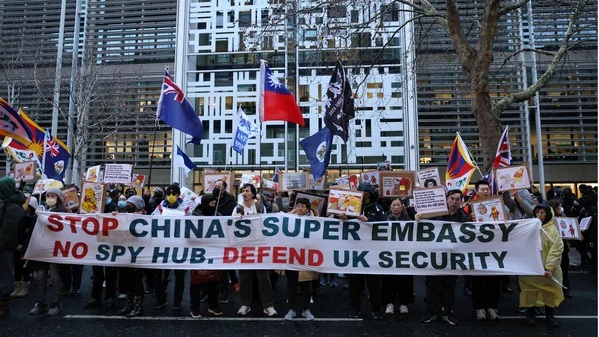
The proposal has been controversial since its submission in 2020. Tower Hamlets Council rejected it in 2022, and China initially chose not to appeal. After Labour came to power in 2024, approval authority was centralized under the national government. In 2025, London police withdrew their objections, prompting mass protests, including two demonstrations in February and March that drew more than 4,000 participants, including Hong Kong activists, Tibetans, Uyghurs, and Falun Gong practitioners.
Key concerns include risks of underground cable surveillance, including the fact that the site sits atop major communications infrastructure linking the City of London and Canary Wharf, and sees persistent protests involving potential intelligence operations.
Trump warned publicly in June 2025 that U.S.–UK intelligence sharing would be reassessed if the project went ahead. MI5 has repeatedly warned of CCP interference in British politics, and the dropping of charges last November against two Britons accused of spying for China further intensified criticism.
A stab in the back
Royal Mint Court dates back to the 14th century; Isaac Newton once laid the foundations of the gold standard there, making the site a symbol of Britain’s former financial dominance. Located near the Tower of London and between two major financial hubs, it forms what many call a “triangle of power.”
For many Britons, allowing China to build a “mega-embassy” there symbolizes a historic reversal, from the Opium Wars and unequal treaties to China’s modern economic rise. The site also carries deep political resonance: China’s first UK legation was established in 1877, and the 1896 “Sun Yat-sen London Incident” underscored how embassies can become flashpoints of political confrontation.
UK–China relations have deteriorated sharply since the 2015 “golden era,” amid Hong Kong’s crackdown and the Huawei 5G ban. The Labour government has sought a more “pragmatic” approach and secured a £600 million Chinese investment pledge in 2025. Supporters see the embassy approval as a calculated trade-off; critics, from Conservatives and Liberal Democrats to human rights groups, see it as a profound misstep.
Local residents have already indicated they will pursue judicial review. Community representative Dave Lake told Reuters, “This is far from over,” citing fears that the massive complex could attract constant protests and become a security liability.
Alina Wang contributed to this report.