By Hu Ping
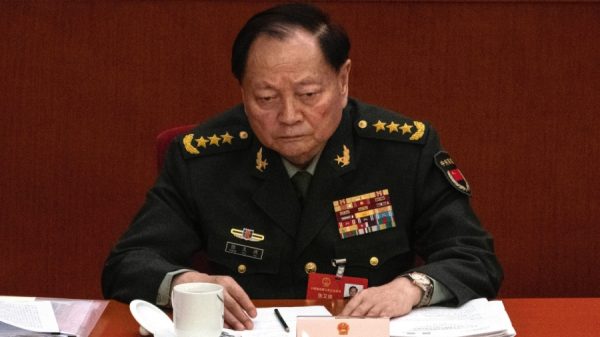
A report cited by The Wall Street Journal claims that Zhang Youxia, vice chairman of China’s Central Military Commission, leaked sensitive nuclear information to U.S. officials. This essay argues that the accusation is untenable on its face and reflects a familiar Communist Party tactic: deploying vague charges of “foreign collusion” to silence debate and enforce discipline.
An accusation circulated, not demonstrated
Discussion sparked by a Wall Street Journal report has centered on an explosive allegation: that Zhang Youxia leaked nuclear secrets to the United States. It is entirely possible that the source who supplied this claim to the WSJ did so with ulterior motives. Journalists are not at fault for recording what they hear. But within Chinese elite politics, “exporting” an accusation to foreign media—and then “re-importing” it for domestic use—is a familiar maneuver.
The aim is not to persuade, but to intimidate: to attach a far graver political crime to Zhang Youxia and, at the same time, to foreclose questioning.
On its merits, the allegation does not stand.
Who is making the claim—and what could he know?
The charge originates with Gu Jun, a former general manager of the China National Nuclear Corporation, the state-owned body overseeing China’s civilian and military nuclear industries. The question is simple: how could he know?
Success
You are now signed up for our newsletter
Success
Check your email to complete sign up
If Zhang Youxia disclosed classified information to U.S. officials, only those physically present would know what was said. Gu Jun was not present. He cannot know. At most, he could claim that Zhang Youxia had access to certain highly classified materials.
But that proves nothing. As first vice chairman of the Central Military Commission—the Chinese Communist Party organ that exercises absolute command over the People’s Liberation Army—and the official overseeing its routine operations, Zhang Youxia is authorized to know virtually all military and weapons-related secrets. Access is not evidence of disclosure.
How secrecy actually works in China
In China, as everywhere else, classified information is graded. “Secrecy” does not mean secrecy from everyone; it means secrecy from those without clearance. Some people may know; others may not. In much of the military system, the definition of what can be shared—and with whom—is set by the official responsible for the Central Military Commission’s daily work. That official is Zhang Youxia.
The only remotely plausible scenario is this: during closed-door meetings with U.S. diplomatic or military officials, Zhang Youxia disclosed certain information about China’s military posture or weapons programs that he himself judged permissible—or even necessary—to share. That is not “leaking secrets.” It is a matter of policy judgment.

Closed-door talks are not espionage
Senior-level, off-the-record meetings routinely involve exchanges that are never made public. If anything truly extraordinary had been said, someone present would almost certainly have reported it to Xi Jinping, the Chinese Communist Party’s general secretary and chairman of the Central Military Commission.
Xi might believe that certain remarks were ill-advised. He and Zhang Youxia might differ over where a particular secrecy boundary lies. But disagreement over judgment is not an accusation of espionage.
The timeline alone exposes the weakness of the charge. Zhang Youxia’s most recent meetings with American officials occurred one to two years ago. If he had genuinely disclosed sensitive secrets to the United States, Xi Jinping would have known long ago. Any investigation or punishment would already have occurred. There is no plausible reason for such a charge to surface only now.
What official silence reveals
Most telling of all, the accusation of “leaking secrets to the United States” does not appear in official announcements. For a charge of this magnitude, that omission is decisive. It is not accidental. It reflects the fact that the claim cannot be substantiated.
Its real function is political. It is meant to silence.

The Peng Dehuai precedent
This tactic has a long history inside the Chinese Communist Party. It inevitably recalls the case of Peng Dehuai, Mao Zedong’s defense minister and a senior marshal of the People’s Liberation Army.
At the 1959 Lushan Conference, a high-level Party meeting on economic policy, Peng criticized Mao Zedong’s disastrous initiatives. Mao responded by branding him the leader of an “anti-Party Rightist opportunist clique.” A nationwide political campaign followed, sweeping up large numbers of officials, senior and junior alike, who were labeled Rightist opportunists.
The catastrophe that followed was the Great Famine. Forced to retreat, the Party undertook economic “readjustment.” After the 1962 Conference of Seven Thousand Cadres, a major internal review meeting, officials began removing the Rightist label from many who had been purged.
Peng Dehuai himself was excluded. The justification was blunt: he had “colluded with foreign powers.”
Why such charges are so effective
Like today’s accusation of leaking secrets to the United States, the charge of “colluding with foreign powers” required no evidence. Because it allegedly involved state secrets, no details needed to be disclosed. No one could question the facts. No one could demand clarification.
The effect was immediate. It silenced those who doubted Peng Dehuai’s case, those who defended him, and those who demanded his rehabilitation. Above all, it preserved the image of the supreme leader as 伟大、光荣、正确—great, glorious, and correct.
The pattern is unchanged. Only the names are different.