By Cai Siyun, Vision Times
A “smart rail” transit project in China’s Shaanxi Province that cost a whopping 700 million yuan to build has suspended operations after less than three years, raising questions about the sustainability of high-profile infrastructure projects promoted as regional “demonstration” achievements.
The Xixian New Area Smart Rail Demonstration Line No. 1 officially opened on March 21, 2023, according to state media “Shaanxi Daily.” Marketed as the first smart rail line in northwest China, the project carried a total investment of 705 million yuan.
The route began at Doumen Station on Xi’an Metro Line 5 and extended west to Happy Valley Station, also connected to Metro Line 5. The full planned length was approximately 11.9 kilometers, though only four stations — Doumen, Haojing Avenue, Hanxi Lake, and Kunming Pool — were initially put into service, covering about 6.5 kilometers.
RELATED: Shenzhen Slumps Into a Deep Freeze: Where Did All 18 Million Residents Go?
Success
You are now signed up for our newsletter
Success
Check your email to complete sign up
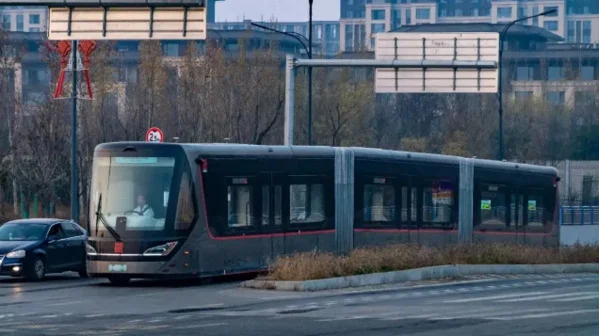
The vehicles measured 30.2 meters in length and used a standard three-module configuration, with a maximum passenger capacity of 283. Trains were able to operate in both directions, traveling at an average speed of 25–30 kilometers per hour.
Unlike a subway system, the so-called “smart rail” did not run underground. Instead, it operated at street level, typically occupying the middle lanes of major roads such as Yuzhang Avenue, Chenzhi Road, and Fenghao Avenue. Although the name includes the character for “rail,” the system did not require specially laid tracks, relying instead on guided road technology separated from normal traffic by dark gray fencing.
Service halted in January
A local resident told China Newsweek that operations stopped around Jan. 12 of this year, and the fences were removed soon afterward. He said: “I pass Yuzhang Avenue every day, which runs parallel to the Smart Rail Line 1. Since the smart rail stopped operating, traffic has been smoother, and the driving experience has actually improved.”
Other residents noted that even before the shutdown, only the four original stations were ever opened, while the remaining planned stops sat abandoned. Additional stations, including Kunming Pool West, Shiyuan, Shijingli, Haojing West, and Happy Valley, were never put into service.
Ms. Wang recalled: “Recently I passed by the Shijingli Station and found it still in an abandoned state. I used to look forward to it opening, but I never expected it would be abandoned before it even began operating.”
Empty cars, sparse ridership
Multiple residents described extremely low passenger numbers throughout the line’s short lifespan. Ms. Wang said she had taken the smart rail several times on weekdays, only to find one or two other riders, or sometimes none at all.
She described the experience as practically a private train, calling it a “special charter.” Mr. Wang added that aside from one occasion when a marathon event drew more passengers, ridership was consistently minimal. Initially, the line operated for free, before later charging a 2-yuan fare. It also supported the Chang’an Transit Card, Xi’an’s citywide transportation payment system.
Yet even with free rides and low ticket prices, passenger traffic remained weak, largely because few residents lived nearby. Ms. Liu explained that trains often appeared nearly empty and service intervals were long, even during rush hour. Ultimately, the line was suspended.
She lamented: “This is just burning money. An investment of 700 million yuan, and now it’s all gone down the drain. What a tragedy.”
A vanishing ‘Northwest first’ showcase
Reporters visiting the site observed that trains had stopped running, fencing along the dedicated lanes had been dismantled, and multiple stations had lost power. Entry gates were removed, and even the official WeChat account no longer provided operational information. Once promoted by Chinese authorities as the “northwest’s first smart rail,” the line now shows few visible signs of active service.
Public records indicate the Xixian smart rail project was approved at the State Council level, with a construction timeline spanning nearly a decade. The line sits between Xi’an and Xianyang, involving seven counties or districts and 23 townships and subdistrict offices.
Officials previously positioned the project as a regional transportation and tourism connection model. But during the planning and construction phases, state media repeatedly praised it for “filling the technological gap in northwest China” and highlighted claims that it balanced capacity with cost efficiency, offering a short construction period and relatively low investment. But in reality, ridership after launch fell sharply short of those promotional expectations.
Warnings ignored
Mr. Dong, a private business executive in Shaanxi, said that as early as 2014, scholars and industry professionals voiced opposition to the project. Concerns included dispersed population distribution and the availability of alternative transportation options such as buses and metro lines. He said: “Opposition existed, but it never truly entered the decision-making level.”
Mr. Dong argued that such projects often prioritize symbolic “innovation” and political demonstration value over long-term operational viability. “The launch was very high-profile,” he said, “but when operations stopped, hardly anyone came forward to explain what happened.”
In the end, he noted, the financial burden still falls on local governments, and ordinary citizens.