By He Zi
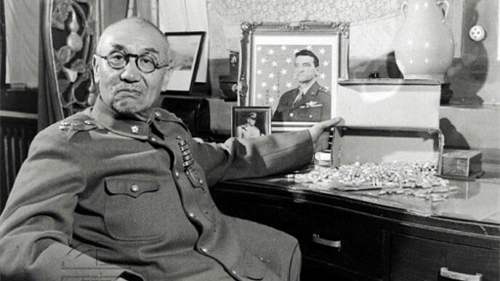
Yan Xishan was a major political and military figure in Republican China. As the long-time ruler of Shanxi Province, he was widely promoted during the 1920s as a “model provincial governor” and became a key supporter of the Northern Expedition—the Nationalist Party’s campaign to unify China and dismantle warlord rule. He worked closely with Chiang Kai-shek and played a decisive role in stabilizing North China during a period of national fragmentation.
Yet after the Chinese Communist Party (CCP) took power in 1949, Yan’s historical image was systematically dismantled. He was recast as a “reactionary warlord,” a “feudal remnant,” and an enemy of the people. This reversal was not the result of new evidence or historical reassessment, but of a political judgment rooted in one defining moment: Yan’s decision in 1927 to reject communist influence within the Nationalist movement.
That decision would determine not only his political fate, but also how the CCP would portray him for generations.
The 1927 crisis: competing governments and ideological breakdown
In the spring of 1927, the National Revolutionary Army captured both Wuhan and Nanjing. What initially appeared to be a unified Nationalist regime quickly fractured. Wang Jingwei and other left-wing leaders established a rival National Government in Wuhan, openly advocating cooperation with the Chinese Communist Party and the Soviet Union. Chiang Kai-shek responded by forming a separate government in Nanjing and initiating a purge of communist forces within the Nationalist Party.
Success
You are now signed up for our newsletter
Success
Check your email to complete sign up
This rupture—known historically as the Ning–Han split—nearly destroyed the Northern Expedition and marked a turning point in modern Chinese politics.
At the center of this crisis stood Yan Xishan. As both a regional military commander and provincial administrator, he could not avoid choosing sides. Wuhan and Nanjing each claimed to represent the legitimate central government and both sought Yan’s allegiance. His decision carried national consequences.
Yan Xishan’s assessment of the Wuhan government
In early summer 1927, representatives from both governments arrived in Taiyuan, Yan’s provincial capital. Wuhan’s envoy, Kong Geng, argued that Wuhan represented the true revolutionary center and urged Shanxi to declare support.
Yan rejected this claim outright.
“Nanjing is the government of the Nationalist Party,” Yan stated. “Generalissimo Chiang is a follower of Sun Yat-sen and a revolutionary. Wuhan is a communist government.”
He explained his reasoning in concrete terms. The Wuhan government, he observed, was dominated by Mikhail Borodin, a Soviet Comintern representative; major decisions were dictated by international communist interests; private property was being confiscated; and economic life was being reorganized along communist lines.
In Yan’s judgment, Wuhan no longer represented national revolution but ideological subordination and social destabilization.
Cultural destruction as a political red line
What ultimately hardened Yan’s position were reports from Hankou, then under Wuhan’s control. Revolutionary activists, acting under slogans such as “eliminating feudalism,” publicly paraded and destroyed a statue of Confucius.
For Yan, this was not a symbolic excess but a fundamental violation.
“The Hankou side drags a statue of Confucius through the streets and heaps insults upon it,” he said. “This is the destruction of Chinese culture. I will have no dealings with Hankou. I will cooperate only with Nanjing.”
Confucius, in Yan’s view, represented the ethical framework and social order of Chinese civilization. Publicly humiliating that symbol signaled a willingness to dismantle the cultural foundations of society itself. This crossed a line Yan was unwilling to accept.
From that point forward, his alignment with Chiang Kai-shek and the Nanjing government became definitive.
Revolution versus communism in Yan Xishan’s political thought
During the turmoil of 1927, political language within the Nationalist Party became increasingly confused. “Revolution,” “anti-imperialism,” and “communism” were often treated as interchangeable concepts. Yan Xishan rejected this conflation.
In his political philosophy, revolution meant restoring national sovereignty and reforming institutions while preserving social cohesion. Communism, by contrast, represented a radical restructuring of society through class struggle and coercive egalitarianism.
Yan belonged to a generation of conservative reformers. He accepted the need for change but rejected violent social engineering. Educated in Japan and influenced by ideas of national reconstruction and industrial development, he emphasized moral discipline, gradual reform, and institutional stability.
He viewed society as an organic system capable of adjustment, not as a permanent battleground between hostile classes.
Yan Xishan’s critique of communist economics
Yan studied Marxist theory closely and focused particular criticism on the principle of “distribution according to need.” In his writings—later compiled in Collected Political Essays of President Yan—he identified three fundamental problems.
First, when workers have no ownership over what they produce, labor and reward are separated, undermining motivation.
Second, equal distribution ignores differences in ability and effort, suppressing innovation and initiative.
Third, political systems cannot replace family responsibility; weakening family bonds destroys basic human ethics.
He summarized his position bluntly: “Distribution according to need is neither just nor humane.”
The emphasis on “not humane” was central. Yan viewed communism not merely as inefficient or extreme, but as fundamentally incompatible with human responsibility and moral order. This conviction shaped his actions in 1927 and explains why the CCP would later treat him as ideologically irredeemable.
Alignment with Nanjing and Party purification in Shanxi
As military pressure mounted from the Fengtian clique in the northeast, Yan concluded that Chiang Kai-shek represented both revolutionary legitimacy and the capacity to stabilize China. He formally transferred allegiance to the Nanjing government, accepted appointment as Northern Commander-in-Chief of the National Revolutionary Army, and fought alongside Nationalist forces.
Following the April 12, 1927 party purge, Yan implemented anti-communist measures in Shanxi. He stressed ideological cleansing over personal vendettas, warning that communist infiltration threatened the survival of the Nationalist Party.
“Party purification is now an urgent task,” he stated, noting the extent to which communist activists had entered the party under the banner of revolution.
Post-1949: systematic rewriting of Yan Xishan’s legacy
After the CCP established control over mainland China in 1949, Yan Xishan’s historical record was comprehensively rewritten. He was labeled a “reactionary warlord” and blamed for suppressing revolutionary movements.
His contributions to the Northern Expedition were erased. His service as Northern Commander-in-Chief was dismissed as opportunism. His land reforms and local governance experiments in Shanxi—such as the 1930s “public village land” policies—were omitted from official accounts.
Instead, propaganda emphasized his anti-communist actions, portraying him as a brutal oppressor of workers and peasants. During the early 1950s “Campaign to Suppress Counterrevolutionaries,” confiscations and arrests in Shanxi were justified as efforts to eliminate “Yan bandit remnants.”
Textbooks simplified the Ning–Han split into a morality tale of “Chiang Kai-shek’s betrayal,” while Yan’s rejection of Wuhan was framed as early collaboration with reactionary forces. His comments on the Confucius statue were distorted into evidence of feudal backwardness.
The Cultural Revolution and total denunciation
During the Cultural Revolution, Yan Xishan became a recurring target of political campaigns in Shanxi. Cultural productions depicted him as a caricatured “local despot.” His economic critiques were selectively quoted and mocked as “landlord ideology.”
His family members and former associates were subjected to denunciations and struggle sessions. Even his early education in Japan was recast as proof of betrayal.
By the end of these campaigns, a simplified image remained: Yan Xishan as a villain, stripped of context, motivation, and intellectual substance.
Why Yan Xishan still matters
Nearly a century after 1927, official rhetoric toward Yan Xishan has softened, but the core judgment remains unchanged. He is still categorized primarily as a reactionary figure.
Yet his decision during the Ning–Han split was not merely a calculation of power. It was a principled rejection of communist ideology based on concerns about social order, cultural continuity, and human ethics.
Reexamining Yan Xishan does not require idealization. He was a warlord, a reformer, and a political operator. But he was also a serious thinker confronting the consequences of ideological extremism.
Understanding his choice helps explain not only Republican-era politics, but also how the Chinese Communist Party has enforced ideological conformity through historical memory.