By Li Deyan
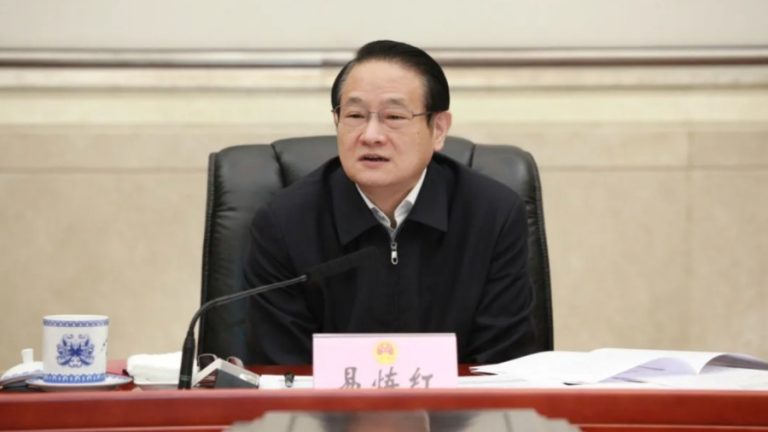
Chinese authorities have placed Yi Lianhong, a former vice chairman of the National People’s Congress Financial and Economic Affairs Committee, under investigation, according to official announcements. People familiar with the matter say Yi was once regarded as a key cadre cultivated within the Chinese Communist Party leadership, but allegedly crossed a major internal red line by building personal networks and promoting associates across multiple postings.
The announcement, made shortly before China’s annual Two Sessions, has drawn attention for its political timing. Some analysts say the move reflects an effort to remove uncertainties and obstacles ahead of sensitive personnel arrangements tied to the meetings.
The Central Commission for Discipline Inspection and the National Supervisory Commission said on Feb. 10, 2026, that Yi, a vice chairman of the 14th NPC Financial and Economic Affairs Committee, was under investigation for “serious violations of discipline and law.”
Public records show Yi was born in 1959 in Lianyuan, Hunan Province, and is a member of the CCP’s 20th Central Committee. His career spanned several provinces, including Hunan, Liaoning, Zhejiang, and Jiangxi. He previously served as Party secretary of Changsha and later of Shenyang.
Success
You are now signed up for our newsletter
Success
Check your email to complete sign up
In 2018, Yi was promoted to governor of Jiangxi Province and later became the province’s Party secretary, reaching full ministerial rank. In December 2022, he was transferred to Zhejiang as provincial Party secretary. After stepping down from that role in October 2024, Yi was reassigned to the national legislature as vice chairman of the NPC Financial and Economic Affairs Committee, a position he held until the investigation was announced.
Official CCP media reports indicate that Yi focused on economic and fiscal matters during his tenure in Jiangxi, while in Zhejiang he oversaw regional development and industrial planning. At the NPC committee, his work involved financial legislation and budgetary review.
Third ministerial-level official placed under investigation this year
Yi is the third full ministerial-level official to be placed under investigation this year, following former Inner Mongolia Party secretary Sun Shaocheng and Minister of Emergency Management Wang Xiangxi. He is also the first sitting vice chairman of an NPC special committee during the current term to face a public investigation.
U.S.-based independent political commentator Cai Shenkun wrote on X that rumors surrounding Yi’s political troubles had circulated well before the official announcement.
According to Cai, Yi’s career took off in Hunan during the tenure of Zhou Qiang as provincial Party secretary. Yi later served as a close aide in the provincial Party committee office and became Party secretary of Changsha. In 2017, he was transferred across provinces to Shenyang as Party secretary, before being appointed governor of Jiangxi in 2018. Three years later, he was promoted to Jiangxi Party secretary.
After the CCP’s 20th National Congress, Yi was appointed Party secretary of Zhejiang, a move widely interpreted as positioning him for further advancement within the Party hierarchy.
Cai said Yi benefited from backing by senior figures, including He Guoqiang, and was reportedly endorsed by Teng Wensheng, a former special assistant to Jiang Zemin known for close personal ties with Xi Jinping. In later years, Yi was also said to have gained recognition from Li Ganjie.
According to Cai, Yi’s situation worsened following the so-called “Hunan Seven Princes” case. The parents of those involved were reportedly senior provincial- and ministerial-level officials from Hunan with considerable political influence. They were alleged to have intervened in major provincial projects and personnel decisions and to have formed an informal high-level think tank linking more than 100 senior officials. The case reportedly implicated a wide range of cadres, with figures including Li Weiwei, Jiang Chaoliang, Yi Lianhong, and Zhou Deyu among the earliest to be affected.
Once regarded as a priority candidate
A mainland Chinese insider identified as Mr. Qin told overseas Chinese media that Yi had once been regarded as a priority candidate within the CCP leadership ahead of the 20th Party Congress.
“Yi Lianhong rose very quickly,” Qin said. “He became acting governor of Liaoning in 2018, governor in 2019, and was transferred to Jiangxi as Party secretary in 2021. I heard the investigation into him began last year.”
Qin said concerns at the highest levels over factional behavior played a decisive role in Yi’s downfall.
“He allegedly built networks and promoted his own people wherever he went,” Qin said. “This happened in Liaoning, Jiangxi, and Zhejiang. That kind of behavior is what angers the top leadership the most. His investigation was expected by many insiders.”
Such accusations mirror language frequently used in CCP disciplinary cases, including references to “forming cliques,” “engaging in factional activities,” and “cultivating personal power.” Article 54 of the Party’s Disciplinary Regulations explicitly prohibits faction-building, non-organizational political activity, and the construction of personal influence networks within the Party.
Yi’s investigation was announced just weeks before the opening of the Two Sessions, prompting renewed scrutiny of internal political dynamics.
A Beijing-based independent scholar identified as Chi said the recent string of high-level cases points to intensified power struggles ahead of the meetings.
“From cases involving Zhang Youxia, Liu Zhenli, and multiple ministerial-level officials, it is clear that a new round of personnel contention is underway before the Two Sessions,” Chi said. “Yi Lianhong will not be the last senior official investigated before the meetings. More cases are likely to follow.”
Another mainland source, identified as Mr. Ye, said the timing was intentional.
“Handling high-level cases before the Two Sessions serves a clear purpose,” Ye said. “It clears the way for completing this year’s personnel arrangements.”
Some netizens have also noted that Yi was associated with the so-called “Zhijiang New Army,” a group of officials whose careers advanced in Zhejiang and who were viewed as close to Xi Jinping. Yi’s transfer in October 2024 from Zhejiang Party secretary to a largely ceremonial NPC role was widely interpreted as an early sign of political retreat.
The formal investigation announced on February 10, 2026, has further fueled speculation that Xi’s ability to shield close associates may be weakening, a development some observers see as reflecting mounting pressure at the top of the CCP.
Editor’s Note:
This article is based on official Chinese Communist Party announcements, commentary by overseas Chinese analysts, and statements from individuals described as insiders. Allegations involving internal Party dynamics and factional behavior cannot be independently verified and are presented as claims attributed to the cited sources.