By Li Deyan
Zhang Shengmin, one of two vice chairmen of China’s Central Military Commission, the country’s top military command body, visited the Beijing Garrison Command in the days before Chinese New Year 2026, delivering a speech heavy on loyalty demands and stability rhetoric that, according to multiple overseas Chinese media sources, confirms deep unrest within the Chinese military. Separately, a leaked slogan circulating among Chinese troops, “Remove Xi on New Year’s Eve, and all under heaven will be at peace,” has fueled speculation that military discontent with Xi Jinping, China’s paramount leader, is approaching a breaking point.
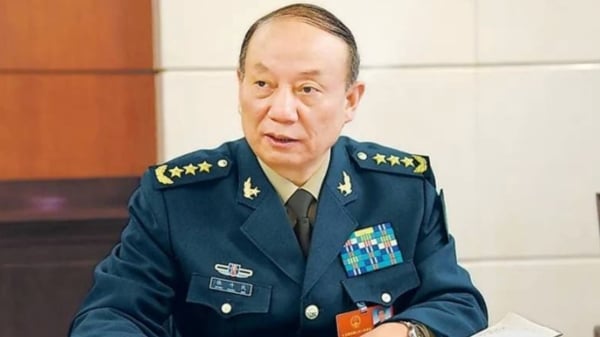
Xi’s military vice chairman visited the Beijing garrison to demand loyalty and stability
On Feb. 11, 2026, Zhang Shengmin, vice chairman of China’s Central Military Commission, made pre-holiday visits to an engineering brigade under the military’s Aerospace Force and a guard regiment of the Beijing Garrison Command, the army-level unit under direct central military control that is responsible for the physical security of China’s political leadership in the capital. Zhang’s remarks centered on the standard loyalty formulas: “Xi Jinping’s thought on strengthening the military,” “implementing the Chairman Responsibility System,” and “resolutely listening to and following the Party.” He also ordered troops to “intensify combat readiness training,” to “prepare for all manner of sudden contingencies,” and to “maintain a high degree of unity, cohesion, and security stability within the force.”
The Beijing Garrison Command plays an outsized role in any power struggle within Zhongnanhai, the Chinese Communist Party’s central leadership compound. The unit’s commander position had been vacant for ten months until recently, when it was filled by Chen Yuan, the former commander of the Armed Police Shanghai General Corps. According to online sources, Chen is reportedly connected to the circumstances surrounding the death of former Premier Li Keqiang.

Last year’s military vice chairmen delivered routine speeches, then were both purged
The contrast with last year’s Chinese New Year visits is striking. In early 2025, the two vice chairmen of China’s top military body at the time, Zhang Youxia and He Weidong, each visited separate military units. Their speeches contained the usual boilerplate expressions of loyalty to Xi, along with routine references to “strengthening combat readiness” and “political construction.” Within months, both men were purged. Zhang Youxia, widely regarded as the most experienced combat commander in China’s senior military leadership, had his fall send particularly severe shockwaves through the armed forces.
Success
You are now signed up for our newsletter
Success
Check your email to complete sign up
Li Linyi, an overseas Chinese political commentator, argued that the sudden arrests this year of Zhang Youxia and the former chief of the military’s Joint Staff Department, Liu Zhenli, two officers with real battlefield credentials and deep respect within the ranks, provoked widespread anger among lower-ranking soldiers. Zhang Shengmin’s visit to the Garrison, Li said, was a “stability maintenance” mission aimed at tamping down that anger. The very fact that Zhang had to visit the troops and demand “security and stability” proves that security and stability no longer exist.
The purges of Zhang Youxia and Liu Zhenli have paralyzed military command
Overseas Chinese media, citing sources inside the military, reported that the detention of Zhang Youxia and Liu Zhenli triggered intense reactions across every branch and service arm of the Chinese armed forces. Multiple officers have privately questioned why the central leadership locked up two senior generals who commanded long-standing respect and were regarded as “old chiefs” by the rank and file, all without presenting any public evidence. This, sources said, has severely damaged trust within the military in the CCP’s top-level decision-making.
Further reports claim that at least two directives issued by the Central Military Commission’s General Office to China’s major theater commands and group armies have gone unexecuted. Military orders, in other words, are spinning in a void.
Vision Times has been unable to independently verify this claim, but it illustrates the scale of the predicament Xi faces after moving against Zhang Youxia and Liu Zhenli.

Chinese troops are circulating ‘remove Xi on New Year’s Eve, and all under heaven will be at peace’
Military discontent with Xi Jinping has reached overseas audiences through multiple channels, and Zhang Shengmin’s pointed visit to the very unit tasked with protecting China’s leaders, where he pleaded for “security and stability,” offers independent corroboration that the phrase “military morale is shaken” is no longer alarmist rumor.
According to the blogger “Ordinary Person Inside the Wall” (墙内普通人), a rhyming couplet is now circulating within the Chinese military: “除夕除习,天下大吉” (“chúxī chú Xí, tiānxià dàjí”). The phrase is a pun. “Chúxī” is the Chinese word for New Year’s Eve, but when the second character is replaced with Xi Jinping’s surname (习, also pronounced “Xí”), the meaning becomes “Remove Xi on New Year’s Eve.” The second half, “all under heaven will be at peace,” completes the couplet as a prophecy of deliverance.
In Chinese history, rhyming folk prophecies have preceded virtually every dynastic collapse. They circulate among commoners and soldiers as cryptic predictions of regime change, and their appearance is traditionally taken as a sign that the Mandate of Heaven has shifted.
Overseas Chinese political commentator Tang Jingyuan noted on his program that the phrase “all under heaven will be at peace” (天下大吉) originates from the rallying cry of the Yellow Turban Rebellion of 184 AD, when the peasant leader Zhang Jiao proclaimed: “The Azure Sky is dead; the Yellow Sky shall rise. In the year of Jiazi, all under heaven will be at peace.” Zhang Jiao was declaring that the corrupt Eastern Han dynasty was finished and a new era was about to dawn. The echo in today’s “military folk rhyme” carries unmistakable overtones of regime change.
Tang added a coincidence: in the weeks before Chinese New Year 2026, cities across China hung yellow lanterns in place of the traditional red ones. In Chinese color symbolism, yellow is the color of imperial authority and, in the context of the Yellow Turban slogan, of the new order that replaces a dying regime. The yellow lanterns, whether intentional or not, visually echo the ancient prophecy.
Reports claim China’s armed forces have split into two rival command centers
Tang Jingyuan assessed that anti-Xi sentiment within the Chinese military is now intense, but that the armed forces cannot act as an independent political force under the current system. China’s theater commands and service branches are deliberately siloed from one another, and since Zhang Youxia’s removal, the military lacks any single figure with sufficient authority and cross-service prestige to unify the armed forces. The military’s only option, Tang argued, is to form an alliance with anti-Xi political factions.
The linchpin of that alliance, Tang said, is Liu Yuan, a retired Chinese general and the son of former Chinese president Liu Shaoqi, who was persecuted to death during Mao Zedong’s Cultural Revolution. Liu Yuan is the only senior political figure in China who simultaneously belongs to three power bases: the “red second generation” (children of founding CCP revolutionaries), the network of retired Party elders hostile to Xi, and the military establishment. His parentage gives him deep connections to the elder statesmen; his career gives him standing within the armed forces.
Tang identified four factions now locked in the struggle: Xi Jinping’s inner circle, the military, the anti-Xi Party elders, and the broader red second generation. The elders, the red second generation, and the military have formed a tacit alliance against Xi, with Liu Yuan as the focal point connecting all three.

Xi controls the Beijing garrison, but the 82nd Group Army blocked his takeover of the Western Hills command center
According to “Ordinary Person Inside the Wall,” Xi’s faction still holds the institutional advantages of the central government, but Xi has been unable to bring the broader military to heel. The blogger reported that Xi recently used Beijing Garrison troops to seize the Bayi Building, the Chinese military’s main administrative headquarters in central Beijing. When Garrison forces then attempted to take over the Western Hills Command Center, the military’s underground wartime command facility in Beijing’s western suburbs, they were blocked by the 82nd Group Army.
Tang Jingyuan interpreted this as evidence that China’s armed forces have, in practice, fractured into two command centers: the Bayi Building, now under Xi’s control through the Garrison, and the Western Hills facility, held by forces aligned against him. Where once the CCP’s internal power struggle was between two civilian factions (Party versus state), the military itself has now split.
Xi’s armed resources, Tang concluded, are essentially limited to the Beijing Garrison and the domestic security apparatus (the “political-legal system”). The anti-Xi coalition appears to have greater numbers, but it is paralyzed by an internal disagreement: whether to use force to remove Xi. Some red second generation figures and Party elders fear that a military move would destabilize the situation beyond control, potentially triggering civil war and the collapse or breakup of the CCP itself. The faction that prioritizes “saving the Party” currently has the upper hand within the coalition. The result is a stalemate: Xi is weaker in raw strength, but the opposition is too cautious to strike.
The stalemate hinges on what happens to Zhang Youxia and Liu Zhenli
Tang Jingyuan observed that Xi used force to seize Zhang Youxia, but because he failed to bring the broader military under control, his power remained limited. The anti-Xi faction, meanwhile, is in a state the Chinese idiom describes as “afraid to throw the stone for fear of hitting the vase,” meaning they fear that striking at Xi could shatter everything around him, including the Party itself. Neither side is openly escalating, but both are maneuvering behind the scenes.
The next signal to watch, Tang said, is how the cases of Zhang Youxia and Liu Zhenli proceed: what charges are brought, how the trials are conducted, what sentences are imposed, and, critically, whether and how the two generals appear publicly to prove they are still alive. That last point, Tang emphasized, may be the single most important indicator of where the power struggle goes next.
Vision Times has been unable to independently confirm reports of the Chinese military splitting into two command centers.