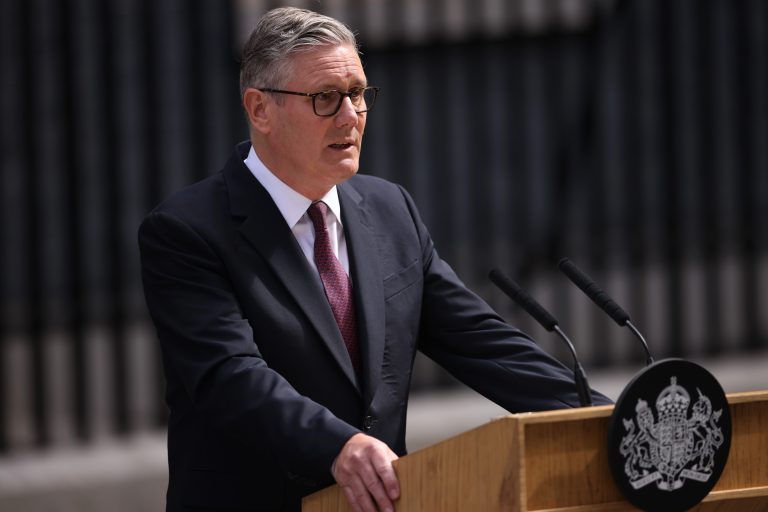
On June 22, Keir Starmer announced his resignation as Prime Minister on the steps of 10 Downing Street, the official residence and office of the UK Prime Minister. He said he would remain in a caretaker role until the Labour Party selects a new leader in September.
“The question my party is asking now is whether I am best placed to lead us into the next general election. I have heard the answer of my parliamentary party to that question. And I accept that answer with good grace,” Starmer said.
After leading the Labour party to a landslide victory in a July 2024 general election, Starmer has seen his fortunes fade.
Poor results in the May 2026 local and regional elections preceded his resignation, with the opposition Reform UK Party inflicting significant losses. A recent by-election win for Andy Burnham further intensified calls for change.
Andy Burnham, a prominent Labour politician and native of Liverpool, is often referred to as the “King of the North” for his strong advocacy of northern England and regional devolution. He won a June 18 by-election in the Makerfield constituency after the sitting MP resigned, securing a decisive victory with 55 percent of the vote, up from Labour’s 45 percent share in the 2024 general election.
Success
You are now signed up for our newsletter
Success
Check your email to complete sign up
Burnham ran for Labour leadership in 2010 and 2015 coming in second to Jeremy Corbyn in 2015.
His win accelerated pressure on Starmer, who was already facing declining popularity, poor election results and internal party doubts.
Burnham has confirmed he will seek the Labour leadership. He is heavily favored as Starmer’s successor, however his candidacy is expected to be challenged.
‘Less than perfect’
According to the BBC, long-time Greater Manchester MP Graham Stringer describes Burnham’s record as “less than perfect.”
“[Burnham’s] record on being consistent on his policy and delivering is less than perfect.” Stringer said.”I absolutely prefer there to be a [leadership] contest… [so] Andy’s ideas and views could be tested in debate.”
Stringer believes that Burnham, who resigned as mayor of Manchester to return to parliament, has proven to be inconsistent on policy.
Reform UK leader Nigel Farage, who had been one of Starmer’s most vocal opponents, reacted swiftly to the news of the prime minister’s resignation.
Farage took to X to demand an immediate general election.
“Reform demands an election, and we are ready to deliver radical change.” Farage wrote, adding that, “If Labour thinks it can shove another professional politician into No 10, it has another thing coming.”
Trump announces Keir Starmer’s resignation
A day before Starmer’s official resignation, United States president, Donald Trump, took to Truth Social, announcing Starmer’s resignation as rumors swirled.
On the morning of Sunday, June 21 Trump wrote on Truth Social: “Keir Starmer will resign as Prime Minister of The United Kingdom. He failed badly on two very important subjects- IMMIGRATION AND ENERGY (OPEN NORTH SEA OIL!). I wish him well!”
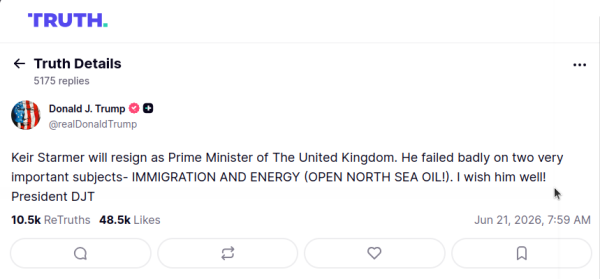
Trump’s Truth Social post generated immediate controversy by appearing to preempt Starmer’s resignation announcement.
Many UK outlets and political figures viewed Trump’s intervention as mean-spirited and an unusual interference in an ally’s domestic politics. It amplified the sense of crisis around Starmer and became a major talking point in coverage of his exit.
Supporters of Trump and Reform UK, however, welcomed the blunt assessment, seeing it as highlighting genuine failures on immigration and energy policy. The episode underscored longstanding tensions in the U.S.-UK relationship during Trump’s second term.
Overall, the post intensified media scrutiny but was widely regarded as opportunistic commentary rather than a decisive factor in Starmer’s decision to step down.
Going forward, Keir Starmer will serve as caretaker Prime Minister until Labour selects a new leader. Nominations open on July 9 and close mid-July; if Andy Burnham faces no serious challengers, he could become Prime Minister as early as late July.
A full contest would conclude by early September when Parliament returns. Burnham, the clear frontrunner, is expected to focus on northern issues, reconnecting with working-class voters, and countering Reform UK.
This would mark Britain’s seventh prime minister in about a decade.