
China’s prolonged economic decline has produced a homelessness crisis on a scale the CCP can no longer hide. Government data published by the financial outlet Caixin in September 2025 revealed that approximately 47.5 million people in China are homeless, a more than fivefold increase from 2020. The age profile is striking: 61 percent of the homeless population is under 33, and 25 percent is over 60. Across China’s major cities, young people are sleeping in parks, under bridges, and on sidewalks, a visible sign of an economic collapse that official GDP figures do not capture.
The Caixin report, based on a nationwide survey organized by Chen Ronghui of China’s National Data Administration, mobilized 34 provincial survey agencies to count the country’s homeless population through the end of August 2025. The methodology was unusually thorough by CCP standards, which makes the results all the more difficult for the regime to dismiss. A fivefold increase in five years reflects an economy that has been shedding workers far faster than any official unemployment figure suggests, and a social welfare system that catches almost no one who falls.
The youth share of the homeless population, 61 percent under 33, maps directly onto the catastrophic youth unemployment crisis that has defined China’s economy in recent years. The 25 percent who are over 60 represent a population abandoned by a system that provides almost nothing for elderly people without family support or pensions.
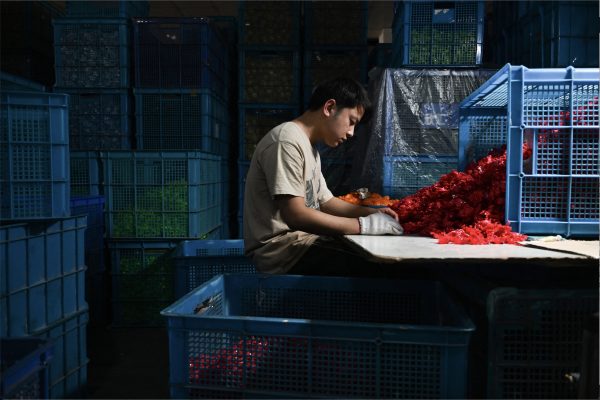
Young workers describe sleeping on streets and in parks
One young man described quitting his job and leaving immediately with nowhere to go. Rather than return to his hometown, he decided to stay in Shanghai and try again. He arrived at a park after dark, only to discover that some Shanghai parks have gates that lock at night. He searched his phone for another option, found one ten kilometers away, and walked there dragging his suitcase because he could not bring himself to spend money on a taxi.
He arrived at 1:00 a.m., lay down on the dirty floor of a park pavilion, and slept fitfully, waking at every sound, afraid someone would steal his luggage. He did not fall into real sleep until dawn broke around 5:00 a.m. By mid-morning it was raining. He bought two steamed buns, sat in the rain through the morning, and spent the afternoon in a 24-hour convenience store. The second night, with more experience, he slept directly on a sidewalk under a streetlight, finding some faint sense of security in the illumination.
Success
You are now signed up for our newsletter
Success
Check your email to complete sign up
In the comments below his post, one user wrote: “I’m only 15 years old and I’ve already started wandering. It’s really exhausting.”
Another man described life in a bridge underpass, acknowledging the constant dampness and the long-term health concerns but explaining that he had made it work. He was far from alone. The bridge sheltered delivery drivers, laid-off white-collar workers, and factory hands, nearly all at the bottom of China’s labor hierarchy, living under concrete to save every yuan they could for families back home.
A Shantou tourist site overrun by beggars reflects systemic failure
The crisis is visible in public spaces across China. A scenic area at the Song Dafeng temple complex in Chaoyang District, Shantou, Guangdong province, has been taken over by large numbers of beggars. Videos circulating online show the temple steps lined with elderly people, individuals with disabilities, and apparently ill people lying in carts, some with intravenous drips attached. Each has a plastic basin or a digital payment QR code placed in front of them.
Local residents say the begging has persisted at this site for several years and is common at other tourist attractions as well. The temple, which is free to enter, attracts large numbers of worshippers and visitors, making it a reliable location for soliciting money.
Online commentary was divided. Some dismissed the beggars as professional operators running organized scams. Others argued that the CCP’s social assistance system is so inadequate that it leaves the most vulnerable with no alternative. For elderly people without pensions and individuals with disabilities, begging is a consequence of a government that has failed them entirely.

Layoffs and factory closures are pushing families past the breaking point
The stories of newly desperate Chinese families follow a pattern that repeats across industries and cities: a sudden job loss, no social insurance, debts that cannot be paused, and a government that offers nothing.
In one household, a woman’s husband was summoned by management and told his factory was closing. The workshop had already been cut from 27 workers to seven through rolling layoffs since 2025, and the company had been losing money every month. He had worked at a small private factory with no social insurance and no severance. The family depends entirely on his income of slightly more than 5,000 yuan per month, with a mortgage payment exceeding 3,000 yuan, a child in school, and no savings. They had planned to put money aside for a trip home during the Lunar New Year. That plan is finished.
A family in Harbin confronted a different version of the same trap after the husband was laid off. They had borrowed from relatives to buy their apartment and were repaying the loans annually. With no income, they considered selling, but property values had fallen further than they expected, guaranteeing a loss. Staying means accumulating debt with no way to service it. Neither option leads anywhere good.
The strain falls disproportionately on women. One mother described her husband closing his household goods wholesale business after months of losses while their youngest child is four months old. She wants to earn money but cannot afford childcare, and cannot work while providing full-time care. The stress has disrupted her sleep and caused her hair to fall out.
Another woman described her husband losing his latest job after less than a week when a construction site ran out of work, with his boss offering only a vague promise to call when the next project starts. She recalled that he had been laid off multiple times in 2025 as well, and friends in similar situations told her the 2026 job market is worse across the board, with lower wages and tighter age restrictions shrinking the available pool even further.

The downward spiral has no visible floor
The economic logic is self-reinforcing: mass layoffs reduce household income, which suppresses consumer spending, which destroys the businesses that employed those consumers, which eliminates more jobs. Each turn of the cycle produces more homelessness, more desperation, and more people sleeping in parks and under bridges.
The CCP’s response has been to lower its 2026 GDP growth target while continuing to publish unemployment statistics that exclude hundreds of millions of rural-registered workers from the count. The gap between the official narrative of managed economic transition and the lived reality of nearly 50 million homeless people is vast and growing.
For tens of millions of Chinese families, the social contract the CCP once offered, stability in exchange for obedience, has been broken. The regime collected the obedience but never delivered the stability, and what remains is a population discovering, one layoff and one missed mortgage payment at a time, that they are entirely on their own.