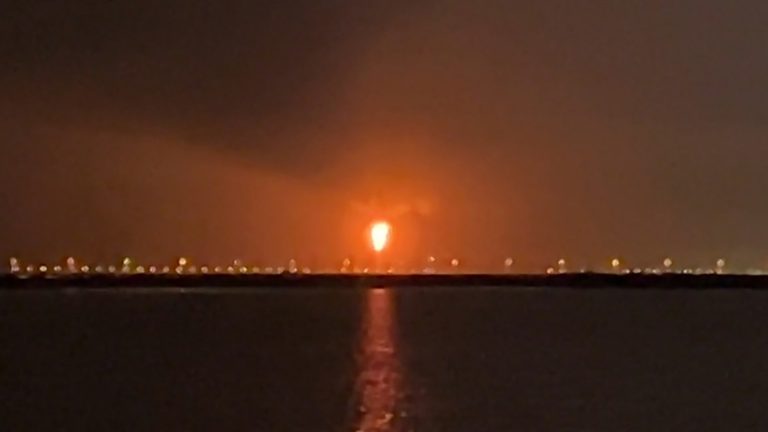
According to the Washington Post, U.S. President Donald Trump announced on Friday evening, March 13 that the United States had carried out an airstrike on Iran’s most important oil terminal — Kharg Island. Located about 15 miles from the Iranian mainland, Kharg Island is the core of Iran’s oil economy, with roughly 90 percent of the country’s oil exports passing through its facilities. The attack could further weaken Tehran’s economy, including the government’s ability to fund military spending. On Truth Social, Trump said the U.S. had “completely destroyed Iran’s crown jewel military targets.”
While flying from Washington to Palm Beach, Florida, Trump said, “The Iranian military, and everyone connected to this terrorist regime, should wisely lay down their arms and save what is left of their country.” He also warned that if Iran obstructs shipping through the Strait of Hormuz, the U.S. might reconsider its current policy of avoiding attacks on oil and gas infrastructure.
The UK Telegraph reported on March 14 that as early as 1988, a young New York real estate developer Trump mentioned Kharg Island during an interview with The Guardian. When asked about his future plans, he said he might one day run for president and vowed to restore America’s “respect” on the world stage. Regarding Iran, he bluntly stated: “They’ve always defeated us psychologically, making us look like fools. Once our soldiers or ships are attacked, I would take action against Kharg Island, seizing it directly.”
At the time, the interview primarily promoted his book The Art of the Deal, so he did not elaborate on a Kharg Island strategy. Nearly 40 years later, his comments reflect a long-standing awareness of Middle Eastern geopolitics. The recent U.S. airstrike on the island comes amid expanded joint bombing operations with Israel after a half-month of conflict.

Trump was aware of Kharg Island’s strategic value
The Telegraph analysis suggests the strategic intent behind the Kharg Island strike may be to fully seize the island, cutting off Iran’s oil exports and weakening its fiscal and security capabilities, all without deploying U.S. forces to the Iranian mainland. Oil exports from the island account for nearly 40 pervcent of the government budget; controlling the island would give the U.S. significant leverage in negotiations.
Success
You are now signed up for our newsletter
Success
Check your email to complete sign up
White House advisor and executive director of the National Energy Dominance Council Jarrod Agen said that seizing Kharg Island would ensure Iranian oil does not fall into “terrorist” hands, weaken the Iranian regime’s finances, and create strategic space for potential future regime changes.
Additionally, U.S. control of Kharg Island could put long-term strategic pressure on China, which imports more than 80 percent of its Iranian oil; controlling the island would mean controlling the world’s largest maritime energy route.

Impact on global energy markets and strategic significance
The Kharg Island airstrike has already affected global oil prices. Since the Trump administration launched “Operation Epic Fury” last month, prices have continued to surge. Although the U.S. temporarily eased some Russian oil sanctions and implemented other measures to stabilize markets, gasoline and aviation fuel prices are still rising. Before boarding Air Force One, Trump said, “After the conflict ends, you will see gasoline and energy prices drop significantly.”
Military analysts believe that seizing Kharg Island would allow the U.S. to exert enormous pressure on the Iranian regime without deploying large ground forces, while controlling the world’s most important maritime energy corridor, benefiting both long-term energy security and negotiation leverage. Experts note that the island’s defenses rely mainly on aging air defense missiles and coastal anti-ship missiles, which may be inadequate against a U.S.-Israel joint operation.
Some analysts also suggest that the U.S. could exploit unrest in western Iran’s Kurdish regions to draw Iranian military attention, weakening southern coastal defenses and increasing the likelihood of a successful seizure. If successful, the U.S. would gain leverage to exert long-range pressure on the Iranian regime while ensuring a dominant position in future negotiations and energy markets.