A residency trainee at Central South University’s Xiangya Hospital in Changsha, Hunan Province, reportedly left a suicide note and drowned in a river on March 14, 2026. The note, which has circulated widely on Chinese social media, describes forced psychiatric hospitalization, threats of expulsion, and relentless exploitation by academic supervisors. The death comes less than two years after another trainee at the same hospital network died under circumstances that led to allegations of forced organ harvesting.
A graduate student in the 2023 class at Central South University’s Xiangya Hospital, identified by the surname Sun, was pulled from the Xiang River on March 15 with no vital signs. A document believed to be Sun’s suicide note appeared online within hours, detailing conditions inside one of China’s most prestigious government-run hospitals. The note describes a medical training environment built on coercion, where students serve as cheap labor for supervisors who face no accountability for the damage they inflict.
Xiangya Hospital is a top-tier public institution directly administered by China’s National Health Commission. It sits at the center of a four-hospital network under Central South University, collectively known as the “Xiangya system,” which has been dogged by scandal, unexplained deaths, and allegations of involvement in forced organ harvesting.
The suicide note described systematic abuse and forced psychiatric commitment
Sun’s note paints a picture of a training program in which the academic supervisor assigned tasks far beyond the scope of clinical residency, including administrative work unrelated to medical education. These duties disrupted Sun’s actual training so severely that clinical mentors also berated the student for poor performance. Sun described being trapped between two sets of superiors, each blaming the student for failures caused by the other’s demands.
The note describes being required to attend the supervisor’s outpatient clinic while simultaneously working overnight and day rotations. Sleep deprivation was constant. “The sound of a phone ringing filled me with dread,” Sun wrote.
Success
You are now signed up for our newsletter
Success
Check your email to complete sign up
When Sun was absent from clinical duties because of the supervisor’s tasks, the response was threats: expulsion proceedings, forced meetings at the academic affairs office, and withdrawal paperwork. Every effort to comply with one set of demands produced punishment from the other.
Pushed to a breaking point, Sun attempted to jump from a building. The note describes this as an act of desperation. The attempt did not improve conditions. Instead, the university’s graduate affairs office had Sun committed to the psychiatric ward at Xiangya Second Hospital, a sister institution in the same network. From that point forward, Sun carried a psychiatric diagnosis and was placed on high-dose, dependency-forming medication while continuing full clinical duties.
Even after discharge, Sun was repeatedly called in for interrogation, forced to sign guarantees and liability waivers, and subjected to further reprimands. The cycle of exploitation, punishment, and institutional retaliation continued without interruption.
The suicide note ends with a plea directed at the institution itself. Sun asked Xiangya Hospital to refrain from targeting the student’s parents, classmates, or supportive clinical mentors in any public statement following the death. The note explicitly rejected the hospital’s prior attempts to blame the student’s family background or general clinical stress for the crisis.
“I loved neurology. I never regretted choosing it,” Sun wrote. “But I truly had no other way out. I want to die as a normal person.”
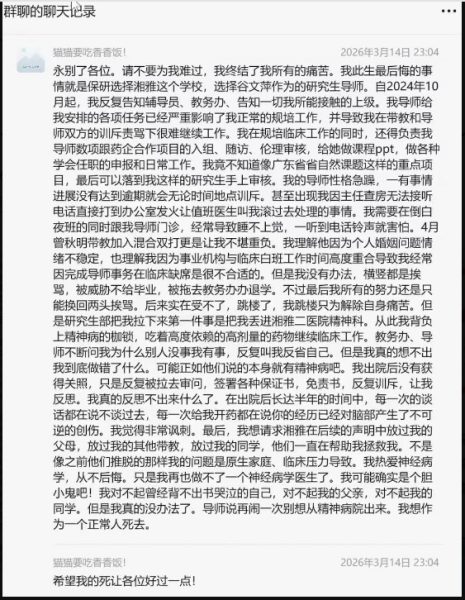
Authorities announced a joint investigation after the body was recovered
According to the Hunan Provincial Health Commission, Sun left the dormitory at 9:57 PM on March 14 and lost contact. At 11:26 PM, police notified the hospital that someone had been seen falling from the Juzizhou Bridge. Professional rescue teams were deployed. The body was recovered at approximately 4:00 PM on March 15 and confirmed to be Sun.
Central South University and the Hunan Provincial Health Commission have formed a joint investigation team. No findings have been released.
The death triggered a wave of anger across Chinese social media platforms. Users questioned the hospital’s record of unexplained fatalities. “How many people have died there now?” one asked. “Every single time, it’s supposedly the dead person’s fault,” another wrote.
Some users pointed to systemic exploitation of students within China’s state-run medical training apparatus. “Student internships are fundamentally broken. The exploitation is extreme,” one commenter wrote. Others demanded a full investigation of the Xiangya system, citing years of accumulated scandal.
On X (formerly Twitter), the account “China Lens Report” called the death institutional murder. The post argued that what the Chinese Communist Party labels “elite training” and “research management” amounts to raw exploitation and psychological coercion, with students used as disposable labor under euphemistic labels like “residency training” and “academic supervision.” Those who resist face psychiatric institutionalization.
Other X users noted the hospital network’s alleged ties to forced organ harvesting operations in Cambodia and the unresolved circumstances surrounding the 2024 death of intern Luo Shuaiyu.
The Xiangya Hospital network has faced organ harvesting allegations since 2024
Central South University operates four affiliated hospitals: Xiangya Hospital, Xiangya Second Hospital, Xiangya Third Hospital, and Xiangya Stomatology Hospital. The network, all directly overseen by China’s National Health Commission, has become a focal point for allegations linking China’s state-run medical system to forced organ harvesting.
On May 8, 2024, a medical intern named Luo Shuaiyu at Xiangya Second Hospital died suddenly after falling from a building. His parents recovered data from his phone and computer and found that Luo had filed formal complaints alleging that Xiangya Second Hospital was involved in large-scale forced organ harvesting from living donors. The family’s protests outside a Changsha courthouse in late 2025 drew renewed public attention to the case and to one detail in particular: Luo’s complaints described the hospital arranging to procure organs from children.
By Li Muzi