After five years of renovation, the permanent exhibition at the Hong Kong Museum of History reopened on April 1. According to reports, the content of the reopened exhibition has been significantly altered. The “1967 riots” are now described as “anti-British resistance,” while the “June Fourth Incident” has been renamed as “political turmoil in the spring and summer,” sparking controversy. Analysts believe that the Chinese Communist Party is replacing Hong Kong people’s original historical understanding with its own narrative.
The Hong Kong Museum of History’s permanent exhibition, “The Hong Kong Story,” was closed in October 2020 for a major renovation and reopened on April 1 after completion of the works.
However, observers have found that the exhibition content has undergone major changes. The original eight exhibition sections have been expanded to ten, with additional content covering the 21st century. Meanwhile, major social events such as the 1967 riots and activities supporting the June Fourth movement have been removed.
The 21st-century section also makes no mention of the 2014 Occupy Central movement or the 2019 anti-extradition bill protests, reported the Japanese broadcaster, NHK.
‘1967 Riots’ renamed as ‘anti-British resistance’
The most notable changes in the reopened exhibition concern how modern political events are described. According to Ming Pao, compared with the content prior to October 2020, the new exhibition has altered the wording for various political events. For example, regarding British colonial rule over Hong Kong after the Opium War, the old exhibition used terms such as “ceding” Hong Kong and “taking over” the New Territories. The new exhibition now uses “forcibly occupying” Hong Kong Island and “forcibly leasing” the land north of Boundary Street and south of the Shenzhen River.
Success
You are now signed up for our newsletter
Success
Check your email to complete sign up
In addition, the description of the “1967 riots” has undergone the most significant change. In the old exhibition, a display panel on social conflicts in Hong Kong during the 1950s and 1960s featured photos from 1967 under the title “1967 Riots,” describing how leftist organizations, influenced by China’s Cultural Revolution, held numerous demonstrations. It also mentioned that “homemade bombs were frequently found on the streets at the time.”
However, in the new exhibition, this has been changed to “the 1967 ‘anti-British resistance,’ with demonstrators confronting riot police in the streets,” reported Ejinsight, a Hong Kong based online media.
“Anti-British resistance” was the term used at the time by the Chinese Communist Party’s newspaper People’s Daily, the Red Guards, and pro-Beijing groups in Hong Kong to describe a series of demonstrations and riots triggered in April 1967 by a labor dispute at an artificial flower factory in Hong Kong.
Public records show that the unrest lasted for eight months. Leftist militants planted bombs that injured people, resulting in at least 51 deaths and 832 injuries. More than 2,000 people were convicted, and innocent children were also killed in bombings. The events became a turning point that fueled public dissatisfaction with leftist groups in Hong Kong.
‘June Fourth Incident’ downplayed as ‘political turmoil in the spring and summer’
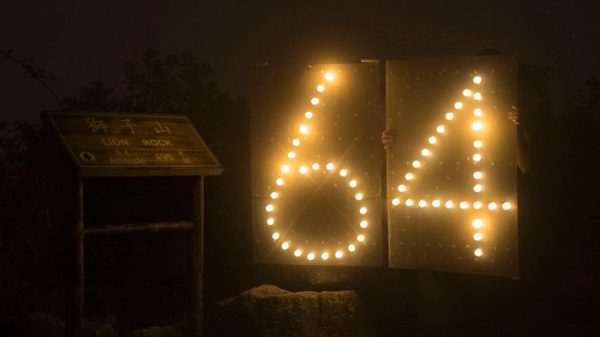
The new exhibition does not mention the term “June Fourth” at all, reported the South China Morning Post. Instead, in the section titled “Hong Kong’s Return to the Motherland,” it uses the phrase “political turmoil in the spring and summer of 1989,” and states that after the turmoil, the British side adopted a “non-cooperative attitude” toward China on Hong Kong-related issues.
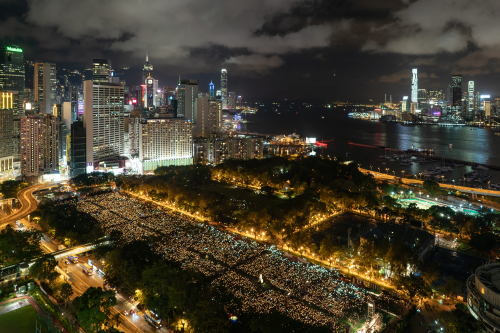
It is reported that before the renovation, the exhibition displayed photos showing that in 1989, one million people in Hong Kong spontaneously took part in marches supporting China’s pro-democracy movement. There were also videos explaining the events of June Fourth in 1989, including footage of Chinese students marching in Beijing’s Tiananmen Square and holding up banners. In the updated exhibition, these photos and videos have been removed.
In response to questions about why certain political events are no longer described in detail, the museum’s director, Ho Pui-yee, explained that Hong Kong has a long history with a wide range of materials, but exhibition space is limited. She added that social development and perspectives are constantly evolving, and the museum has reconstructed its exhibition content accordingly to reflect the times.

CCP historical narrative replacing Hong Kong’s historical understanding
According to a report by Radio France Internationale, Yeung Wing-yu, former manager of the History Subject Assessment Development Division at the Hong Kong Examinations and Assessment Authority and head of the group Edu Lancet, stated that the Chinese Communist Party is replacing Hong Kong people’s original historical understanding with its own narrative.
Yeung pointed out that the CCP has been gradually erasing traces of Hong Kong’s history under British rule. As early as 2001, earlier exhibitions had already begun to downplay the colonial period. Between 2021 and 2023, the “Hong Kong Story Highlights Exhibition” started using the term “seized and occupied,” and now, with the reopening, items symbolizing colonial history—such as photos of past governors and British colonial flags—have been completely removed.
He added that the new exhibition reconstructs historical narratives from the perspective of the CCP’s official discourse. For example, describing the 1967 events as “anti-British resistance” better aligns with its political stance, while replacing the “June Fourth Incident” with “political turmoil in the spring and summer” serves to downplay public memory of the event.
By Li Jingyao, Vision Times