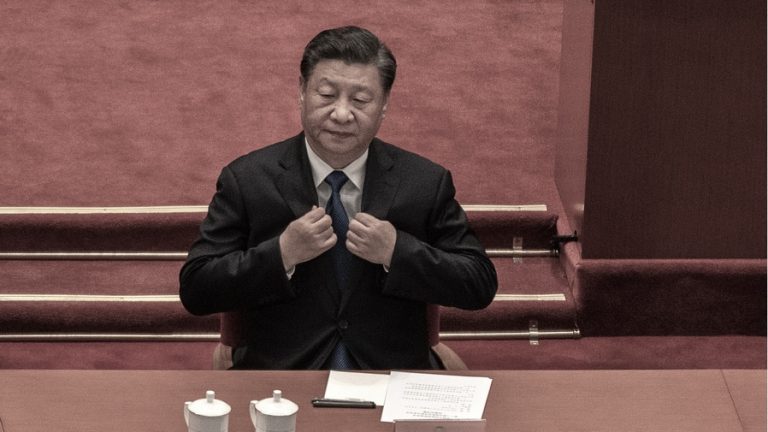
Xi Jinping, general secretary of the Chinese Communist Party and China’s top leader, arrived in Shanghai on July 15 ahead of the World Artificial Intelligence Conference, which runs from July 17 to 20. The city has banned drones from its skies and sealed off the streets around the conference venue. In two high-rise complexes, occupants have reportedly been told to keep every window facing a nearby elevated expressway closed until the meeting ends.
On the afternoon of his arrival, Xi toured a residential community in the city’s Huangpu District, accompanied by Chen Jining, the Politburo member who serves as Shanghai’s Party secretary, and Gong Zheng, the city’s mayor.
The clampdown began three days before Xi landed
On July 12, city authorities announced that all “low-altitude, slow-speed, small” aircraft, including drones, would be barred from taking off or flying anywhere in Shanghai from midnight on July 15 until the end of July 20.
A department at one Shanghai university reportedly followed with an internal notice suspending all low-altitude flight activity, including research test flights, and warning that violators could face action by the police.
The city’s police force then announced traffic restrictions for the district around the conference venue, according to Chinese media outlets including The Paper, a state-supervised Shanghai news site. The zone, enclosed by Bocheng Road, Zhoujiadu Road, Guozhan Road, and Shiboguan Road, is closed to all motor vehicles except taxis and cars carrying conference credentials. Police, fire, ambulance, and emergency repair vehicles on duty are exempt. The closures run from 11 a.m. to 7 p.m. on July 17, then from 7 a.m. to 7 p.m. daily through July 20. Bicycles and other non-motorized vehicles are banned from the zone during the same hours.
Success
You are now signed up for our newsletter
Success
Check your email to complete sign up
On July 14, a notice attributed to the management of the Changfeng Center and the Longemont Plaza, two high-rise complexes in Shanghai, began circulating online. It reportedly told owners and tenants that, to “cooperate with the conference,” every window facing the elevated Yan’an West Road expressway must remain shut.
Occupants were also told not to gather to watch, take photographs, or post anything to their WeChat feeds. The notice reportedly closes by repeating one instruction three times in red letters: keep the windows shut and locked.

Overseas critics call the clampdown proof of the Party’s fear
The order to keep windows closed prompted a wave of ridicule from Chinese-language users on X, a platform banned in China. One commenter reportedly wrote that a leadership operating as though it were at war with the country it governs clearly understands how deeply unpopular it is. Others mocked the Party for constantly claiming to “serve the people” while residents are not even permitted to open the windows of their own homes. Some argued that treating an entire city’s population as potential assassins revealed a regime consumed by fear and guilt.
Some drew comparisons abroad, asking why presidents elsewhere face the press and the public openly while China’s leader seals off every place he visits. The measures go further than the written notices suggest, one user claimed: every building along such routes is warned individually, and a police officer is posted in every stairwell.
An X commentator writing under the handle “Xiang Yang” said the drone ban and mass road closures had made Shanghai itself into a cage. If power is not locked inside a cage, he wrote, power will lock the people inside one. The line inverts a pledge from Xi’s own early tenure, when he promised to confine power within a cage of regulations.
Xiang Yang contrasted the Shanghai operation with Xi’s inspection tour of Guangdong Province in late 2012, shortly after he took power. Traffic police in Shenzhen announced at the time that there would be no road closures and no clearing of crowds, in keeping with the Party’s newly issued “eight-point rules” against official extravagance. Xi’s motorcade traveled alongside city buses and private cars.