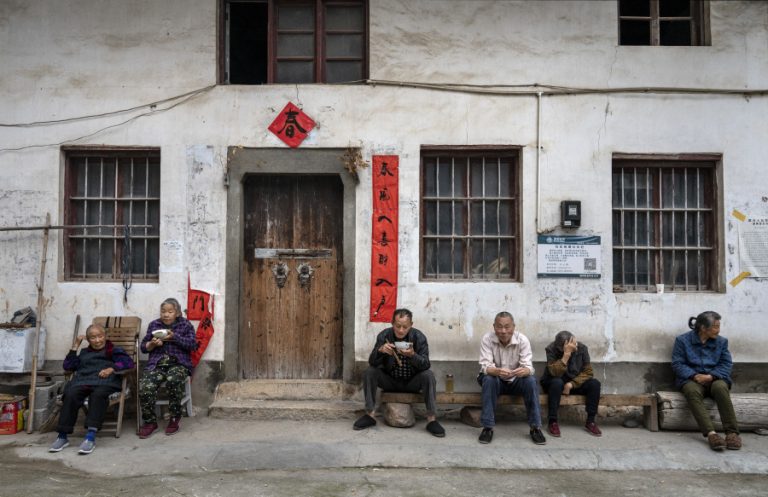
In May 2020, during the final phase leading up to the Chinese Communist Party’s anticipated announcement of “comprehensive victory in poverty alleviation,” an incongruous voice emerged from Beijing. At a press conference during the National People’s Congress, then–Premier Li Keqiang stated:
“China has 600 million people whose monthly income is around 1,000 yuan. In a medium-sized city, that amount may not even be enough to rent a place to live.”
The significance of this statement lies not in the novelty of the data it revealed, but in who said it and when it was said. It came from the country’s number-two official at a moment when state media and official propaganda were fully engaged in celebrating what was described as “the greatest miracle in human history in poverty reduction.”
Six hundred million people—nearly 43 percent of China’s total population—earn less than 1,000 yuan per month, roughly equivalent to 140 U.S. dollars. This is not a marginal group living just above the poverty line. It is a population so large that it could constitute an entire country.
In a nation that proclaims itself to be “rising,” and that has spent vast public resources on projects such as space stations, high-speed rail networks, and the Olympic Games, how is it possible that, after more than seventy years, nearly half of its citizens still have not escaped the constraints of extremely low monthly incomes?
Success
You are now signed up for our newsletter
Success
Check your email to complete sign up
The conventional explanations point to uneven development, the need for gradual reform, and the historical legacy of rural underdevelopment. While these arguments may appear reasonable, they avoid a more fundamental question: if this is truly a problem the system has sought to solve, why has it not been resolved after decades of concentrated political power?
The answer, critics suggest, may be unsettling: it is not that the system is unable to solve the problem, but rather that it cannot. The persistence of a large low-income population is not a failure of the system, but a structural condition upon which it operates.
A parasite requires a permanently weakened host
For someone earning 1,000 yuan per month, nearly all energy is devoted to survival—paying rent, buying food, and, if possible, supporting children’s education. There is little remaining capacity to think about freedom of speech, demand judicial independence, or question the absence of electoral rights. This is not because such concerns are unimportant to them, but because they lack the time and resources to engage with them.
Political participation requires preconditions. It requires time to read, reflect, and engage in discussion. It requires a sense of security—freedom from fear of job loss or retaliation. It requires social connections and horizontal networks among peers. Above all, it requires relief from the daily anxiety of basic survival.
This is not speculation, but a pattern repeatedly observed throughout history.
In the second half of the twentieth century, East Asia inadvertently staged a political experiment. Taiwan, South Korea, Singapore, and Hong Kong—often referred to as the “Four Asian Tigers”—all experienced strong demands for political rights following rapid economic growth. Taiwan lifted martial law and began democratization in 1987, when its per capita GDP reached approximately $5,000. South Korea, at around $3,000 per capita GDP in the same period, saw the June Democratic Movement that ended military dictatorship.
This is not coincidental. Political scientist Samuel P. Huntington, in The Third Wave: Democratization in the Late Twentieth Century, systematically analyzed this phenomenon, arguing that democratization in the late twentieth century was almost universally accompanied by the rise of a middle class. The middle class, possessing property, education, and social networks, has both the capacity and incentive to demand accountable governance.
Conversely, for a political system seeking to avoid such demands indefinitely, one of the most effective strategies is to ensure that the majority of the population remains near subsistence levels—occupied with survival and unable to engage in politics.
Hannah Arendt, in The Origins of Totalitarianism, offered a more direct observation: totalitarian movements require not organized political citizens, but “atomized, isolated masses,” stripped of horizontal connections and fully dependent on the state.
Poverty, in this sense, becomes an effective instrument of atomization. When individuals are dependent on state transfers, state-controlled employment channels, and state-distributed educational resources, their political agency is significantly constrained. They do not resist not because they are satisfied, but because resistance is too costly.
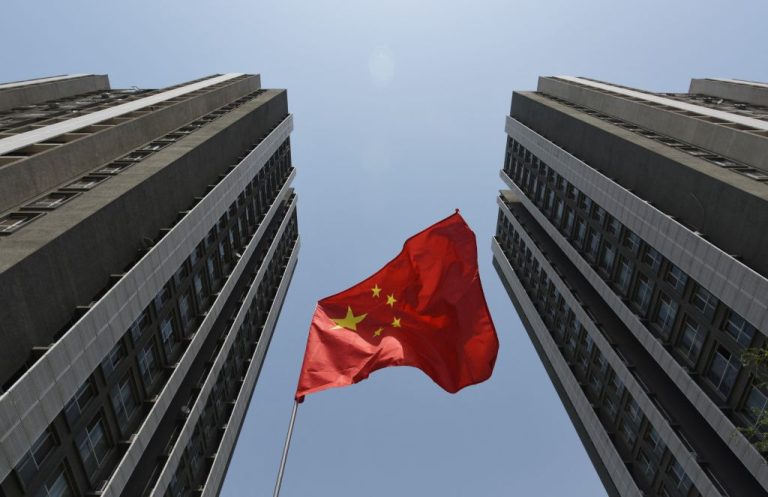
Critics argue that the Chinese Communist Party understands this logic well. This is not a relationship between administrator and governed, but between parasite and host.
In this framework, the ideal condition of the host is not death—which would eliminate the source of sustenance—nor strength and independence, which would enable escape. The ideal condition is a population just weak enough to be controlled, yet alive enough to be productive.
China, with hundreds of millions of people earning around 1,000 yuan per month, appears—according to this view—to reflect such a condition: a population sufficiently poor, busy, and atomized to be politically inert, yet sufficiently industrious to continue generating extractable value.
This state, critics argue, is not accidental.
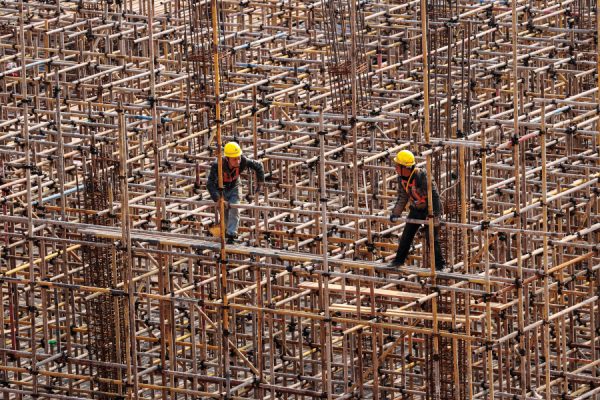
Who is drinking this cup of blood?
If poverty produces political compliance, then the next question is: where does the “saved” labor value go?
The answer lies in a distinctive power structure. In any normal country, citizens support a single government system. In China, however, citizens support two parallel systems of authority: the administrative system and the Party apparatus. At every level—from the central government down to rural villages—each administrative institution is mirrored by a corresponding Communist Party committee. A provincial governor is paired with a Party secretary, a mayor with a municipal Party secretary, a school principal with a Party secretary, and the general manager of a state-owned enterprise with a Party secretary. Across all levels, real decision-making power rests with the Party: the government implements, while the Party controls.
Who ultimately bears the cost of maintaining this dual structure? Critics argue it is the groups with the least bargaining power—farmers and low-income workers.
However, the channels of extraction extend far beyond the operating costs of the Party-state apparatus, feeding into a far broader system of economic interests.
China’s most profitable industries—energy, telecommunications, banking, tobacco, and defense—are all dominated by state-owned enterprises. Where do their profits come from? Critics point to monopoly pricing, preferential access to land and resources below market value, and most significantly, wages far below the true value of labor. The difference, they argue, is absorbed into corporate profits and ultimately flows into networks of political and economic elites that control these enterprises.
China is often described as “the world’s factory,” but few ask what underpins this competitiveness. It is not, in most manufacturing sectors, technological superiority—indeed, critics note that in many areas China’s technology has long lagged behind that of Japan, Europe, and the United States. Instead, the foundation is labor cost.
Hundreds of millions of migrant workers leave their hometowns to work in factories in coastal cities, often working more than 12 hours a day, living in dormitories, and earning wages insufficient to establish themselves in the cities where they work. Their rural household registration (hukou) status prevents their children from accessing urban education and excludes them from local healthcare and social welfare systems. They remain temporary workers—permanently temporary—creating wealth for cities that do not recognize them as full citizens.
If China’s poor were simply victims of “uneven development,” then wealth would be expected to diffuse into a broad middle class. However, the data suggest the opposite. According to Credit Suisse’s Global Wealth Report, the wealthiest 1% of China’s population holds approximately 31% of the country’s total wealth, while the bottom 50% owns less than 6%. More significantly, critics note that a substantial portion of China’s wealthiest individuals have direct or indirect ties to the Communist Party—through family connections to current or former officials, business elites who obtain monopoly licenses through political connections, and “red capitalists” who acquired state assets during privatization processes at prices far below market value.
This, critics argue, highlights a fundamental distinction between inequality in China and inequality in Western market economies. In a market system, inequality is largely the result of rule-based competition and is generally considered a structural outcome of economic activity. In China, however, inequality is shaped primarily by power concentration; it is not a byproduct of market competition but a direct consequence of political allocation of resources.
This system can be understood as a layered extraction chain: hundreds of millions of rural migrant workers supply low-cost labor at the base; state-owned monopolies capture surplus value in the middle; and political and elite networks at the top appropriate accumulated wealth. For this mechanism to operate efficiently, a key condition must be met—the labor force at the bottom must remain inexpensive, compliant, and structurally weak in bargaining power.
From this perspective, poverty is not a malfunction of the system. It is a prerequisite for its efficient operation.
Every path forward leads to its fear
If the Chinese Communist Party truly intended to eliminate poverty, what would be required? Economists can outline a relatively straightforward set of reforms.
Reforming the household registration (hukou) system would allow migrant workers to enjoy equal access to education, healthcare, and social security in the cities where they work. However, this would significantly raise labor costs, weaken export competitiveness, and compress the profits of state-owned enterprises—profits that, critics argue, constitute a vital source of sustenance for elite political and economic networks.
Allowing independent labor unions would give workers the ability to bargain collectively. Yet this would introduce an organized social force outside Party control within factories. The experience of Poland’s Solidarity movement in 1981, observers note, demonstrated to Communist regimes that independent unions can contribute to the collapse of a ruling party within a decade.
Establishing judicial independence would enable victims of forced evictions, wage arrears, and environmental pollution to seek fair rulings. But judicial independence would also mean judges no longer answer to Party committees, undermining one of the core pillars of one-party rule.
Implementing land privatization would give farmers true ownership of their land, allowing it to be sold, mortgaged, or inherited. Yet this would deprive local governments of their primary revenue source—cheap land acquisition and high-price resale—while also removing one of the most significant channels of local official corruption.
Every genuine path toward poverty reduction passes through a door that the Party, critics argue, cannot open. The obstacle is not technical feasibility. Rather, behind each door lies a threat to the system’s core interests and deepest anxieties.
The cycle of promise and betrayal
This is not a new dilemma. It runs through the entire history of the Chinese Communist Party.
When the Communist Party first sought to seize power, it mobilized the working class, praising them as “the most advanced class,” “the leading class,” and “the vanguard of the proletarian revolution.” It promised that “those who till the land shall have it.” After the founding of the state, it quickly eliminated the bourgeoisie and ultimately transformed workers and peasants into a population entirely devoid of ownership.
More than seventy years ago, peasants were promised land—and they received it. Yet within less than two years, through mutual-aid teams, elementary cooperatives, advanced cooperatives, and finally the people’s communes, that land was gradually taken back in its entirety. This was followed by the household registration (hukou) system, which prohibited rural residents from freely moving to cities for work and residence. From that point onward, farmers became second-class citizens in Chinese society.
More than seven decades later, what has changed?
Rural residents can now move to cities to work, but their children are still not allowed to take college entrance examinations in the cities where their parents are employed. They can work in urban areas, but they remain excluded from local healthcare and pension systems. Out of 332 cities nationwide, approximately 49% have removed hukou restrictions, but these are largely smaller cities that migrant workers are less inclined to move to. The major metropolitan centers where migrant workers actually live and work—Beijing, Shanghai, Guangzhou, and Shenzhen—continue to enforce strict point-based systems that systematically exclude low-income laborers.
The form of the hukou system has softened, but its function remains unchanged. It has shifted from a rigid wall that prevents movement into a filtering mechanism that allows labor mobility while denying rights—permitting people to create wealth for the city, but not to access its public services.
The status of second-class citizenship has persisted, only in a more concealed form.
Without property, there is no independence. Without independence, there is no freedom. Without freedom, there is no capacity for resistance.
Carefully maintained poverty
Eliminating poverty would mean the emergence of a citizenry no longer dependent on the system—citizens who would demand rule of law, electoral rights, and accountability of power. This is an outcome the Communist Party system, critics argue, cannot accept.
Therefore, “poverty alleviation” does not truly occur. What occurs instead is a narrative of poverty reduction: a carefully orchestrated performance in which the poverty line is set sufficiently low, statistical figures are made to appear impressive, and the world is led to believe that a miracle is unfolding. Behind the stage curtain, however, hundreds of millions of people—six hundred million by some accounts—continue to earn around 1,000 yuan per month.
This recalls historical cycles. During land reform, peasants were mobilized to denounce landlords under slogans portraying exploitation and redistribution. As historical accounts note, “policies that eliminated rent-seeking and confiscation allowed some peasants to benefit materially, and many impoverished peasants became grateful to the Communist Party, thereby accepting the narrative that the Party served the people.” Yet soon afterward, the land that had been distributed was taken back.
The benefit is temporary. The extraction is permanent.
The “poverty alleviation campaign” is, in this view, the latest iteration of the same model: offering a promise, generating gratitude, and then structurally ensuring that the promise is never fully realized. Because once it is realized, the foundation of that gratitude disappears.
At a deeper level, there is another concealed contradiction. Communism claims to eliminate exploitation and build a classless society. Yet every regime built under its banner has produced social stratifications deeper and more rigid than those it replaced. The promise of “from each according to his ability, to each according to his needs” is, critics argue, inherently unattainable: “from each according to his ability” requires freedom, which such systems suppress; “to each according to his needs” requires an authority to define those needs, which inevitably transforms distribution into allocation by power and rank.
In practice, what emerges is not a market economy but a power economy, where outcomes are determined by political authority rather than individual choice or productivity. Without freedom, “full potential” is impossible to realize.
This is not a deviation from design, critics argue. It is the logic of the design itself.
The Communist Party, they conclude, was never intended to make the poor rich.
When hundreds of millions of people work late into the night in factories, carry bricks on construction sites, or worry about school fees in cramped rental rooms, they may never ask a fundamental question: their poverty, in a certain sense, may be precisely what this system requires.
Because once they are no longer poor—once they have time to think, resources to choose, and confidence to say “no”—the foundation of the system itself begins to weaken.
(This article reflects the author’s personal views and opinions only.)
By Xinye