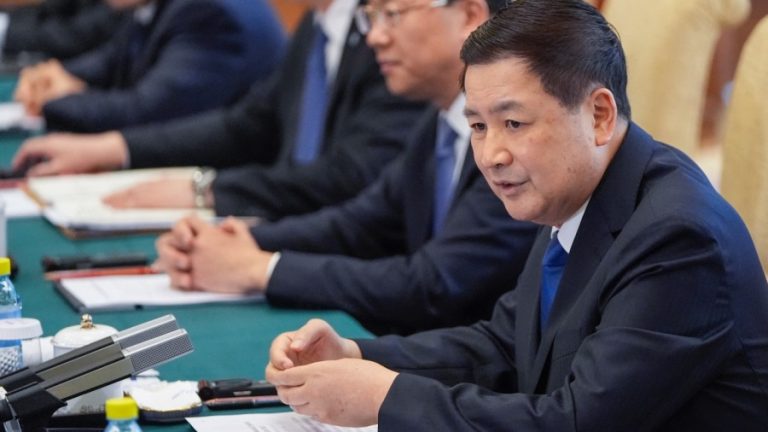
Recently, a delegation led by Vietnamese Communist Party General Secretary Tô Lâm visited China. Chinese state media reports also mentioned Wang Xiaohong, who had not been seen in public for a long time, but the coverage raised many questions.
For example, Vietnamese state media reported that Wang Xiaohong held a one-on-one meeting with Vietnam’s Minister of Public Security Lương Tam Quang, yet Chinese state media remained collectively silent on this. Meanwhile, a central inspection team is also set to be stationed in the Ministry of Public Security. Some analysts believe that Wang Xiaohong’s public appearance was deliberate and that he may follow a “Ma Xingrui-style handling” pattern.
Ma Xingrui, a former member of China’s top leadership body, the CCP Politburo, was officially announced as removed, and the CCP also disclosed his new demoted position in the announcement, according to an earlier recent report by Vision Times.

Tô Lâm’s visit to China; Wang Xiaohong reappears publicly
According to a report by Xinhua News Agency, on the morning of April 14, Tô Lâm—General Secretary of the Communist Party of Vietnam and President of Vietnam—began a four-day state visit to China. On April 15, Chinese leader Xi Jinping held talks with Tô Lâm, reported CGTN, another Beijing state media.
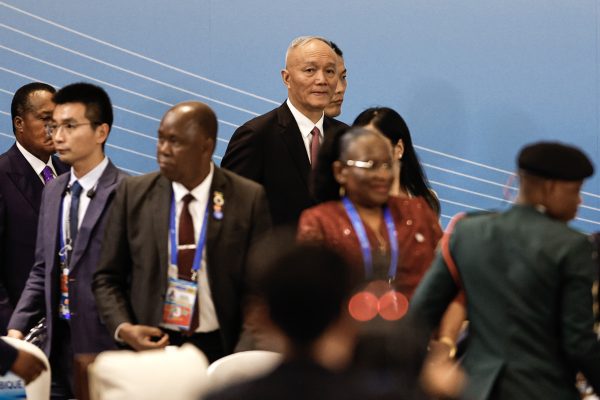
Those accompanying the meeting included Politburo Standing Committee member Cai Qi, Politburo members Wang Yi and Yin Li, as well as State Councilor Wang Xiaohong.
Success
You are now signed up for our newsletter
Success
Check your email to complete sign up
This also marked Wang Xiaohong’s first public appearance after 28 days out of sight. From March 15 to 17, 2026, China’s Minister of Public Security Wang Xiaohong, Foreign Minister Wang Yi, and Defense Minister Dong Jun visited Vietnam and attended the first ministerial-level meeting of the China–Vietnam “3+3” strategic dialogue mechanism on diplomacy, defense, and public security.
After concluding the Vietnam visit, Wang Yi and Dong Jun both made subsequent public appearances. Only Wang Xiaohong remained out of sight from March 18 to April 13, without attending any public events. This led to widespread speculation about whether he had encountered trouble due to internal Party struggles or was experiencing health issues.
Wang Xiaohong is a key longtime confidant of Xi Jinping from his tenure in Fujian. He holds multiple positions, including Secretary of the CCP Central Secretariat, State Councilor, Deputy Secretary of the Central Political and Legal Affairs Commission, and Minister of Public Security.
After Wang Xiaohong reappeared on April 15, 2026, U.S.-based independent commentator Cai Shenkun posted on the platform X, saying: “After returning to Beijing from Vietnam last month, Wang Xiaohong had been out of sight, and there were widespread overseas rumors that he had been detained. I don’t think that’s very reliable. After asking around, people said it was a health issue, not a political one.”
Cai Shenkun noted that Cai Qi and Wang Xiaohong are among Xi Jinping’s most trusted aides. At most, the two compete for favor and credit in front of Xi. If they were truly detained, it would imply that Xi’s position is in serious trouble.
On April 15, Australia-based commentator Jiang Wangzheng posted on X, claiming: “Wang Xiaohong has throat cancer but is reluctant to relinquish power (and money). He is the most knowledgeable among CCP officials about digital currencies and needs to handle large amounts of Bitcoin and USDT, from which he can extract 12%–15% in profits. This is the real reason he is unwilling to step down.”
Although Wang Xiaohong’s public appearance this time seemed intended to “dispel rumors,” unusual signs appeared on the day he met with Tô Lâm, which has led to further speculation about his true situation.
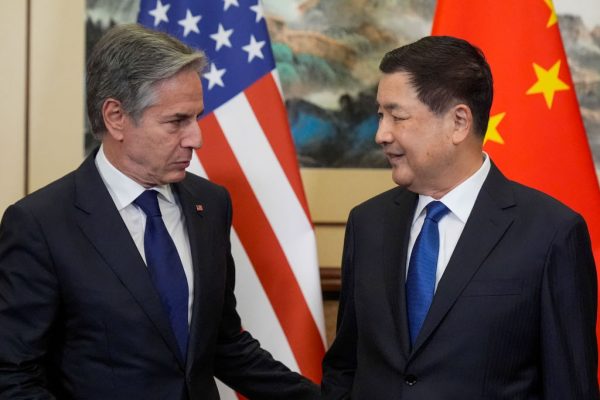
Wang Xiaohong meets Lương Tam Quang; Chinese state media remains silent
On April 15, Xinhua News published a report titled “Chen Wenqing Meets with Vietnamese Politburo Member and Minister of Public Security Lương Tam Quang.”
The report mentioned that on April 14, after Tô Lâm and his delegation arrived in Beijing, Chen Wenqing—member of the CCP Politburo and Secretary of the Central Political and Legal Affairs Commission—met in Beijing with Lương Tam Quang, who was visiting as a Politburo member of the Communist Party of Vietnam and Vietnam’s Minister of Public Security. However, the report did not mention Wang Xiaohong at all, creating the impression that Wang may not have met with Lương.
Logically, since Lương Tam Quang is Vietnam’s Minister of Public Security, his most direct counterpart for a meeting should have been Wang Xiaohong, who holds the same position in China. At the very least, Wang should have been present when Chen Wenqing met with Lương. Yet, Wang’s name was absent from Chinese state media coverage.
In stark contrast, Vietnam’s state media Vietnam News Agency reported that on April 14, Lương Tam Quang separately met with Chen Wenqing; China’s Minister of Public Security, Wang Xiaohong, and China’s Minister of State Security Chen Yixin. On the same day, Vietnam’s government website also published this information as an important accompanying report related to Tô Lâm’s visit to China.
From this, it can be inferred that Wang Xiaohong did in fact meet with Lương Tam Quang. However, Chinese state media collectively remained silent on this point and did not report it.
U.S.-based commentator Tang Jingyuan said on his self-media program that some may argue Wang Xiaohong is only a CCP Politburo member and not of sufficient rank, so state media would naturally focus on meetings between Tô Lâm and Xi Jinping. However, Tang noted that while it may be understandable for other state media outlets not to report Wang Xiaohong’s meeting with Lương Tam Quang, even the official website of China’s Ministry of Public Security made no mention of it.
He pointed out that the Ministry’s homepage prominently reposted a Xinhua article titled “Xi Jinping Holds Talks with General Secretary and President of Vietnam Tô Lâm,” but did not include any report on Wang Xiaohong’s separate meeting with Lương Tam Quang or the signing of a cooperation agreement.
Tang Jingyuan further noted that when checking the Ministry of Public Security’s “Wang Xiaohong important activities” section, the most recent entry is dated March 17, 2026, covering Wang Xiaohong’s visit to Vietnam for the inaugural ministerial-level meeting of the China–Vietnam “3+3” strategic dialogue mechanism on diplomacy, defense, and public security.
He argued that the speculation that Wang Xiaohong’s indirect public appearances indicate he has “safely passed the test” cannot yet be confirmed. In his view, Wang Yi, Dong Jun, and Wang Xiaohong’s March visit to Vietnam was intended to “pave the way” for Tô Lâm’s visit to China. At that time, Wang Xiaohong did meet with Lương Tam Quang, and the recent visit by Lương accompanying Tô Lâm to China can be seen as a typical “reciprocal visit.”
As the host of the public security system, Wang Xiaohong would normally be expected to meet Lương Tam Quang. If he were absent from such an occasion and instead a deputy minister of public security were sent, it would effectively amount to an official signal that Wang Xiaohong was in trouble.
Analysis: Wang Xiaohong may be following a ‘Ma Xingrui-style handling’ pattern
Tang Jingyuan stated that one possible explanation, which he had previously discussed, is that if the CCP authorities are indeed investigating Wang Xiaohong, they may still allow him to appear publicly in necessary situations—such as meetings with foreign officials—in order to avoid exposing the situation prematurely.
Tang Jingyuan believes that, secondly, Wang Xiaohong may be following a “Ma Xingrui-style” model.
On July 1, 2025, the CCP authorities removed Ma Xingrui from his post as Party Secretary of Xinjiang, stating that he would be given “other duties,” but they did not disclose what new position he would take. At the time, outside observers speculated that Ma might be in trouble. On September 3, 2025, during the CCP military parade, Ma Xingrui appeared on Tiananmen Gate to watch the event, and state broadcaster CCTV even gave him a close-up shot.
This created the impression that Ma had “safely landed.” However, it was not until April 3, 2026, that the CCP officially announced Ma Xingrui’s downfall, and the statement finally revealed that his previously mentioned “other duties” referred to the position of Deputy Head of the Central Rural Work Leading Group. Tang Jingyuan pointed out that the reason the authorities delayed announcing Ma’s new position was an intentional effort to handle him in a low-profile manner.
Wang Xiaohong now appears to be somewhat similar, following this type of “Ma Xingrui-style handling” pattern—where a figure may still be made to appear in certain occasions, but is simultaneously subjected to low-profile suppression.
Tang Jingyuan further stated that during this period there have been ongoing rumors that Wang Xiaohong is in trouble. The visit of Vietnamese leaders to China would have been an ideal opportunity to dispel such rumors. However, even though Vietnamese state media openly reported Wang Xiaohong’s meeting with Lương Tam Quang, Chinese state media collectively remained silent. Tang believes this suggests a high probability that Wang is under investigation.
He noted that Wang Xiaohong is a key confidant of CCP leader Xi Jinping. Xi would not easily abandon him, because if even a long-time trusted aide like Wang Xiaohong were not protected, other members of Xi’s faction would become disheartened. Therefore, he argues that the current situation reflects a “tug-of-war” between Xi’s camp and opposing factions.
Tang predicts that Wang Xiaohong may still appear publicly in certain important special occasions in the future, but he is currently in serious trouble. In his view, Wang’s downfall is only a matter of time. As the CCP’s “knife handle” (a term referring to the security apparatus), it is difficult for him to “land safely.”

Central inspection team enters Ministry of Public Security
In addition, perhaps not coincidentally, on the day Wang Xiaohong made a public appearance, the official website of the Central Commission for Discipline Inspection (CCDI) announced at 6:30 p.m. on April 15 that a mobilization meeting had recently been held for the inspection of the Party Committee of the Ministry of Public Security by the CCP Central Inspection Team No. 12.
The meeting was presided over by Wang Xiaohong, Secretary of the CCP Central Secretariat and Minister of Public Security, who also delivered a speech. Shi Kehui, head of the CCP Central Inspection Team No. 12, delivered a mobilization speech and outlined requirements for the inspection work.
According to CCP state media reports, the central inspection team will remain in the Ministry of Public Security for about two and a half months. The period for receiving complaints and reports will last until June 23 this year. It is understood that the inspection team will mainly accept letters, phone calls, and visits concerning issues involving the leadership team of the Ministry of Public Security’s Party Committee and its members, as well as principal leaders of subordinate Party organizations.
The background of Shi Kehui, head of Inspection Team No. 12, is also notable. He is a former aide of both Xi Jinping and former CCDI Secretary Wang Qishan, and also a former subordinate of Xia Baolong, head of the Hong Kong and Macao Affairs Office, during their time in Zhejiang.
In 2014, Shi Kehui was appointed Deputy Secretary-General of the CCDI and Director of its General Office, becoming the “chief administrator” for then-CCD Secretary Wang Qishan. From April to June 2025, Shi led Central Inspection Team No. 12 to conduct inspections in Sichuan Province. On April 25, 2025, former Vice Chairman of the Sichuan Provincial People’s Congress Song Chaohua was investigated; on May 21 of the same year, Sichuan Vice Governor and Public Security Department head Ye Hanying was also investigated and removed. Ye Hanying had long worked in Zhejiang’s public security system and was a key figure in the so-called “Zhijiang New Army,” associated with Xi Jinping’s faction.
At the time, a former aide of Wang Qishan investigating key figures linked to Xi’s faction fueled widespread speculation that Xi had lost significant power within the Party.
Now, as Inspection Team No. 12 under Shi Kehui is set to enter the Ministry of Public Security—Wang Xiaohong’s domain—and given that the two belong to different factions, combined with the fact that Wang Xiaohong did not meet with Vietnamese Minister of Public Security Lương Tam Quang on April 15 according to Chinese state media, the political signals being sent behind these developments have drawn significant attention.
By Li Deyan