Cut open a ripe fig and you will find something no botanist’s diagram quite prepares you for: a dense, fleshy interior packed not with seed pulp but with the remnants of an entire reproductive cycle. Flowers bloom, wasps mate, and a female wasp enters alive and never leaves. The fig is a closed system, where every stage of reproduction unfolds out of sight before the fruit ripens.
Plants use a wide range of strategies to reproduce. Grain crops rely on wind. Fruit trees depend on bees. Bamboo spreads through underground runners without producing seeds. Some plants, such as dodder and the gastrodia orchid, draw nutrients from host plants or fungal networks instead of soil. Dandelions send seeds airborne on fine filaments. Cockleburs attach to passing animals with hooked fibers.
The fig tree follows a different path, one built on a tightly evolved partnership. Neither organism involved can complete its life cycle without the other.
Banyan trees hide their flowers inside the fruit
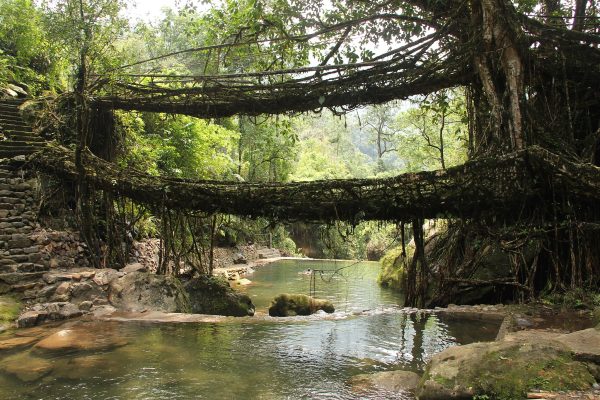
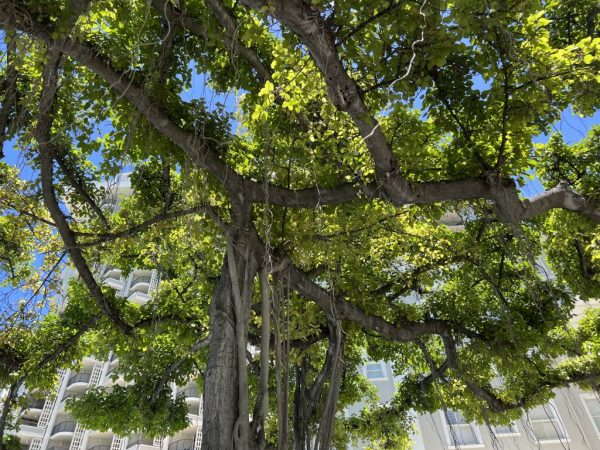
The banyan, discussed in an earlier column, reproduces through stem cuttings, aerial roots, and seeds. The last method presents an apparent contradiction: banyan trees produce fruit continuously, yet their flowers are never visible. The flowers exist, but they are concealed.
Banyans and other fig species belong to what botanists describe as cryptic-flowering plants. Pollination, fertilization, and seed development all take place inside an enclosed structure known as a syconium, an immature fruit that functions as both flower chamber and seed container. The pollination process depends entirely on the fig wasp, a species so small that it often goes unnoticed. Each fig species has co-evolved with a specific type of wasp.
Success
You are now signed up for our newsletter
Success
Check your email to complete sign up
A wasp smaller than a sesame seed forces its way inside
Each fig develops a small opening at its tip, roughly two millimeters across, forming between the eighteenth and twenty-sixth day of growth. The opening releases a scent that attracts the appropriate wasp species. Inside, the chamber is divided into two regions: an upper gall zone for egg-laying and a lower region containing male and female flower structures.
The fig wasp is smaller than a sesame seed. A fertilized female locates a young fig and forces her way through the narrow opening. The passage tears off her wings, leaving them behind. Once inside, she crawls through the flower structures, collecting pollen as she moves. She deposits her eggs in the gall zone and, in the process, transfers pollen to the female flowers. She dies within the fig, and her body is gradually absorbed.
The wasps hatch, mate, and die inside the fruit
Fertilized eggs develop into larvae that feed on the fig’s internal tissue. They mature within the enclosed chamber. Before emerging, male and female wasps mate inside the fruit.
Male wasps develop without wings. They cut open the chambers containing the females and mate with them before the females fully emerge. The males then chew an exit tunnel through the fruit wall. When they leave, they are typically killed by ants waiting outside.
The females, now carrying pollen, exit through the same passage and fly off to locate another young fig. Their lifespan as adults lasts only about two hours. Pollinated figs continue to develop, producing viable seeds. The original female wasp that entered the fig has already been broken down within the fruit.
Each fig species is paired with its own wasp
Different fig species maintain distinct relationships with specific wasp species. The aiyu jelly fig, for example, grows on separate male and female trees. Only pollinated female fruits develop into the fleshy form consumed by animals, which then disperse the seeds. Unpollinated fruits remain small and fall without contributing to reproduction.
The ridge-fruited fig follows another variation. Its associated wasp uses a specialized egg-laying structure to deposit eggs from outside the fruit, without entering it.
In each case, the relationship follows the same pattern. The tree provides a protected environment for the wasp’s offspring, while the wasp delivers the pollen the tree cannot transport on its own.
By Yuan Ding