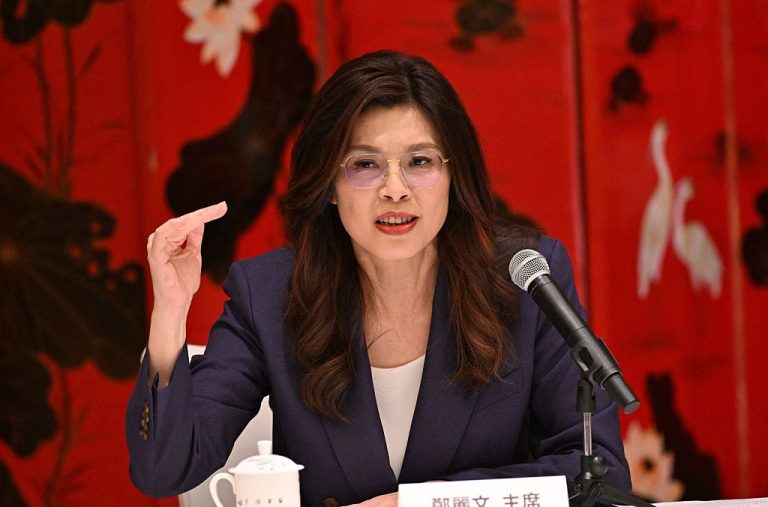
Taiwanese opposition leader and Kuomintang (KMT) chairwoman Cheng Li-wun is currently on a two-week visit to the United States. Before departing Taiwan on June 1, Cheng said she was “very willing” to meet President Donald Trump during the trip.
Her remarks come following her six-day visit to China in April, during which she met Chinese leader Xi Jinping, advocated dialogue, and described Taiwan as a “symbol of peace rather than a flashpoint of conflict.”
Cheng was accompanied by a 14-member KMT delegation, and her meeting with Xi on April 10 drew significant public attention and scrutiny because it took place exactly one month before the Xi-Trump summit in Beijing. Xi told Cheng that the People’s Republic of China (PRC) would not tolerate Taiwan “independence,” a message he repeated during his summit with Trump.
Before departing for her multi-state U.S. trip, Cheng told reporters in Taipei that, just as she had met Xi, she was also “very willing” to engage with Trump and other leaders whose positions and attitudes were “conducive to peace,” according to Reuters.
“The same applies to President Trump. Anything that is helpful to peace, I am willing to do; anyone who is helpful to peace, I am willing to meet — let alone the most critical decision-maker and leader, which is the president of the United States,” she said.The U.S. Department of State said that “travel to the United States by officials from all of Taiwan’s political parties is routine and fully consistent with our longstanding policy” in a response to Taiwan’s Central News Agency (CNA) on Wednesday, June 4. The department declined to comment on the possibility or likelihood of a meeting between Cheng and any U.S. official.
Cheng’s comments on the ‘First Island Chain’, ‘Cold War-era mindset’
Success
You are now signed up for our newsletter
Success
Check your email to complete sign up
Apart from attracting attention for her summit with Xi Jinping — the first such meeting between a top KMT leader and the Chinese leader in a decade — Cheng has also drawn headlines for her calls to move beyond what she describes as “Cold War-era” thinking regarding Taiwan.
The communist-run PRC claims Taiwan as a rightful part of its territory. Taiwan, a democracy of about 23 million, is formally known as the Republic of China (ROC), which governed most of the country until its defeat on the mainland by the communist forces in 1949. The KMT, the name of which means “Chinese Nationalist Party,” ruled Taiwan under martial law until the late 1980s.
Despite the bitter civil war with the Chinese Communist Party, ties between the KMT and Beijing have warmed considerably in recent decades, with the party promoting more business and cultural ties.
Ahead of her meeting with Xi in Beijing, Cheng told CNN in an exclusive interview that the concept of the “first island chain” is rooted in a “Cold War-era” mindset focused on military confrontation and argued that Taiwan did not want to become the “next Ukraine.”
RECENT COVERAGE
- US Delay of $14 Billion Taiwan Arms Package Raises Questions Over America’s Defense Capacity and China Strategy
- Trump’s Warning Against ‘Taiwan Independence’ Seen as Tactical Play in Talks With Beijing: Analysts
- Xi Meeting With KMT Chair Cheng Li-wun Signals Narrative Shift Toward ‘Peaceful Reunification,’ Taipei-based Experts Say
She was in California on Thursday, June 4 (Wednesday Pacific time), where she sought to strengthen strategic ties and expand cooperation between Taiwan and Silicon Valley.
Speaking in Santa Clara, Cheng said the “first island chain,” which includes Taiwan, Japan and South Korea, had historically served as a forward defense line for U.S.-aligned countries.
In the 21st century, however, she said that Taiwan should move beyond this “Cold War mindset” and help transform the chain into a “chain of peace and prosperity” that promotes the convergence of talent, technology and capital, as reported by CNA.
Critics have noted that such rhetoric is similar to that deployed by the PRC government and its state mouthpieces.
The KMT chairwoman added that Taiwan should not be forced to choose between China and the United States and that, despite its many differences with Beijing, Taiwan should seek “common ground” to avoid conflict.
“Being friendly to the US does not necessarily mean there’s animosity toward China,” Cheng told CNN.
‘Alternative’ approach or pro-Beijing?
Cheng, a former Democratic Progressive Party (DPP) activist, became KMT chairwoman in November 2025. Since then, she has attracted attention for her messaging on cross-strait peace and relations with Beijing.
Some analysts have described her approach as an “alternative” framework for cross-strait relations, while others have criticized it as an accommodation of Beijing and characterized both her leadership and visit to mainland China as being problematic for Taiwan’s sovereignty and democratic political system.
Hungdah Su, president of the Taipei Forum Foundation, described Cheng’s messaging as an “alternative approach” in a Brookings commentary published on June 2.
Su wrote that Cheng’s summit with Xi had already influenced Taiwan’s political landscape and the trajectory of cross-strait relations.
“Through a series of addresses delivered in Nanjing, at the Sun Yat-sen Mausoleum, at the Port of Shanghai, and during the summit itself, Cheng articulated a new strategic framework toward Beijing, which I characterize as Cheng’s ‘alternative approach’ or ‘path’ (鄭麗文路線),” he wrote.
While describing the trip as a tactical success, Su said the PRC authorities had demonstrated “diplomatic restraint” throughout Cheng’s itinerary.
“Xi and other Chinese Communist Party (CCP) officials deliberately eschewed provocative terminology such as ‘One China,’ ‘Chinese unification,’ or ‘one country, two systems,’” he wrote, adding that the omissions reflected a “high-level mutual understanding, with both parties adopting a recalibrated foundation as a prerequisite for the summit and future bilateral cooperation.”
According to Su, the summit improved Cheng’s public standing but had little effect on support for the ruling DPP or President Lai Ching-te.
“For the Taiwanese public, the Cheng-Xi summit’s most significant immediate consequence has been a perceptible de-escalation of cross-Strait tensions, albeit perhaps temporarily.”
Others have taken a different view.
In a commentary published on April 23, analysts at the Washington-based Global Taiwan Institute described Cheng as a “controversial” leader and her China visit as “polarizing.”
“The trip has proven to be highly controversial in Taiwan, and even within Cheng’s own Kuomintang Party— revealing cleavages between ‘deep blue’ KMT members favoring closer ties with Beijing, and more moderate members uneasy with the KMT leadership’s open cultivation of the PRC’s Communist rulers,” analysts John Dotson, Yuchen Lee and Ben Levine wrote.
According to the analysts, Cheng’s trip reflected Beijing’s long-standing preference for cultivating party-to-party contacts rather than state-to-state relations. They argued that this approach explains why Beijing continues to characterize the DPP-led administration as separatist while seeking closer ties with the KMT.
The analysts also pointed to Cheng’s own remarks about seeking peace across the Taiwan Strait. During the trip, Cheng had said that “[the KMT is] seeking an institutional solution to prevent war.”
The Global Taiwan Institute analysts highlighted what they described as several “provocative remarks” and argued that her visit differed significantly from those of previous KMT leaders.
“In her speech, Cheng repeatedly referenced Japan, tracing the origins of current cross-Strait divisions to the First Sino-Japanese War; and portraying Japan as both a colonial ruler of Taiwan, and a participant in imperialism and aggression during the Second World War,” they wrote.
The analysts said this narrative closely mirrors Beijing’s recent rhetoric accusing Japan of interfering in cross-strait affairs and contributing to regional tensions through what the CCP criticizes as “remilitarization.”
They also questioned whether any meaningful “institutional solutions” emerged from the visit, arguing that contrary to claims that the trip was aimed at promoting peace across the Taiwan Strait, it ultimately proved “controversial” both within Taiwan and within Cheng’s own party.