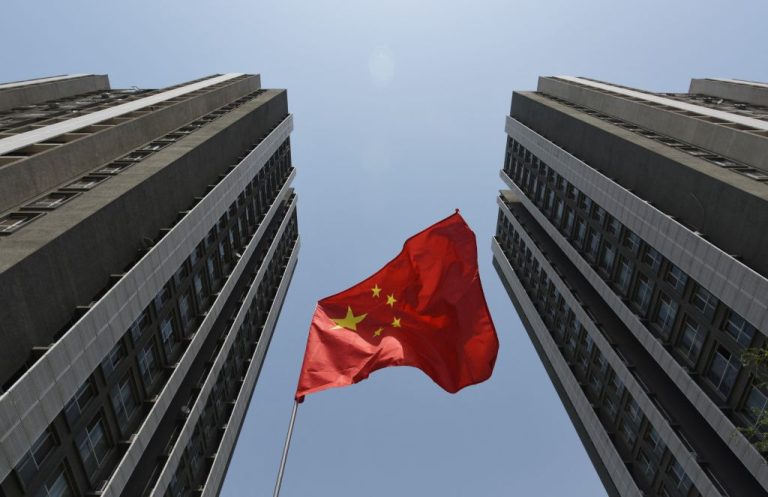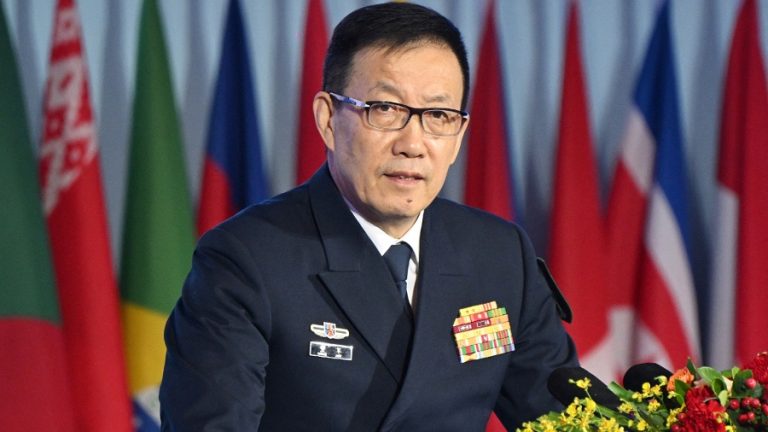
Amidst U.S.-China growing geopolitics and the intense clique politics within the Chinese Communist Party, the recent movements of Chinese Defense Minister, Dong Jun have attracted significant attention.
Most notably, according to the South China Morning Post (SCMP), he was absent for a second consecutive year from the Shangri-La Dialogue in Singapore, a development that has sparked considerable discussion. Instead, Dong unexpectedly appeared in South Africa on a public visit, drawing further scrutiny.
At the recently concluded Shangri-La Dialogue, Chinese representatives reportedly adopted an aggressive and confrontational tone toward U.S. and Japanese officials, displaying what commentators described as a “Wolf Warrior” posture.
The episode has also prompted comparisons with the meeting between Donald Trump and Xi Jinping two weeks earlier, after which three separate incidents involving Chinese and American personnel reportedly occurred within a single day.
Success
You are now signed up for our newsletter
Success
Check your email to complete sign up
Dong Jun’s sudden appearance in South Africa; three absences from major events
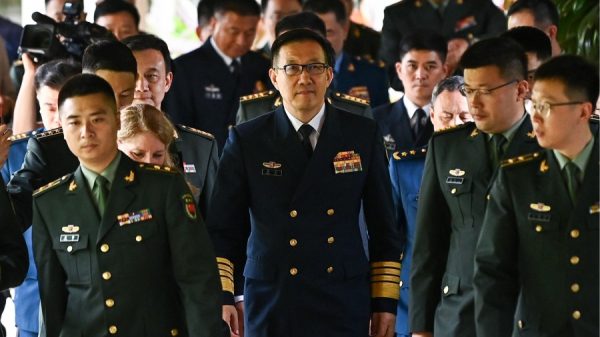
The whereabouts of Dong Jun in recent weeks have become a subject of public interest. The most widely discussed issue has been his second consecutive absence from the Shangri-La Dialogue in Singapore.
Prior to that, he had also missed a number of other diplomatic and foreign-affairs events in succession. According to China Daily, on May 25, 2026, Asim Munir, Commander of Pakistan’s Armed Forces and Chief of Army Staff, led a delegation on a visit to Beijing. In an unusual move, Chinese Defense Minister Dong Jun did not meet with Munir. Instead, the talks were conducted by Zhang Shengmin, Vice Chairman of China’s Central Military Commission.
On May 27, Zhang Shengmin chaired a meeting on “deepening the study and implementation of Xi Jinping’s military-strengthening thought.” According to footage broadcast by CCTV, Dong Jun was again absent. There were also no reports that day of Dong attending any military or diplomatic activities.
Dong’s absence from three important events fueled speculation about his status.
On June 2, 2026, China’s Ministry of National Defense announced that Dong Jun had made an “invited visit” to South Africa on June 1 and held talks with Angie Motshekga, South Africa’s Minister of Defence and Military Veterans.
The timing of Dong’s public reappearance was also seen as unusual.
From May 29 to 31, 2026, the 23rd Shangri-La Dialogue was held in Singapore. The summit had just concluded when Dong appeared at an event in South Africa on June 1.
As for why Dong did not attend the dialogue, the issue has become the subject of widespread speculation.
On May 29, independent Chinese commentator Cai Shenkun, speaking on the current-affairs program Current Affairs Panorama (Shishi Zongheng), argued that Dong’s absence reflected Beijing’s relatively low level of importance attached to the Shangri-La Dialogue. Cai suggested that the Chinese government preferred not to make public statements on sensitive issues such as the Taiwan Strait and the South China Sea at the forum and therefore sent lower-ranking representatives rather than the defense minister himself.
At the Shangri-La Dialogue on June 2, 2024, Chinese Defense Minister Dong Jun stated that, in the face of the Chinese military, Taiwan was engaging in actions akin to “a praying mantis trying to stop a chariot” and “deceiving itself.” He also declared forcefully: “Anyone who dares to separate Taiwan from China will be crushed and shattered.”
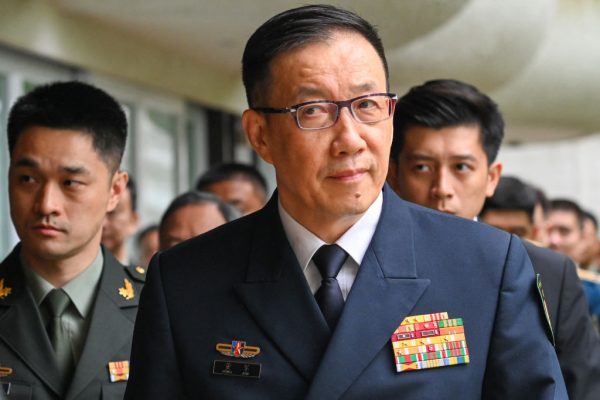
During the Shangri-La Dialogue, Chinese delegates again displayed a ‘wolf warrior’ style
This year, instead of attending the Shangri-La Dialogue himself, Dong Jun delegated attendance to Meng Xiangqing, a professor at the National Security College of China’s National Defense University.
Although Meng holds the rank of major general, he is primarily an academician and does not occupy a senior command or government position. As a result, some observers described him as the lowest-ranking head of a Chinese delegation ever sent to the Shangri-La Dialogue.
According to a May 31 report by Politico, U.S. Defense Secretary Pete Hegseth called for Washington and Beijing to have a relationship “based on fairness and reciprocity.”
On May 30, during a breakout session at the conference, Meng Xiangqing questioned whether Japan was “qualified to speak extensively about defense cooperation in international forums,” and further accused Japan of being a “new militarist” state.
On May 31, Japanese Defense Minister Shinjiro Koizumi strongly pushed back against the Chinese remarks. He pointed out that China has been rapidly expanding its military capabilities without sufficient transparency. According to The Guardian, Koizumi said: “Think about it. There is a country that has a huge arsenal of nuclear weapons and strategic bombers. Japan has neither of such weapons. And yet, Japan is labelled (as) ‘new militarism.’ Isn’t it strange?”
During the conference, a Chinese scholar also directly questioned U.S. General Xavier Brunson, the top four-star commander of U.S. Forces Korea, in the presence of U.S. Defense Secretary Pete Hegseth. The challenge stemmed from Brunson’s recent description of South Korea, a U.S. ally, as a “dagger” pointed at China.
On May 22, 2026, Brunson gave an interview to the China Landpower Studies Center under the Strategic Studies Institute of the U.S. Army War College. During the interview, host Dr. Tom Spahr asked him to imagine rotating a map of the Pacific region 90 degrees to the right and viewing the strategic environment from China’s perspective, with South Korea positioned at the center of the map.
Brunson replied: “I was always one of these people that was like, what are they so concerned about? There’s all kinds of gaps in those islands that they could just drive through, and they don’t have any problem with access to the greater Pacific.”
“Well, they do in their mind, because of capabilities that might be resident on those landmasses and how it might impact their ability to transit smoothly,” Brunson said.
When confronted by the Chinese scholar, the U.S. representatives did not back down and instead emphasized the importance of Indo-Pacific security cooperation.
Several conference participants told reporters that the Chinese delegation as a whole displayed a noticeably aggressive posture throughout the event.
Three confrontations erupt within a day of the Trump–Xi meeting
Chinese personnel’s perceived discourteous treatment of foreign counterparts has occurred on more than one occasion. During U.S. President Donald Trump’s recent visit to China, at least three separate confrontations reportedly took place between Chinese and American personnel in a single day.
On the morning of May 14, Chinese media personnel allegedly obstructed White House reporters from entering the meeting hall where U.S.-China talks were being held. U.S. officials repeatedly shouted, “White House press pool only!” to ensure the reporters were allowed entry.
After White House reporters entered the hall, Chinese security personnel reportedly blocked them again from following President Trump. This led one American photographer to curse in frustration and prevented White House journalists from capturing the moment when Trump first took his seat.
Later that afternoon, when President Trump arrived at the Temple of Heaven for a visit, Chinese security personnel reportedly stopped an armed U.S. Secret Service agent. U.S. Secret Service personnel routinely carry firearms while protecting the president during overseas visits.
The standoff reportedly lasted nearly 30 minutes, delaying the White House press pool’s coverage by approximately half an hour.
White House reporters were later directed into a room near the Hall of Prayer for Good Harvests within the Temple of Heaven complex. At one point, the door was allegedly closed, and security personnel stationed outside prevented journalists from leaving.
After a period of confrontation, one reporter reportedly shouted that he wanted to leave, prompting broader protests from the White House press corps. Several journalists then forced their way past the restrictions, pushed open the door, and hurried to catch up with Trump’s motorcade. Even then, some Chinese personnel continued attempting to block the reporters, who ultimately rejoined the presidential convoy after pushing through the barriers.
These incidents involving White House journalists during the Trump–Xi meeting shocked outside observers. It further contends that the confrontational behavior attributed to Chinese representatives at the Shangri-La Dialogue two weeks later reinforced international perceptions of what the article characterizes as the Chinese Communist Party’s heavy-handed and discourteous conduct.