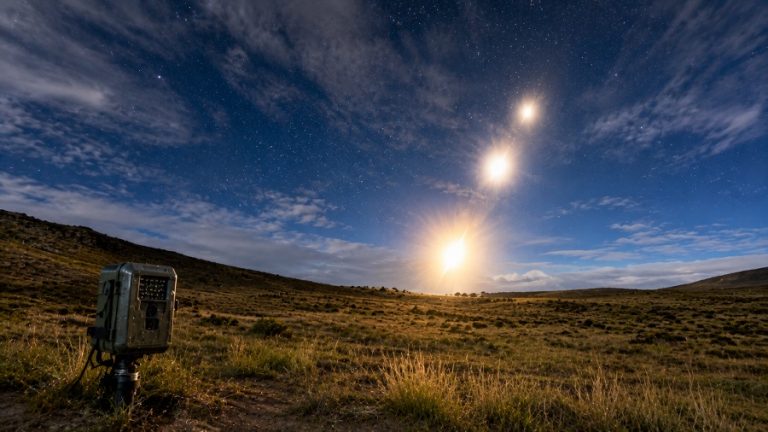
The wildlife cameras had been waiting for pumas.
Set along the edge of open grassland in Chilean Patagonia, the infrared camera traps deployed by the University of Magallanes were designed to log the nocturnal movements of pumas, foxes, and other animals across one of South America’s most remote ecosystems. On the night of Jan. 21, 2025, at 12:22 a.m., one of those cameras recorded something else entirely.
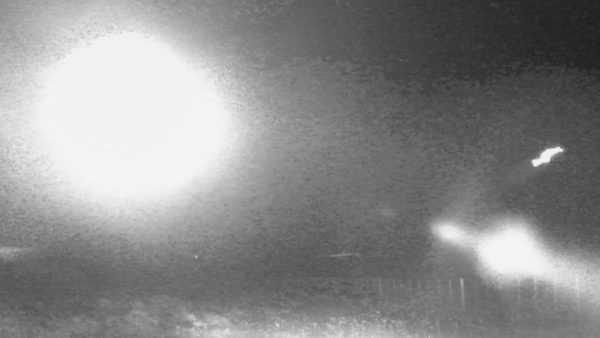
In the span of two seconds, the trap captured three consecutive photographs. In each frame, a brilliant light source moved closer to the lens, descending toward the ground, growing so intense by the third image that it nearly overwhelmed the camera’s sensor. The research team had no explanation ready.
Three photographs among 360,000
The cameras were part of a project called the Public Baseline Program, launched in November 2023 to document wildlife activity across Patagonia and Tierra del Fuego. By the time the anomalous images surfaced, 65 cameras had collectively produced more than 360,000 photographs and video clips.
The three photographs were the only ones in that entire archive to show anything like it.
Success
You are now signed up for our newsletter
Success
Check your email to complete sign up
Alejandro Kusch, a biologist and one of the project’s lead researchers, said in a university podcast that the camera “faced a flat horizon” with no nearby roads or structures, and that the lights “appear to be descending” as they approached the lens.
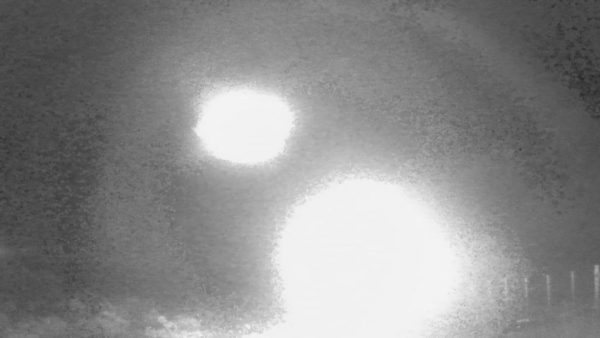
Scientists, civil aviation authorities, and UFO researchers all examine the footage
According to Vice, unable to reach a conclusion internally, the University of Magallanes shared the images with several outside institutions: Chilean civil aviation authorities, researchers who specialize in anomalous aerial phenomena, and organizations that collect and study unidentified aerial phenomena data.
The early theories were varied. Some analysts proposed that a spider or insect had come extremely close to the lens and triggered the camera. Others suggested an unusual internal lens reflection. A few raised the possibility of an unidentified flying object.
A plasma ball in the Patagonian night?
According to the university, one analyst, Freddy Alexis, conducted a detailed examination of the images, tracing the trajectory, spectral characteristics, and morphology of the light. His assessment was that the primary light source was probably a single object, with the surrounding points of light likely caused by internal lens reflections. His preferred hypothesis was unusual: a “plasma blob.”
Plasma blobs, sometimes called plasmoids, are transient structures formed from superheated ionized gas. Ball lightning, a rare and poorly understood atmospheric phenomenon in which a glowing sphere drifts slowly through the air before dissipating, is thought by some researchers to belong to this category.
The problem was the weather. The night of the sighting was calm and clear, with a temperature of around 8 degrees Celsius, typical of a Southern Hemisphere summer evening in southern Chile. Ball lightning is generally associated with thunderstorm activity; there was none. Alexis acknowledged the inconsistency and suggested that, if the object was indeed a plasma phenomenon, it might represent an atmospheric plasma structure not yet fully characterized by science.
A parallel with Norway’s long-running mystery
The images called to mind a well-known case from the other side of the world. For decades, residents and scientists in the Hessdalen Valley of Norway have observed luminous spheres drifting, shifting shape, and moving through the air without any consistent explanation. The Hessdalen lights have been the subject of sustained scientific study, but no consensus explanation has emerged.
Some researchers involved in the Patagonia case suggested that the Chilean footage might reflect a similar atmospheric plasma mechanism. If the light source were a distant, fast-moving object rather than something near the camera, calculations based on the images put its speed at roughly 947 kilometers per hour, approximately 70 percent of the speed of sound. The research team was careful to add that there was no evidence supporting the interpretation that the light came from an aircraft.
A spider and an unresolved center
A separate line of analysis approached the images from a more pragmatic direction. Analysts noticed what appeared to be an insect or spider silhouette at the edge of the first photograph and proposed that the creature had brushed the sensor, triggering the camera to begin shooting.
Even if an insect had activated the camera, it could not explain the intense, centrally positioned light source visible across all three frames. The research team reviewed a large archive of images taken by the same equipment under daylight, nighttime, and varying weather conditions, and consulted the camera’s technical documentation to rule out mechanical malfunction or image artifact. As of publication, no satisfying technical explanation had been found.
The Public Baseline Program is scheduled to continue for at least ten years, with additional cameras to be deployed across the region.