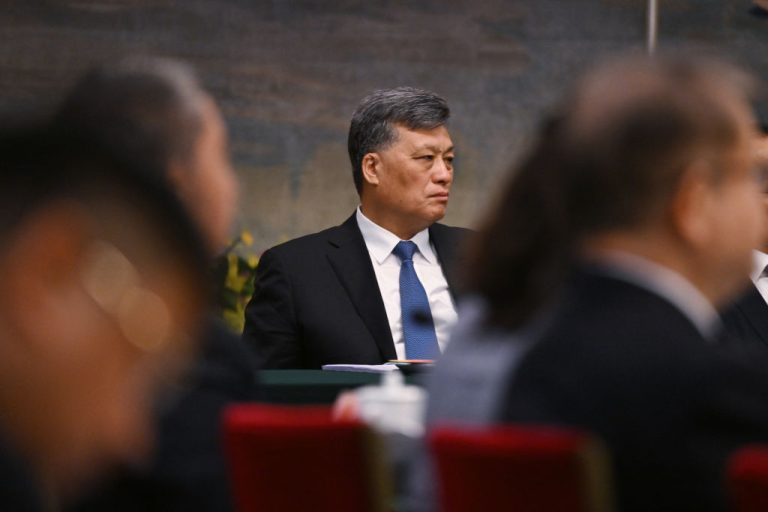
Former Xinjiang Secretary Ma Xingrui has been officially expelled from the Chinese Communist Party (CCP) and removed from public office following a corruption investigation, making him one of the highest-ranking officials to fall during Chinese leader Xi Jinping’s current term.
The announcement, made on July 14 by China’s state news agency Xinhua, comes just weeks before the CCP’s annual Beidaihe leadership retreat, a closely-watched gathering that draws global attention to Beijing’s top leadership’s internal priorities and political dynamics.
RELATED: Another Former Ma Xingrui Associate Investigated as Xinjiang Probe Expands
Sacked following corruption probe
According to Xinhua, China’s Central Commission for Discipline Inspection (CCDI), the country’s top watchdog concluded that Ma had committed “serious violations of discipline and law.” The official notice said the findings had been reviewed and approved by the Politburo during a June 30 meeting. The Politburo serves as the CCP’s top ruling body.
Authorities accused Ma of violating political discipline, improperly intervening in personnel appointments, accepting gifts and money as bribes, abusing his authority to benefit relatives, engaging in “power-for-sex” and “money-for-sex” exchanges, and allowing family members to profit from his official position.
Success
You are now signed up for our newsletter
Success
Check your email to complete sign up
The CCDI described the case as having an “extremely serious nature” with an “extremely negative impact.” Ma was expelled from both the Party and public office, stripped of his delegate status to the CCP’s 20th National Congress, and transferred to prosecutors for criminal proceedings. His expulsion from the Party is expected to be formally ratified at a future Central Committee plenary session.
His removal follows an earlier announcement by China’s National People’s Congress Standing Committee on June 26 terminating the legislative credentials of 14 deputies, including Ma.
A far fall grom grace
Ma built much of his career in China’s aerospace and defense industries before entering provincial politics. He held senior positions at the China Aerospace Science and Technology Corporation and served as head of the China National Space Administration and the China Atomic Energy Authority.
He later became Party secretary of Shenzhen, governor of Guangdong Province, and Party secretary of Xinjiang, one of China’s most politically sensitive regions.
Ma was first removed as Xinjiang Party secretary in July 2025, when authorities said he would receive “another assignment.” In April 2026, Chinese authorities formally announced he was under investigation, identifying him as deputy head of the Central Rural Work Leading Group.
Since then, several officials who previously worked under Ma in Guangdong and Xinjiang have also come under investigation or been removed from office, according to public announcements by Chinese authorities.
‘Unseen in decades’
According to reporting by South China Morning Post (SCMP), Ma became the third Politburo member to come under investigation during the current Party Congress term that began in 2022, a situation the newspaper described as “unseen in decades.” The outlet also noted that Ma had once been viewed as a leading example of Xi’s technocratic leadership model, rising from China’s aerospace sector into the country’s highest political ranks.
Political commentators and analysts have argued that the latest disciplinary action reflects continuing instability within the upper levels of the CCP ahead of the next Party Congress, though such assessments remain speculative.
Independent China commentator Cai Shenkun, writing on X on July 14, predicted that Ma could face a “severe sentence” if convicted, including the possibility of a “suspended death sentence,” a penalty that typically carries a two-year reprieve before being commuted to life imprisonment. Cai also speculated about possible legal consequences for members of Ma’s inner circle.
However, Chinese authorities have not commented on those claims, and no court has announced potential charges or sentencing recommendations as of yet.
Beidaihe timing draws attention
The announcement comes shortly before the annual Beidaihe meeting, an informal gathering where current and retired Party leaders have traditionally discussed major policy issues and personnel matters.
Because of the timing, some China observers have suggested that Ma’s dismissal may shape speculation about elite political dynamics in Beijing in the weeks ahead. However, the Chinese government has provided no indication that the disciplinary case is connected to the Beidaihe meeting or to broader leadership discussions.
While Ma’s prosecution will now proceed through China’s judicial system, the case marks another high-profile chapter in Xi Jinping’s long-running anti-corruption campaign, which has continued to remove senior military, provincial, and central government officials from office.