Commentary
In 2004, overseas Chinese newspaper Dajiyuan, now better known as The Epoch Times, published an editorial series taking aim at the ruling Chinese Communist Party (CCP). Titled Nine Commentaries on the Communist Party, the series that began running that Nov. 19 would spark a grassroots mass movement counting hundreds of millions of participants.
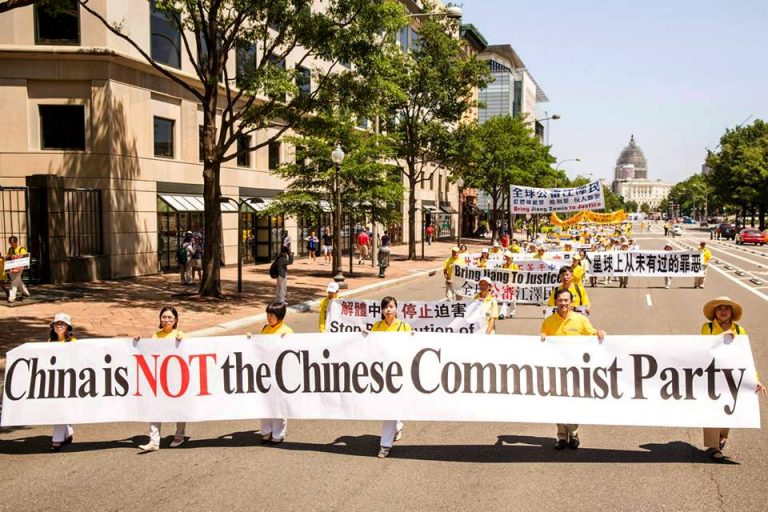
Called “Tuidang” (退黨), or “Quit the Party,” in Chinese, the movement encourages Chinese around the world to renounce the oaths they made to lay down their lives for communism when joining the CCP or its affiliated youth organizations.
Communist China is the deadliest regime in history, having been responsible for the deaths of around 80 million people since its establishment in 1949.
According to Daijiyuan webpage tuidang.epochtimes.com, nearly 440 million statements from people participating in the Tuidang Movement have been recorded since 2004. The number reached the 400 million mark in August 2023.
Success
You are now signed up for our newsletter
Success
Check your email to complete sign up
Though the CCP only counts around 90 million members, the majority of China’s over 1 billion people have joined its youth organizations, the Communist Young Pioneers and Communist Youth League. Both require pledging to sacrifice one’s life for the communist cause if necessary.
- ‘We now know clearly that the CCP does not equal China’: Statements From the Tuidang Movement (September 2024)
- ‘The real cancer plaguing China is the CCP itself’: Statements From the Tuidang Movement (August 2024)
The Nine Commentaries
Founded as a Soviet front group in Shanghai over a century ago, the CCP spent decades rebelling against the Chinese republican government, including sabotaging China’s efforts to resist Japanese invasion in World War II.
When the communist armies toppled the weakened republic on mainland China, Party chairman Mao Zedong claimed that the Chinese people had “stood up.” The CCP portrayed its rise to power as the “choice” of history.
In fact, the CCP imposed an unprecedented tyranny upon China that led to the deaths of some 80 million people through executions, forced labor, physical and psychological torture, and mass famine. Religions were stamped out in favor of atheist Marxism, and thousands of years of civilization was repudiated as “feudalist” backwardness to be dismantled in the CCP’s “New China.”
- Chinese Woman Who Spent 14 Years Convincing 70,000 Compatriots to Quit the CCP Shares Her Experience
While many scholars have documented the CCP’s vast atrocities, the Nine Commentaries sharply defines the political and ideological characteristics of Communist China that set the regime apart from all past dynasties.
“The goal of using force is to create terror. Every struggle and movement has served as an exercise in terror, so that the Chinese people tremble in their hearts, submit to the terror, and gradually become enslaved under the CCP’s control,” reads the first of the Nine Commentaries.
‘Deceit, malice, struggle’
The Nine Commentaries highlights examples of the CCP’s inclination to not merely hold power, but exercise total cult-like control over the minds and bodies of those under its rule. The Party’s violent philosophy of Marxism-Leninism did not liberate China from backwardness, but rather imposed a culture of “deceit, malice, and struggle” (假惡鬥) on the ancient civilization.
Even after the death of Mao and the start of economic reforms, the CCP retained its grip on absolute power. Party leaders sent troops to slaughter protesting students in Tiananmen Square in 1989; a decade later, CCP head Jiang Zemin banned the Falun Gong spiritual practice and launched a nationwide campaign to persecute its tens of millions of adherents.
Circulation of the Nine Commentaries in mainland China and the Tuidang movement more generally is often facilitated by adherents of Falun Gong, who continue to suffer brutal persecution for their faith at the hands of the CCP.
Millions of volunteers in China and around the world tell people about the movement to quit the CCP, and relay their statements to the Tuidang website if the person making the statement is not able to submit it themselves.
While many participants may choose to annul their oaths using a pseudonym, those relaying the renunciations report large numbers of people who decide to make the statements using their true identity.
Recent statements from the Tuidang movement
Some of those renouncing the CCP give detailed statements on their decision to distance themselves from the regime. Many express their dissatisfaction with rampant corruption, lack of freedom, economic hardship, or rejection of the Party’s human rights abuses.
Selected statements are published on the Tudiang site.
One person from “a province in northern China” quitting the Youth League and Young Pioneers writes, “after I entered society, I came to recognize the true nature of the Communist Party’s rule. I hated its demonic system with every fiber of my being.” He noted that many low-level civil servants no longer believed in communism and were simply after money.
A participant from Dalian, northeastern China, wrote on Nov. 22: “I have witnessed too much injustice in society and too many acts of tyranny and oppression by CCP enforcers against ordinary people. I have come to understand that renouncing the mark of the evil Party is the hope for salvation. I hereby solemnly declare my withdrawal from the CCP’s Communist Youth League and Young Pioneers, hoping for a brighter future.”
Giving the name “Liu Chenxiao,” another person quitting the Party, League, and Pioneers praised the democratic system of Taiwan (the island to which the Chinese government retreated after mainland China was taken over the CCP):
“The Republic of China in Taiwan today is politically free and democratic, economically prosperous, and its quality of life ranks among the best in Asia. This clearly shows what a China without CCP rule could be like and what the mainland could have been without the Communist bandits seizing the nation! I hereby declare my withdrawal from all CCP-affiliated organizations. The Communist Party is the chief culprit responsible for dragging China into the abyss. Without the CCP, China will surely regain its vitality and restore its former glory!”