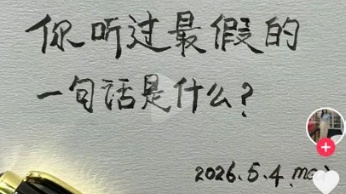
A Guangdong blogger’s throwaway question set off one of the more striking displays of public cynicism toward Chinese Communist Party (CCP) rule to appear on Chinese social media in recent memory. On May 4, the blogger known as “Mai Mai Who Loves to Write” posted a single prompt to Douyin, China’s state-supervised equivalent of TikTok: “What’s the most dishonest thing you’ve ever been told?” The comment section erupted, and by May 7, the platform had censored it entirely.
Party slogans top the list of lies Chinese people say they were told
The responses that poured in before censors intervened read like a chronicle of the Party’s history of deception. Users zeroed in on the slogans that have papered Chinese public life for generations: “Putting the people at the center.” “Serving the people.” “All power in the People’s Republic of China belongs to the people.” “Selfless dedication to others.” “Teaching and educating people; saving lives and healing the wounded.” “Fair competition.” “Hard work brings prosperity; labor is glorious.” “The future of the motherland belongs to you.”
These are phrases hammered into Chinese schoolchildren from the earliest grades, displayed on government buildings, and repeated at Party meetings. For the netizens filling the comment section, they had all aged into punchlines.
Others took the opportunity to extend the list. “There are so many lies, I don’t know which one is the most dishonest.” “Too many, too fake, impossible to choose.” “There’s no dishonesty, only more dishonesty.” “Past, present, future, there will always be lies.” And, with a sharper political edge: “The people of Taiwan are living in dire poverty and misery” — a line drawn directly from the propaganda script Beijing has used for decades to justify its claim that Taiwanese people long for “liberation” by the mainland.
Pandemic promises and political satire fill the comment thread
Several users turned to black humor to process the COVID-19 years. One comment, which circulated widely before deletion, skewered the Party’s entire pandemic response in a single paragraph: “Three years of effort, only to be told it was just a cold. Three vaccine doses, only to be told they were fake. Three years of PCR testing, only to be told the positive or negative results were arbitrary. A lockdown with no purpose, lifted without warning. It felt like being pulled out of the ICU and thrown straight into a karaoke bar — moved, but afraid to move. A COVID era has ended. It began on Dec. 8, 2019; it ended on Dec. 7, 2022. The End.”
Success
You are now signed up for our newsletter
Success
Check your email to complete sign up
The reference to the vaccine being “fake” reflects a widespread suspicion among mainland Chinese users that domestic COVID vaccines, particularly the Sinovac and Sinopharm products promoted as a patriotic alternative to Western mRNA shots, were largely ineffective — a conclusion the CCP never publicly acknowledged.
Others reached further back. One user invoked the story of Zhang Haidi, a disabilities activist the Party elevated as a model of perseverance, by observing that she “supposedly contracted over a dozen types of cancer” yet had been living well for decades — a dry verdict on a regime that has long needed its heroes to suffer on cue.
Another user cited Meng Wanzhou, the Huawei executive who was detained in Canada for nearly three years and released in 2021: “I’m back home, motherland” — a line from Meng’s much-publicized homecoming speech, used here to mock how the episode was turned into nationalist spectacle. A third user fired at the corporate-speak adopted by China’s tech sector: “Cut costs and boost efficiency. The future is promising. We’re far ahead. Every kind of dream” — a condensed mockery of the empty optimism that has accompanied waves of layoffs and economic slowdowns.
READ MORE:
- Li Rui Archives Win Landmark US Court Ruling Against CCP Efforts to Reclaim Diaries
- China State TV Anchor Endorses ‘Lying Flat’ Days After CCP Declared It a Foreign Threat
- CCP-Linked Hackers Impersonate Journalists to Target Dissidents Worldwide: Report
Decades of broken promises, from the cultural Revolution to the COVID lockdowns
Some comments reached back to the founding promises of the socialist project. One user recalled being told, as a child, “You are the successors of the revolution,” and waiting decades for a future that never arrived.
These reflexes of disillusionment track a much longer history. As Taiwan’s Central News Agency reported in June 2021, the CCP’s lies have taken multiple forms throughout its rule. Some involve deliberate silence: the official death toll from the Cultural Revolution, the decade-long campaign of political terror launched in 1966, has never been released. The massacre of protesters in and around Tiananmen Square on June 4, 1989 remains a prohibited subject in Chinese historical scholarship and public discourse. Even textbooks that mention the Cultural Revolution treat it as a research-restricted zone.
Other lies arrive dressed in euphemism. Su Xiaokang, a prominent dissident intellectual and co-creator of the 1988 documentary River Elegy, one of the most politically charged cultural works produced in China before the Tiananmen crackdown, documented in his memoir The Year of Slaying Dragons how the Great Famine of the late 1950s and early 1960s, during which tens of millions died and some survivors resorted to cannibalism, generated its own bureaucratic vocabulary. In Henan’s Xinyang region, the act of eating a corpse was formally categorized as “destruction of a body.” The regime invented a term clinical enough to obscure the horror, and subsequent generations inherited the fog.
The most aggressive form of CCP falsification involves rewriting history outright. The Party claims credit for leading Chinese resistance against Japan in World War II, a claim that erases the central role played by Chiang Kai-shek’s Nationalist government. Informed analysts have long cited an internal directive attributed to Mao Zedong instructing that the Party should allocate “seven parts development, two parts coping, one part fighting Japan” during the war years, meaning armed resistance was the lowest priority. In 2017, rather than engage with this history, the CCP simply expanded its own role: primary school textbooks were revised nationwide to reframe the war as a “fourteen-year war of resistance” instead of eight years, pushing the Party’s claimed contribution further back in time.
The CCP’s governing method, from Mao to Xi Jinping, has always depended on systematic deception
The tradition of lying as a governing method did not die with Mao Zedong. Xi Jinping, the CCP’s general secretary and China’s current top leader, has preserved the political architecture of the Mao era intact: one-party supremacy, total surveillance, no freedom of speech, indirect control over private enterprise. The economic model has shifted toward what is effectively capitalism; on every question of political power, the structure has not budged.
For the netizens who filled “Mai Mai Who Loves to Write’s” comment section before it was erased, no external analysis was necessary. The lies were simply part of the weather, familiar enough and old enough that cataloguing them had become a form of dark comedy.