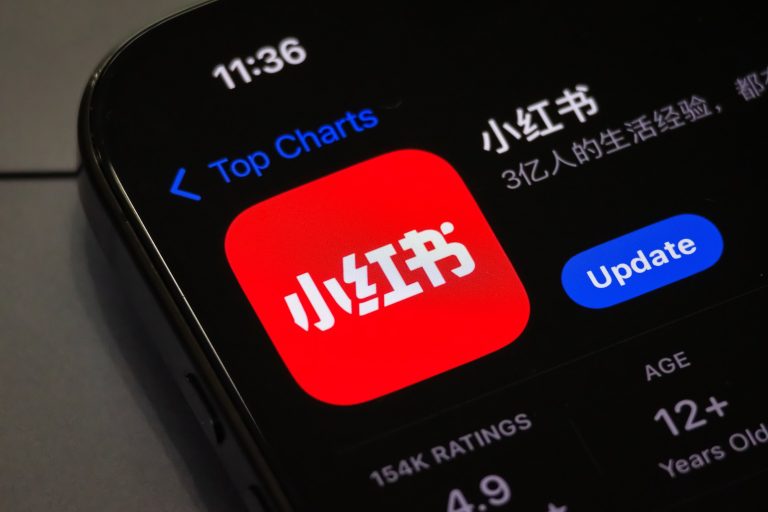
Since Jan. 13, when the U.S. government issued its ultimatum to TikTok parent company ByteDance to sell the popular social media app or face a nationwide ban, millions of U.S. users have become “refugees” to another Chinese-owned and operated platform: Xiaohongshu (小红书), or RedNote.
The app’s Chinese name, which literally translates to “little red book,” may seem like a reference to the Quotations of Chairman Mao Zedong, a 1964 pamplet of passages from the communist dictator’s ideology that was printed billions of times and used to indoctrinate the Chinese population during the Cultural Revolution. In fact, unlike in English, the term “little red book” in Chinese does not actually refer to Mao’s doctrine; the word “red” in the app’s name has connotations of popularity or trendiness, and RedNote’s userbase is predominantly female.
Nevertheless, many of the American “TikTok refugees” from TikTok, which was made temporarily unavailable to its over 100 million U.S. users on Jan. 19, have, in moving to RedNote, experienced up close the censorship that the Chinese Communist Party (CCP) seeks to impose on all online content.
RedNote itself issued notices saying that it welcomed the influx of American users, but also urged caution against discussing sensitive topics or posting banned content.
Getting a taste of censorship
TikTok, which experts see as a propaganda and data collection tool for the CCP, was subject to a ban that went into effect on Jan. 19 following a Supreme Court decision, but the ban was overturned by incoming President Donald Trump when he took office on Jan. 20.
Success
You are now signed up for our newsletter
Success
Check your email to complete sign up
Trump has expressed a wish to see the app turned over to majority American control, implying that he will use the issue in negotitions with Beijing over issues such as trade tarrifs.
Despite Communist China’s strict controls on information, RedNote has attracted many users by offering a virtual space that allows a measure of free interaction. With TikTok facing a ban in the U.S., RedNote has naturally become an alternative for many overseas Chinese and some Americans.
To address the sudden influx of international users, RedNote had to respond quickly. According to internal sources, the company accelerated the development of English-language content review tools and expanded its workforce to manage the growing amount of content. In job postings released by the company, RedNote required reviewers to have a score of 425 or higher on China’s CET-6 English proficiency exam, with a monthly salary of 4,600 yuan (about US$700) during training and 7,000 to 9,000 yuan (US$1,000–1,300) upon formal employment.
Some newcomers went out of their way to test the limits of Beijing’s information controls. Christine Lu, a Taiwanese-American living in Los Angeles, registered an account on RedNote and posted content such as an artistic photo of the “Tank Man” symbolizing the 1989 Tiananmen Square massacre, the Tibetan flag, and an image of the protagonist from the film “Top Gun” wearing a jacket with the Taiwan flag. These posts were quickly flagged. The photo of the “Tank Man” was removed for “violating platform regulations,” the Tibetan flag was placed under prolonged review, and Lu’s account was permanently suspended. Lu explained that her actions aimed to show how expressions considered normal in democratic nations are banned under authoritarian systems like China’s.
Similar cases have occurred with other users. For instance, a Canadian user’s account was suspended after posting an image of “Winnie the Pooh,” and an American user was suspended after sharing a composite image of Mao Zedong and basketball player LeBron James. In RedNote’s comment sections, warnings such as “Avoid discussing politics, religion, or drugs” and “Adhere to the One-China principle” (viewing Taiwan as a rightful part of Communist China) have increased.
Interactions and narrative challenges
Li Yuanhua, a Chinese scholar based in Australia, pointed out that RedNote uses the same version of its platform for both Chinese and international users, enabling direct interaction between them. In one instance, a Chinese user asked an American construction worker, “How much do you earn on construction sites in the U.S.?” The worker replied, “$50 an hour, about $1,200 a week,” and added that they had the right to unionize (in China, the CCP nominally acts as the union so there are no separate labor organizations).
One Chinese user commented on the influx of foreign users, saying, “it seems that the barrier [i.e. the Great Chinese Firewall] only stops us from going out, but it doesn’t stop Americans from coming in”
Sheng Xue, a Chinese democracy movement leader residing in Canada, noted that RedNote initially began as a shopping guide and commercial app, but after the Chinese government recognized its potential influence, the platform underwent funding restructures and functional upgrades. Over time, it evolved into a platform encompassing all aspects of daily life, such as dining, entertainment, health management, and emotional exchange.
“As the number of international users grows, RedNote faces significant challenges in regulating these users while balancing [Chinese] domestic and international interests,” Sheng Xue told Vision Times. She predicted that the app might eventually split into mainland Chinese and international versions like TikTok (the Chinese version is known as Douyin), while emphasizing that the CCP is vanishingly unlikely to relax its censorship policies.
In a piece published Jan. 19 on the Chinese-languaeg edition of Vision Times, opinion writer Ni Ren pointed out some positive aspects of the interaction between ordinary Chinese and American netizens:
“For Chinese netizens, Americans are not the arrogant and domineering figures often depicted [in Chinese media]. They’re just ordinary people—youths, middle-aged men, and women who enjoy food, fun, and leisure. Similarly, from the perspective of Americans, [they realize that] Chinese people are not merely collectivist, national anthem-singing individuals. They’re lively, friendly, curious, and just as human.”
“Some Chinese netizens were surprised to learn through these conversations that there’s also plenty of patriotic education in America. Of course, this patriotism is limited to national pride; the Democratic and Republican parties are viewed simply as political entities by the average American,” Ni Ren continued, refering to the nationalist doctrine of the CCP that conflates love of China with loyalty to the Party.
The Japanese-language edition of Vision Times contributed to this report.