By Meng Hao, Vision Times
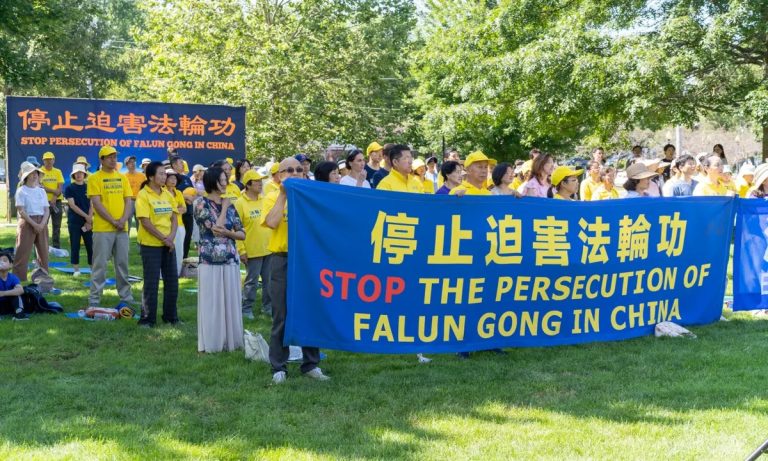
July 20 marked the 27th anniversary of the Chinese Communist Party’s (CCP) campaign to eradicate Falun Gong, a peaceful spiritual practice that has faced systematic persecution since 1999. Zhang Ren, a Chinese human rights lawyer who previously represented Falun Gong practitioners, said the decades-long campaign demonstrates why the U.S. Senate recently characterized the CCP as a “transnational organized crime group” and argued it should be held accountable before an international tribunal.
His remarks came as the Falun Dafa Information Center (FDIC) released its annual report outlining four major trends in the persecution over the past year, including the expansion of Beijing’s campaign beyond China’s borders through transnational repression.
Falun Gong, also known as Falun Dafa, was introduced to the public in China by Mr. Li Hongzhi in 1992. Centered on the principles of Truthfulness, Compassion, and Forbearance, the practice is known for its meditation exercises and moral teachings, and was widely embraced in China for its reported health benefits and emphasis on personal character. In July 1999, the CCP, under the leadership of then-party chief Jiang Zemin, launched a nationwide campaign to suppress the practice.
RELATED: Thousands Rally in Manhattan to Condemn 27 Years of Falun Gong Persecution
Persecution rages on in China
Success
You are now signed up for our newsletter
Success
Check your email to complete sign up
The report documents continued harassment, arbitrary detention, imprisonment, and alleged torture of Falun Gong practitioners across China. Among the cases highlighted was 52-year-old Zhang Fengxia from Daqing, Heilongjiang Province, who died in custody just one week after her arrest last August. Elderly and disabled practitioners have increasingly become targets.
Over the past two years, more than 1,000 cases involving practitioners aged 60 or older were documented. In one case this March, a 90-year-old woman in Jinan, Shandong Province, was sentenced to two years in prison after speaking to passengers on a public bus about Falun Gong.
According to the Information Center, more than 5,300 deaths linked to persecution have been documented since 1999. The organization says the true number is likely significantly higher because of Beijing’s strict information controls and longstanding allegations of forced organ harvesting.
Zhang said the growing focus on elderly and disabled practitioners mirrors the authorities’ broader suppression of human rights lawyers, restrictions on legal representation, and obstruction of defense attorneys. “The purpose is not simply law enforcement,” he said. Rather, he argued, authorities are using the state apparatus to intimidate anyone who challenges the regime and create a climate of fear throughout society.
Regarding allegations of forced organ harvesting, Zhang claimed the victims have expanded beyond Falun Gong practitioners to include other missing persons. He argued that organ trafficking has evolved into a tacitly accepted industry in China and called for the international community to investigate the CCP’s broader human rights record.
Rule of law undermined
The FDIC report argues the persecution has not only targeted Falun Gong practitioners but also systematically weakened China’s legal system. To sustain the campaign, authorities have relied on the 610 Office, an extralegal security body established specifically to direct the suppression of Falun Gong, as well as propaganda networks, schools, workplaces, and judicial institutions.
In February, officials in Xianning, Hubei Province, issued public reward notices encouraging citizens to report practitioners who distributed informational materials or organized study activities, offering payments ranging from 100 yuan to 50,000 yuan.
Zhang described the 610 Office as an institution operating entirely outside China’s legal framework. “In Falun Gong cases,” he said, authorities frequently determine guilt first and fill in legal procedures afterward. Evidence is accepted without proper examination, violating basic rules of evidence and, in his view, creating the institutional foundation for both a culture of informing on others and the erosion of the rule of law.
Campaign expands overseas
The report also notes Beijing’s campaign has increasingly shifted beyond China’s borders since Xi Jinping ordered an escalation of overseas security operations in 2022. Volunteers staffing Falun Gong information booths in cities including New York, Los Angeles, and London have reportedly been assaulted, while similar incidents have occurred in South Korea.
In addition, escalating threats against Shen Yun Performing Arts have been reported. Between Jan. 28 and Feb. 1, Shen Yun’s website reportedly received more than 200 anonymous threats. In Canada, Toronto’s Four Seasons Centre canceled six performances after receiving bomb threats, despite police finding no evidence of any credible attack. The report also cites an incident in which officials from the Chinese consulate in Canada allegedly attempted to pressure Vancouver authorities to cancel Shen Yun performances.
Founded in 2006, Shen Yun is a New York-based company dedicated to reviving traditional Chinese culture and art through classical Chinese dance and music. Many of Shen Yun’s performers and staff are practitioners of Falun Gong. Because of this, Shen Yun is not currently able to perform in mainland China.
Separately, the report points to findings by cybersecurity firm Graphika, which uncovered a network of websites impersonating major Western media outlets while disseminating negative narratives targeting Falun Gong and Shen Yun.
Addressing overseas harassment and bomb threats, Zhang argued that victims should pursue legal action through international institutions, including the International Criminal Court, while urging the U.N. Human Rights Council to hold hearings examining the CCP’s overall human rights record.
Growing international support
Despite the ongoing persecution, Zhang said international recognition of the issue continues to expand. He highlighted the U.S. Senate’s unanimous passage of Resolution 444 on June 16, which formally described the CCP as “a criminal organization posing a serious threat to global stability and peace.” Although nonbinding, Zhang said the resolution provides an important political and moral foundation for future sanctions, including those under the Global Magnitsky Act.
Meanwhile, the Falun Gong Protection Act, which unanimously passed the U.S. House of Representatives in 2025 and has bipartisan support in the Senate, seeks to sanction individuals involved in forced organ harvesting. Sen. Ted Cruz, one of the bill’s sponsors, has called for dismantling the CCP-backed organ trafficking industry, while Rep. Pat Ryan has pledged to hold those responsible accountable.
FDIC Executive Director Levi Browde said the anniversary serves as a reminder that the CCP has demonstrated its willingness to mobilize the full machinery of the state against tens of millions of innocent people. “That threat has long since extended beyond China’s borders,” Browde said, noting that many overseas practitioners continue to fear retaliation against relatives in China and remain unable to safely return home.
Zhang said he and the Overseas Chinese Human Rights Lawyers Alliance will continue assisting victims of transnational repression and urged governments, media organizations, and civil society to maintain scrutiny of the CCP’s human rights record.