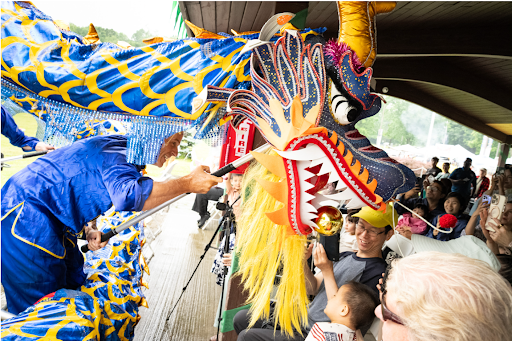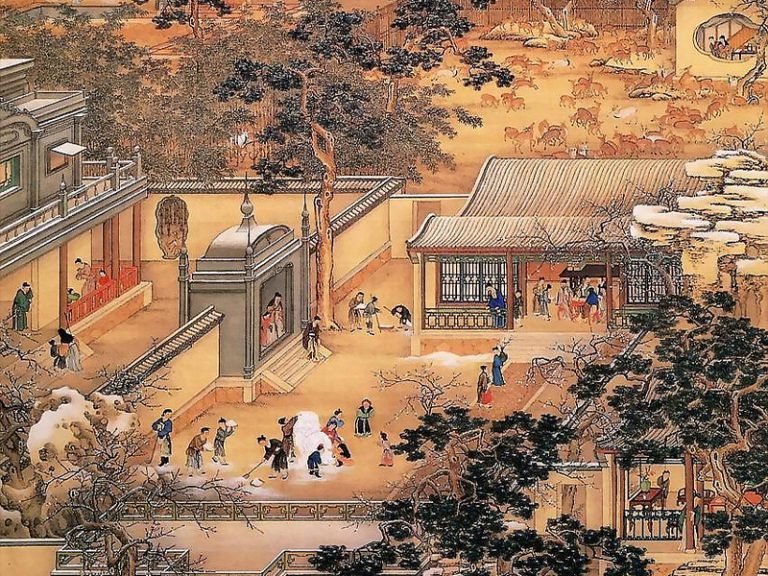
On January 29, 2025, over one billion people around the world will welcome the Chinese New Year with fireworks, parades, decorations, and gatherings of friends and family. The year of jia chen (甲辰), the yang wood dragon, will make way for the coming of the yin wood snake, yi si (乙巳).
Customs, beliefs, and lore surrounding the Chinese New Year are many, given that the ancient celebration spans nearly 5,000 years of history and, from its legendary beginnings associated with the founding of Chinese civilization, spread to the other peoples of Asia.
Some of the most common Chinese New Year customs are tied to core Chinese beliefs. For example, the burning of the stove god effigy is done to allow the deity — who watches over the household and records each family member’s virtues and vices — to return to heaven and make his report to the Jade Emperor.
In ancient times, the New Year was a two-week celebration, with different rituals and customs to be observed on each day going up until the Lantern Festival, which takes place on the 15th of the first lunar month.
Chinese New Year and the traditional lunisolar calendar
Chinese New Year is sometimes referred to as the “Lunar New Year.” However, it is rooted in the traditional Chinese calendar — a system of timekeeping that balances the cycles of both the moon and the sun.
Success
You are now signed up for our newsletter
Success
Check your email to complete sign up
Ancient Chinese placed great emphasis on the balance of yin and yang. During the creation of the traditional calendar, they considered both the lunar phases and the Earth’s solar orbit. Thus, the traditional Chinese calendar is neither a pure “lunar calendar” nor a “solar calendar” but a precise and scientific lunisolar calendar. Chinese New Year coincides with the start of spring, marking the arrival of the new year.
Featuring an intricate system of leap days and even months, the Chinese lunisolar calendar keeps pace with both the lunar phases and the four seasons. The 1st day of each month corresponds to the new moon, while the full moon is on the 15th.
Moreover, based on the sun’s relative position to the Earth and seasonal climatic changes, the ancients devised the 24 solar terms. These terms provided profound guidance for spiritual life, societal management, health, and agriculture, making it the most harmonious and comprehensive timekeeping system aligned with natural changes.
Out of respect for the Yellow Emperor Xuanyuan (軒轅黃帝), the legendary founder of Chinese civilization, the lunisolar calendar is properly referred to as the huang li (黃曆) — the Yellow Emperor’s calendar. As his reign was said to have begun in 2698 B.C., the year 2025 is Year 4723 by the Chinese reckoning.
In practice, however, the Chinese counted years by the name of the era, established by the emperor or government, as is still done in Japan and Taiwan today.
The sexagenary cycle, five elements, and zodiac
Another important system was a 60-year cycle that resulted from the combination of two important concepts in Chinese cosmology and divination: the heavenly stems (天干 Tiān gān) and earthly branches (地支 Dì zhī).
There are 10 heavenly stems and 12 earthly branches, all arranged in a set order:
Heavenly stems: 甲乙丙丁戊己庚辛壬癸
Earthly branches: 子丑寅卯辰巳午未申酉戌亥
The heavenly stems determine the element and its nature as either yang or yin — the basic duality of Chinese Daoist philosophy that separates heaven and earth, male and female, form and formlessness.
Heavenly stems are also sometimes used as traditional numerals, similar to Roman numerals used in the West.
The Five Elements of Chinese cosmology include wood, fire, earth, metal, and water.
Hence, while the first two Stems (甲 and 乙) belong to the wood element, the stem 甲 (jia) is considered yang while the 乙 (yi) stem is of the yin nature.
The 12 Earthly Branches correspond to not only the twelve lunar months and the twelve two-hour periods, called shichen (時辰), that made up an ancient Chinese day, but also the animals of the Chinese zodiac.
Moreover, while animals in the Chinese zodiac shift between the five elements, they always maintain their respective yin or yang attribute.
2024, the year of the wood dragon, was of the yang nature — all dragon years are yang. Conversely, the year of the snake, sometimes also called the xiao long (小籠) or “minor dragon,” is always yin.
Restoring the correct meaning of the traditional calendar and Chinese New Year
After the Chinese Communist Party (CCP) seized power in 1949, it sought to abolish China’s millenia of spirituality and faith by denouncing traditional culture. The CCP abolished terms of respect such as the “Imperial Calendar” or “Yellow Emperor’s Calendar,” calling it instead a “lunar calendar” and eventually just the “farmer’s calendar” — relegating its importance to something solely relevant to peasantry or agriculture.
Likewise, the Party diminished the status of Chinese New Year by renaming it the “Spring Festival,” again stripping the celebration of its spiritual background and reducing it to the mere announcement of a new season.
With this renaming, the CCP aimed to tear down the cultural essence of New Year traditions: reverence for the divine and the continuation of Chinese traditional heritage.
In fact, the traditional Chinese calendar not only provides an accurate system of astronomical calculations but also offers a profound interpretation of the relationship between humans and nature.
Behind the Chinese calendar — and by extension the Chinese New Year — lie the values of reverence for heaven, faith in the divine, and a wish to abide by the Heavenly Way (天道). Its design embodies the philosophy of yin-yang and the five elements, and encapsulates the natural cycles of transformation, as its creators devised it according to the principle of harmony between humankind and the divine.