Chinese tradition treats the peak of summer as a season in its own right, with a start date, an end date, and its own rules for eating, farming, and medicine. It is called sanfu, and the character at the center of the name describes crouching, concealment, and lying flat against the ground. Getting from that image to the hottest weeks of the year runs through Chinese astronomy, a theory of elements, and an observation about heat that Western science would later explain quantitatively through thermodynamics.
This year sanfu began on July 15 and runs through Aug. 23, forty days in total. By tradition it contains the worst weather China will see.
The character means crouching, not burning
In classical Chinese, the word carries the sense of pressing yourself to the ground, whether to hide or to submit. The Shuowen Jiezi, China’s oldest surviving dictionary, compiled around AD 100, explains the graph in terms of lying in wait. Later commentators traced the sense from there to bowing and prostrating. The character is still ordinary vocabulary: an ambush is a “hidden force,” and to prostrate yourself in apology is to “lie flat on the ground and admit fault.”
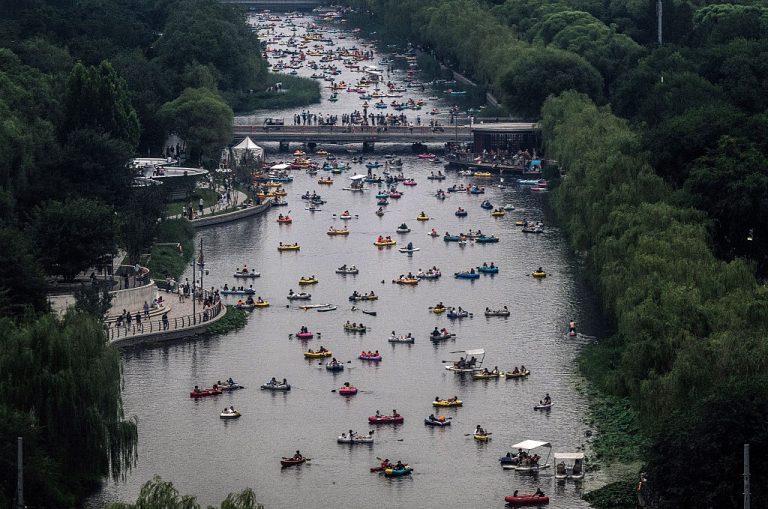
Read literally, the name describes what people do. In serious heat they shut the door, stay in, and wait. Living in hiding from the sun is a kind of hiding.
Chinese cosmology puts the season’s opposite underground
The older explanation is about the natural world rather than human behavior. In the yin-yang framework that organized Chinese natural philosophy, the summer solstice is the maximum of yang, the hot and expansive principle, and it is also the precise moment its opposite starts coming back. Yin is born at the solstice, at the very peak of yang.
Success
You are now signed up for our newsletter
Success
Check your email to complete sign up
The newborn yin has nowhere to go. Yang is still overwhelming, so yin is driven underground, where it waits out the summer. Yan Shigu, the seventh-century scholar whose annotated edition of the Book of Han became the standard text, glossed the term along these lines: yin has begun to stir, the surviving yang presses it down, it cannot rise, and so it lies concealed, which is what gives these days their name. On this reading the word describes an invisible process, and the heat is incidental.
The count runs on metal days, and summer suppresses metal
Sanfu sits outside the twenty-four solar terms, the official divisions of the traditional Chinese year, while still depending on two of them for its boundaries. The dates inside those boundaries come from a separate system: the sixty-day cycle of ten stems and twelve branches, used to name consecutive days in China since the Shang dynasty more than three thousand years ago. With ten stems, each one comes around every ten days.
The third metal day after the summer solstice opens the first period. The fourth opens the middle one. The first metal day after the start of autumn, a solar term that falls in early August, opens the last. The first and last always run ten days. The middle one runs ten or twenty depending on how the metal days fall, which is why the season lasts thirty days in some years and forty in others. This year five metal days fell between the solstice and the start of autumn, stretching the middle period to twenty days and the whole season to forty.
The choice of that particular day-name was deliberate. In the Five Phases system that organizes Chinese cosmology, the stem in question, geng, belongs to metal, and summer belongs to fire. Fire overcomes metal in that scheme, an idea often illustrated by the image of metal melting in a furnace. At the height of summer, then, the metal principle is overpowered and has to go into hiding. The scheme closes on itself: the element forced into hiding lends its name to the days when the hiding begins.
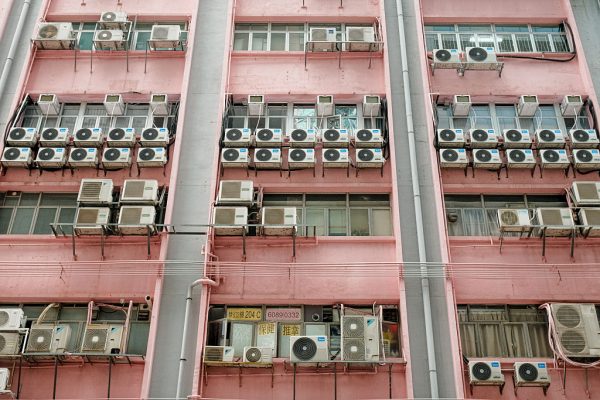
Peak heat arrives weeks after the longest day
The solstice brings the longest day and the strongest sun, so the solstice ought to be the hottest day of the year. It never is, and the ancient explanation and the modern one point to the same mechanism.
Ground and air store heat. After the solstice the incoming sunlight weakens, but the earth’s surface keeps absorbing more energy than it gives back for weeks afterward, and the heat radiating off it keeps climbing. Peak temperature therefore lands well after peak sunlight, right inside the sanfu window. Meteorologists call this seasonal lag, and it is why the worst weeks across most of the Northern Hemisphere fall in late July and August rather than in June.
Chinese astronomers had no thermodynamics. What they had was a few thousand years of daily record-keeping, and it was enough to find the right window and write it into the calendar.
Sacrifices, dumplings, and mutton in the worst of the heat
Under the Qin and Han dynasties the court held sacrifices on these days, offering rites to ancestors and deities to ask for safety and protection from disease.
A northern saying assigns a dish to each of the three periods: dumplings in the first, noodles in the second, pancakes with fried eggs in the third. Jiangsu and Shandong favor cold noodles made from the new wheat harvest. Xuzhou, in northern Jiangsu, still holds an annual Mutton Festival in the middle of the heat, on the theory that warming meat brings on a sweat and drives out internal damp.
Traditional Chinese medicine works these weeks on the principle of treating winter illness in summer: the body’s yang peaks now, making it most receptive to therapies aimed at conditions that flare in the cold. The best-known application is a medicated plaster applied to acupuncture points on specific days of the season, still sold in Chinese pharmacies today and prescribed for chronic respiratory complaints.
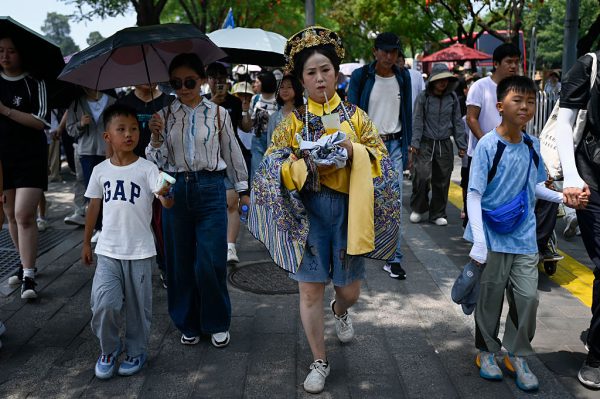
The poets recorded the heat as an ordeal
Classical poetry treated the season as suffering rather than cosmology. Bai Juyi, the Tang poet whose plain style made him the most widely read writer of his age, opened “Dispelling the Heat” with a question and a modest answer: what can dispel this oppressive heat, sitting still in the middle of a courtyard. Nothing in the poem cools anything down. He notes that he owns almost nothing, that a breeze reaches him under the window, and that the heat disperses when the mind is quiet and the room is empty. The remedy is acceptance, offered by a senior official with the means to do better and no better option available.
Two counted periods bracket the Chinese year
Summer’s season has a winter twin. The “three nines” counts twenty-seven days forward from the winter solstice and covers the coldest stretch of the year, the third nine-day block traditionally the coldest of all.
Neither belongs to the twenty-four solar terms. Both were worked out separately, and both sank deep into daily life, setting when farmers worked, what families ate, and how people managed their health. A proverb pairs them as a test of discipline: train through the three nines in winter, train through the three hiding periods in summer.
One character carries the whole apparatus: a hidden turn in the balance of cosmic forces, an element overpowered and driven underground, a population sheltering behind closed doors, and the specific weeks when the heat becomes unbearable. Sanfu measures time. It also states a conviction that human life runs on the same clock as everything else, and that reading one correctly means reading the other.
By Chen Jing