Over the last two years, a number of vessels linked to the People’s Republic of China (PRC) have been involved in multiple incidents of alleged sabotage involving undersea cables and pipelines in Europe and Asia, infrastructure that is vital for global communication and energy distribution.
The most recent incident occurred in January this year, when a cargo ship, the Shunxin 39, sailing under the flag of Cameroon but linked to Chinese ownership, allegedly damaged an undersea telecom cable off the coast of Taiwan. The vessel had turned off its tracking system and loitered in the area for a month prior to the incident.
The damaged cable is part of the Trans-Pacific Express Cable System, a crucial communication link connecting Taiwan to the United States and other countries. Fortunately, service disruptions were minimal, as Chunghwa Telecom, the operator of the cable, promptly rerouted data to other available cables.
The incident occurred on Jan. 3, when the vessel allegedly dragged its anchor along the seabed near Keelung Harbor.
At the time, efforts by Taiwan’s Coast Guard to board the ship to investigate were thwarted by adverse weather conditions and the ship departed towards South Korea.
Success
You are now signed up for our newsletter
Success
Check your email to complete sign up
The possibility that Communist China is intentionally sabotaging communication lines leading to Taiwan is especially concerning, given that Beijing claims the island as part of PRC sovereign territory and has made “reunification” a non-negotiable foreign policy “red line.”
Taiwan, officially called the Republic of China (ROC), hosts the government that once governed the entire country until being defeated by the communists on the Chinese mainland in 1949.
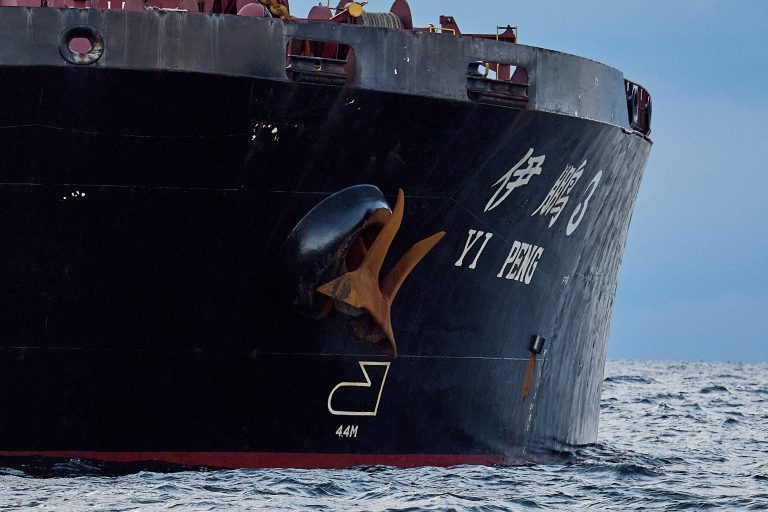
Another incident in Nov. 2024, in the Baltic Sea, cut two communication cables between Finland, Germany, Lithuania, and Sweden. A ship, the Yi Peng 3, allegedly intentionally dragged its anchor along the seabed for more than 100 miles in order to sever the links.
The BCS East-West Interlink and the C-Lion fiber-optic cables were damaged, both of which play a vital role in regional data transmission. The incidents occurred on November 17 and 18, respectively, and prompted investigations by European authorities.
Investigators suspect intentional sabotage. There is speculation that Russia may have influenced the alleged sabotage after encrypted messages, relayed to the Yi Peng 3 prior to the event, were discovered.
Following investigations, damage on the vessel’s anchor was found to be consistent with dragging along the seabed.
PRC representatives denied full access to the ship during the investigation and following the investigation the ship departed Danish waters where it was moored and continued towards a port in Egypt.
RELATED:
Gas pipeline allegedly sabotaged
In October 2023, also in the Baltic Sea, a Chinese-owned vessel, the Newnew Polar Bear, was suspected of working with a Russian ship to damage a Finland-Estonia gas pipeline and two fiber optic cables. At the time, China dismissed inquiries, citing accidental damage due to poor weather conditions.
The Hong Kong-registered container ship allegedly dragged its anchor along the seabed for several hundred nautical miles, leading to the damage.
An August 2024 internal investigation by the PRC authorities acknowledged the ship’s responsibility for the damage, but concluded that the incident was accidental.
The event heightened concerns about the security of critical undersea infrastructure, particularly amidst ongoing geopolitical tensions.
In February 2023 two undersea cables linking Taiwan’s Matsu Islands to the main island were also cut, isolating around 14,000 Taiwanese residents. Taiwan traced the damage back to three PRC vessels.
The first cable was restored after 50 days, while repairs to the second cable were scheduled for completion within two months.
Taiwan authorities suspect sabotage and the event highlighted the strategic challenges faced by Taiwan’s outlying islands, which are situated close to the Chinese mainland.
Investigations into these incidents revealed that mainland Chinese researchers have been developing technology capable of severing undersea data cables and pipelines for some time.
In the late 2000s, marine engineers form the State Oceanic Administration (SOA) developed a device termed the “ocean towing type cutting device.” The SOA’s patent application indicated its purpose was to eliminate unauthorized cables near China.
More recently, a team of engineers from Lishui University in Zhejiang Province applied for a patent for a “dragging type submarine cable cutting device.” The apparatus was designed to be towed by a vessel, using a specialized mechanism to sever undersea cables by dragging along the seabed.