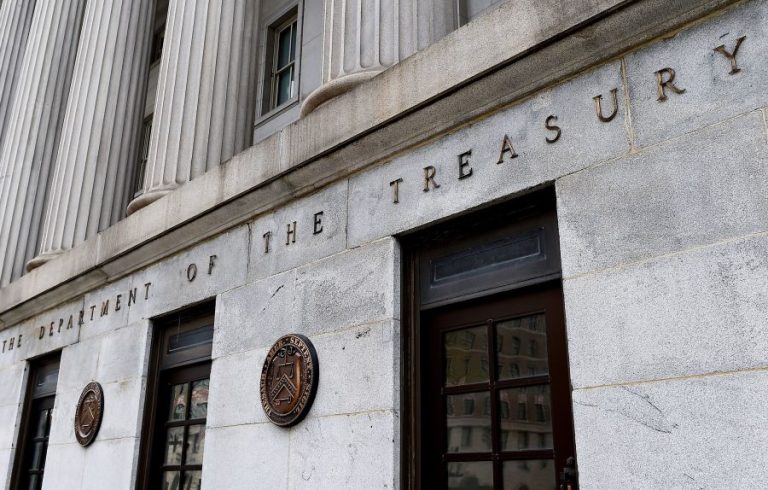
The U.S. Department of the Treasury announced on Tuesday, June 2 that it has sanctioned Iran’s largest digital asset exchange, Nobitex, along with three other Iranian cryptocurrency exchanges. The U.S. government accused these platforms of helping the Iranian regime evade international sanctions, supporting terrorist activities, and providing financial services to Iran’s Islamic Revolutionary Guard Corps (IRGC).
The Treasury’s Office of Foreign Assets Control (OFAC) said in a statement that the action is part of the Trump administration’s “Economic Fury” program, aimed at continuing maximum economic pressure on Iran and weakening its ability to access and transfer funds.
U.S. Treasury Secretary Scott Bessent said that despite Iran’s worsening economy, the regime continues to use digital asset technologies to advance corrupt activities, including sanction evasion and moving wealth abroad.
He said Iran’s current economic turmoil demonstrates that the Trump administration’s “maximum pressure” policy has been effective. The Treasury will continue tracking funds flowing through both banking systems and digital assets to prevent Iran from developing nuclear weapons.
According to Treasury data, Nobitex is Iran’s largest digital asset trading platform. In 2025, it processed more than 50 percent of Iran’s digital asset inflows and was involved in transactions linked to terrorist activity, sanctions evasion, and the IRGC.
Success
You are now signed up for our newsletter
Success
Check your email to complete sign up
The U.S. government said Nobitex helped Iran’s Central Bank obtain hundreds of millions of dollars in stablecoins to support the rapidly depreciating Iranian rial. The platform also helped regime insiders access global cryptocurrency markets and evade sanctions across multiple jurisdictions.
The Treasury further noted that even after U.S. military actions against Iran, and despite domestic internet restrictions, Nobitex continued transferring funds and moving regime assets abroad.
In addition to the exchanges, the U.S. also sanctioned Nobitex chairman, co-founder, and former CEO Amir Hossein Rad, along with several senior executives.
Two co-founders, Seyed Mohammad Ali Aghamir Mohammad Ali and Seyed Mohammad Aghamir Mohammad Ali, were identified as members of the Kharrazi family. The Treasury said the family has close ties to Iran’s Supreme Leader Ali Khamenei’s inner circle.
Current CEO Seyed Ali Khoee was also added to the sanctions list.
The Treasury also sanctioned three other Iranian digital asset exchanges:
- Wallex — Iran’s second-largest exchange by trading volume, which received about 12% of Iran’s digital asset inflows in 2025.
- Bitpin — received about 10% of Iran’s inflows in 2025 and processed a large number of IRGC-related transactions.
- Ramzinex — based in Tehran; since its founding in 2018 it has processed over $2.45 billion in transactions and was accused of sanction evasion.
The Treasury said all three platforms were sanctioned under Executive Order 13902 for operating in Iran’s financial sector.
‘Economic Fury’
The statement also highlighted results of the “Economic Fury” campaign, claiming it has blocked tens of billions of dollars from reaching the Iranian regime and its proxies, and frozen nearly $500 million in cryptocurrency assets linked to the regime.
The U.S. has also continued targeting Iran’s underground financial networks, weapons procurement systems, illegal oil trade, and “shadow fleet,” while sanctioning individuals and entities involved in oil sales.
The Treasury warned that any individuals, companies, or vessels involved in illegal Iranian oil or commodity trade—whether through traditional finance or digital assets—may face U.S. sanctions.
The U.S. also reaffirmed recent sanctions on the so-called “Persian Gulf Strait Authority,” which Washington claims is linked to the IRGC and engages in extortion by charging transit “fees” to international ships passing through the Strait of Hormuz.
The U.S. State Department also announced that the Rewards for Justice (RFJ) program will offer up to $15 million for information that helps disrupt the IRGC and its affiliated financial networks.
Under the sanctions regime, assets of designated individuals and entities in the United States are frozen, and U.S. persons and companies are prohibited from engaging in transactions with them. The Treasury also warned that foreign financial institutions and companies assisting these sanctioned entities may themselves face secondary sanctions.