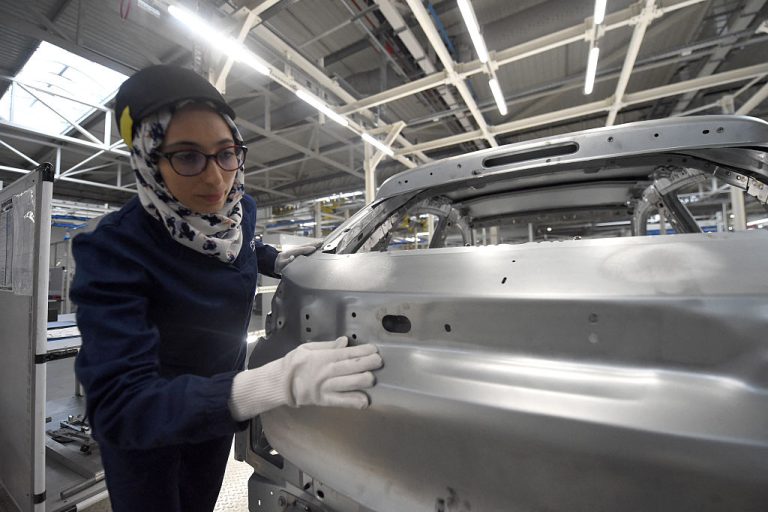
Europe, which has imposed tariffs of up to 45 percent on Chinese electric vehicles, fears Beijing is rapidly shifting parts of its EV manufacturing supply chain to nearby Morocco in an effort to bypass those duties and gain easier access to the European market.
EU Trade Commissioner Maroš Šefčovič has repeatedly expressed concern about the threat posed by Chinese manufacturing to European markets, particularly the growing Chinese industrial footprint in third countries from which Beijing is increasingly redirecting exports into Europe. European officials worry this is putting pressure on both European exports and European investment in those same markets.
In a recent interview with the Financial Times, Šefčovič pointed to Morocco — located just 14 miles across the Strait of Gibraltar from Spain at its closest point — as a country attracting massive Chinese investment in EV manufacturing and increasingly serving as a gateway for heavily subsidized products entering Europe.
“It’s becoming a big, big issue for the European economy,” Šefčovič told the Financial Times.
Earlier, during a structured dialogue with the European Parliament’s Committee on International Trade on Feb. 24, Šefčovič said the market share of EU companies in China was shrinking while “their exports and investments in third countries [are] being displaced by their Chinese competitors.”
Success
You are now signed up for our newsletter
Success
Check your email to complete sign up
His remarks are particularly relevant to Morocco, where China has invested roughly $10 billion since the pandemic, including an estimated $6 billion in the EV sector alone.
RECENT COVERAGE
- Deep Beneath the Pacific, Japan Hunts for a New Source of Rare Earth Metals
- Xi-Putin Summit Underscores China-Russia Push for Multipolar World Order: Reports
- India-Nordic Summit: $100 Billion Trade Framework to Boost Tech, Green Transition and Arctic Cooperation
Chinese companies are increasingly competing with established European automakers already operating in Morocco, including French manufacturer Renault, the country’s largest automotive investor, and Stellantis, which announced plans last year to double production capacity at its plant in Kenitra, a Moroccan city on the Atlantic coast that is rapidly emerging as the country’s automotive and EV hub, Reuters reported.
At the same time, China’s EV industry — facing intense competition at home and higher tariffs abroad — was reported last year to have spent more on establishing manufacturing capacity overseas than domestically for the first time, according to CNBC.
This creates a difficult situation for EU regulators. If Brussels were to penalize Moroccan exports, it could also disrupt the supply chains of major European automakers already manufacturing in the country, according to Business Insider Africa.
Šefčovič’s comments come as Europe increasingly seeks to rebalance its trade relationship with China and as governments across the continent prepare businesses and consumers for the possibility of a broader trade confrontation with Beijing, Bloomberg reported Wednesday, June 3.
The European Commission’s College of Commissioners held an internal strategy session in Brussels on May 29 to discuss responses to what officials described as an increasingly imbalanced economic relationship with China ahead of the G7 summit and the June 17-18 EU leaders’ summit.”The current state of the trade and investment relationship is not sustainable. As economic and security interests become ever more intertwined, both dimensions will require a more robust and coherent response,” the commissioners said in a statement.
Geoeconomics across the Strait of Gibraltar
The Chinese infrastructural footprint in Morocco is extremely strategic, determined by the north African nations location on the Strait of Gibraltar that connects the Atlantic Ocean and the Mediterranean Sea. It’s the only western maritime launchpad to the Mediterranean—geostrategically a tough chokepoint with zero alternative routes.
About 10 percent of global trade traffic passes through it with over 500 million people from 22 Mediterranean nations depending upon it for seaborne trade. Sitting at the most important and the narrowest intersection of the Atlantic Ocean and the Mediterranean Sea connection is the Moroccan port city of Tangier where the Chinese are setting up a massive automotive manufacturing plant on a 500 hectare site fished out of farmland, reported Financial Times.
The Mohammed VI Tanger Tech City, also called the Tanger Tech in Tangier already hosts nearly a dozen Chinese companies manufacturers of EV auto parts including an already operational Sentury Tire plant; an under construction unit by BTR New Material Group, the world’s largest supplier of battery anodes and a plant by APG, a Chinese brakes manufacturer which plans to establish a $70 million facility in the tech city this year, according to Morocco World News.
The Moroccan media said this Chinese cluster in Tanger Tech is only a fraction of the $6 billion investment from Beijing that poured into the north African nation since the pandemic started. Tanger Tech website defines itself as “a visionary Morocco-China Collaboration for Economic Growth.”
The entire situation becomes geopolitically motivated because the Chinese parts are heavily subsidized and its industrial processes heavily state supported.
The European officials thus worry that the “Chinese parts will undergo only minor processing in North Africa before being shipped tariff-free into Europe, allowing China to export its domestic industrial overcapacity,” reported Business Inside Africa.
The fact also remains that Chinese state supports its companies expansion plans abroad through a combination of supporting policies and the decision to set up manufacturing units in third countries is simply following the surge of Chinese EV exports in the global market–both these factors are connected and helpful to the Chinese companies, according to the testimony of Ilaria Mazzocco, the Deputy Director and Senior Fellow, Trustee Chair in Chinese Business and Economics before the the U.S.-China Economic and Security Review Commission about the state of China’s electric vehicle industry, its internationalization, and its implications for the United States and the world in August 2023.
In this context Morocco’s EV manufacturing ecosystem is increasingly becoming a contest of geopolitics with greater impact on Morroco’s domestic politics as it has speedily emerged as the leading export industry in the country with $14 billion worth of exports contributing 22 percent to the nation’s GDP, according to a 2024 AP report. In the first four months of this year itself, the EV exports had increased to over $ 6.4 billion USD up by over 18 percent from last year, according to Reuters.